
The phrase in Psalm 126, “we were like dreamers," is analyzed by combining classical commentaries with modern Jewish history. Many people do not recognize the miracle of Israel’s rebirth and the redemption of the Shechina. What is needed is renewed awareness, joy, patience, and active commitment to Torah, faith, and national responsibility.
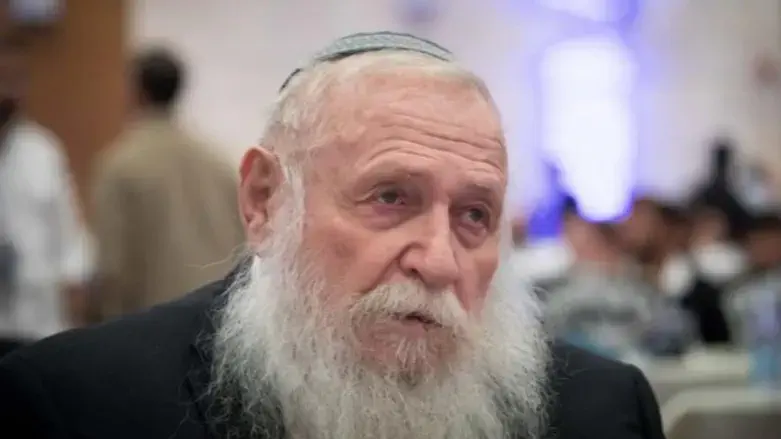
This article is an extract from Rabbi Chaim Druckman’s book, “Step by Step," an enlightening discussion of the process of redemption that is taking place in our generation. (Adapted and translated by Moshe Goldberg)
The Disconnect from Great Events
The beginning of Psalm 126 is: “Shir Hama'alot - A song of rising: When God returned the captives of Zion, we were like dreamers." (Tehillim 126:1). What does that mean, like dreamers? Three prominent commentators explained the phrase in different ways.
(1) Avraham Ibn Ezra writes: When God brings your captives back - This is what Yisrael will say: We could never have imagined these wondrous events while we were awake, we could only think about them as a dream! Redemption is like a dream. It is such a unique and wonderful experience that it cannot be compared to anything that we might see when we are awake.
(2) Radak quotes his father (Rabbi Yosef Kimchi): In our eyes, the suffering of the Exile will be like a passing dream as compared to the great joy we will feel when we return to our Land. When the Redemption comes there will be such great joy that the entire Exile will seem to us like no more than a “passing dream."
(3) Meiri feels the dream shows how we constantly anticipated the Redemption. We will never despair of Redemption; we will always keep it in our thoughts and in our hearts. The verse teaches us that we constantly dreamed of Redemption while we were in Exile. Our yearning for Redemption was so great that we dreamed about it all the time, anticipating it and never falling into despair.
Based on recent history, we can now understand another meaning for the phrase, we were like dreamers. As an example, think of a teacher in a classroom. A student might sit and “dream" - his eyes are wide open, he is not asleep. But he is still “dreaming," with thoughts far away from the class. Ask him about the lesson and he will not know anything, since he didn’t hear a single word.
The phrase we were like dreamers can be understood in a similar way. Instead of seeing the glorious events in which we had the privilege of participating and feeling their magnitude, we remained mired down with minor problems, detached from the true significance of the events. We simply did not perceive the miracle of the creation of the State of Israel.
We remained in our dream state. For years we had a dream of returning to Zion. As the Meiri explained, we never despaired. We dreamed of establishing a Jewish state, a Jewish government, a Jewish army. But when we were privileged to attain all of this - we were caught daydreaming, just like the student. We remained stuck with our own problems, great or small. We worried about our own physical or spiritual difficulties - but we did not see or feel the true significance of the momentous events taking place.
The Shechina is Redeemed Too
Note the exact wording of the verse in Tehillim: Not behashiv Hashem - when God brings back - but beshuv Hashem - When God comes back. God Himself returns and does not just bring the Jewish People back home. This can be compared to the verse, And your God will bring your captives back (Devarim 30:3). Rabbi Shimon Bar Yochai explained: “It is not written vehaishiv - God will bring you back - but veshav - God will return. This teaches us that the Holy One, Blessed be He, returns with them from Exile." (Megillah 29a).
See also the Mechilta: “Wherever Yisrael went into exile, the Shechina went with them, as it were. And when they will be redeemed, the Shechina will return with them, as it were. As is written, And your God will return your captives - beshuv and not behashiv." (Massechta D'Pisscha 14).
When we are not disconnected from reality; when we have a feeling for current events; when we realize the Holy One, Blessed be He, returned with us; when we understand that the holy Shechina was also in Exile and was redeemed together with the Jewish People - as it were - how can we not jump for sheer joy? But what happened? We were caught dreaming! We were not “like dreamers" when we finally woke up and saw the great miracle (Ibn Ezra), or when we realized the dream we held for so many years was actually happening (HaMeiri). The events took place, but when they did - we were busy daydreaming, like the student who did not hear his teacher.
I cannot forget how in the early days of the country, when I was a student in Yeshivat Merkaz Harav, we would dance through the streets of Jerusalem on the eve of Yom Ha’atzmaut, going from the yeshiva to the President's Residence (just as we used to dance on Simchat Torah from the yeshiva to the homes of the Chief Rabbis). And as we danced, many others joined in - Jews of all types, a cross-section of the people, a very diverse gathering. I well remember the exhilarating words of our mentor, Rav Tzvi Yehuda Kook: “When I see these Jews dancing here, I can see ‘Ribbono Shel Olam,’ the Master of the World, dancing with them!"
And that is the expression of happiness we should feel about the miracle of the rebuilding of our Land - not only joy for our Redemption but for the Redemption of the Shechina itself.
From Theory to Practice
Our task is to remove the shadows that surround us. But we must know that the only way to overcome darkness is to increase the intensity of the light. There are Jews who see shadows in the current situation, and this pains them. But they think it is enough to complain. They see the shadows without seeing the great light.
See the words of Rav Avraham Yitzchak Kook (Arpilei Tohar, p. 39):
Pure and righteous people:
- Don’t complain about evil - they enhance righteousness.
- Don’t complain about apostasy - they disseminate faith.
- Don’t complain about ignorance - they add to the world’s wisdom.
This process cannot be rushed. We like to sing a song based on Rav Kook’s adage, “The eternal nation is not afraid of a long journey." This is not simply a song - it is the essence of reality! There are those who sing it, but in practice, when the process begins to take a long time - and especially when difficulties and complications arise and complex problems crop up - they begin to despair. We must be aware that this is indeed a long and continuing process, with failures as well as successes. But it will undoubtedly succeed in the end!
Hunger and Thirst for the Word of God
See the following prophecy: “And I will bring back the captives of My nation Yisrael, and they will rebuild desolate cities and dwell there, and they will plant vineyards and drink their wine, and they will plant gardens and eat their fruit. And I will plant them on their Land, and they will not be uprooted again from their Land which I gave them - so says your God." (Amos 9:14-15).
There can be no doubt this prophecy refers to our era, we can see it taking shape with our own eyes. Another prophecy is also being fulfilled in our time: “Behold, a time is coming - so God declares - and I will send forth hunger in the Land. But not hunger for bread or thirst for water - rather, a desire to hear God’s words." (Ibid. 8:11).
There can be no doubt there is a thirst for God’s words today, despite all the gloom and negative elements around us. We can even say that the negative elements, at least in part, stem from an unfulfilled internal thirst. The previous generation believed in incomplete values that are now “bankrupt."
Who can quench the thirst for God’s word? This is a task for people of true faith.
There is a dire need to teach the truth to all Am Yisrael, both in Israel and in the Diaspora. We must enhance the love for the Holy Name and increase the sanctification of the Name wherever we are. Our task is to raise the banner of the full Torah, including mitzvot between man and God, between man and man, and between man and the nation, the Land, and the country. We are duty bound to present the word of God to those who thirst for it so strongly. This is the only way to advance our nation and our country.
We must stand up and acknowledge the exalted status of the era in which we live, identify with it, and be aware of God’s sanctity, which is the foundation of the State of Israel. We must fulfill our responsibilities. We must light up the entire nation with the true light of Torah and mitzvot. The State of Israel is based on genuine sanctity and we must fill it with holiness, so that it will accomplish its ultimate mission - Torah emanating from Zion and God’s word from Jerusalem, reaching all corners of the globe.
Rabbi Chaim Meir Druckman (16 Cheshvan 5693 - 2 Tevet 5783/1932-2022) was the most venerable rabbi and prominent leader of Israel's National Religious community until his passing. He was Rosh Yeshiva of Or Etzion and head of the Center for Bnei Akiva Yeshivot.