
Ruthie Blum, a former adviser at the office of Israeli Prime Minister Benjamin Netanyahu, is an award-winning columnist and a senior contributing editor at JNS. Co-host with Ambassador Mark Regev of the JNS-TV podcast “Israel Undiplomatic," she writes on Israeli politics and U.S.-Israel relations. Originally from New York, she moved to Israel in 1977. She is a regular guest on national and international media outlets, including Fox, Sky News, i24News, Scripps, ILTV, WION and Newsmax.
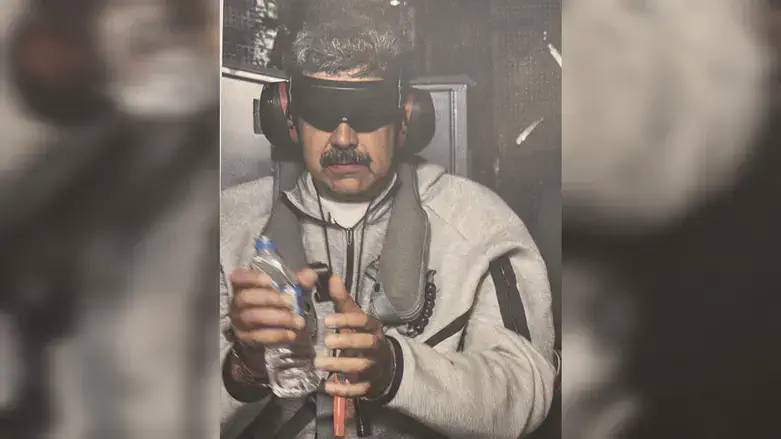
(JNS) Just when it appeared that President Donald Trump’s most dramatic threat was to the Iranian regime on Friday, he announced on Saturday that U.S. forces had conducted large-scale strikes on Venezuela. Even more jaw-dropping was his confirmation that dictator Nicolás Maduro and his wife, Cilia Flores, had been captured and brought to the United States to face trial.
The news reverberated far beyond Caracas. This was not merely a symbolic reckoning for a narco-state spiraling into ruin. Nor was it simply overdue justice for a despot who plundered one of Latin America’s wealthiest nations while exporting corruption and violence.
It was a signal with global reach-directed, among others, at Tehran, Moscow and Beijing. No wonder all three promptly condemned the actions as a “violation of international law."
But they got the message: that no “sphere of evil influence" is immune from the Trump administration’s wrath; that no client regime is beyond reach, geographically or otherwise; and that Venezuela can no longer serve as a hub for bad actors.
Trump had already demonstrated this principle during the “12-Day War" in June, when the United States joined Israel to destroy the Islamic Republic’s key nuclear sites. Still, America’s enemies seemed to think-or at least hope-that Trump’s ordering of the B-2-bomber blitz was a one-off show of bravado, rather than a long-term strategy.
Viewed through this lens, Israeli Prime Minister Benjamin Netanyahu’s recent meeting with Trump at Mar-a-Lago takes on added significance. By all indications, the encounter was substantive and productive, reflecting the two leaders’ crucial cooperation and shared peace-through-strength doctrine.
Interestingly, Trump revealed that the Venezuela operation had been scheduled to take place three or four days earlier, but was postponed due to unfavorable weather conditions-placing its original timing squarely during Netanyahu’s visit.
The coincidence is difficult to dismiss. It’s even possible that Trump informed Netanyahu that a major operation was imminent. Given Venezuela’s longstanding role as a playground for Iranian activity and Hezbollah financing, it’s also plausible that the Mossad provided the CIA with crucial intelligence-gathering in the South American country.
Iran’s “supreme leader," Ayatollah Ali Khamenei certainly believes this is the case. He’s undoubtedly shaking in his robes while hiding out in a bunker, leaving the Islamic Revolutionary Guard Corps and Basij militias to quash the ever-growing street protests raging throughout the country.
It’s an old scenario with a new flavor. This time, the demonstrators aren’t backing down.
For one thing, their economy is in dire straits. For another, they witnessed how Israel, with the full backing of the Trump administration, had exposed their oppressive regime as a paper tiger, no match for Western might.
The contrast with their plight during Democratic administrations could hardly be sharper.
Five months after then-U.S. President Barack Obama’s inauguration in 2009, millions of Iranians flooded the streets to decry the results of their own election, stolen by Khamenei’s puppet, incumbent President Mahmoud Ahmadinejad. The regime’s response was to gun them down and jail anyone who dodged the bullets.
Obama-who entered the White House with a pledge to overturn predecessor George W. Bush’s policies and position on radical Muslim regimes as an “axis of evil"-adopted a neutral stance. Though he, then-Vice President Joe Biden and then-Secretary of State Hillary Clinton said in interviews that violence against protesters was “concerning," they all held with the stance that the best way to deal with the regime was through “dialogue."
Khamenei and his henchmen were laughing, literally and figuratively, all the way to the bank. You know, to deposit the billions of dollars handed to them by their appeasers in Washington.
A decade later, similar weakness was broadcast globally during President Biden’s chaotic retreat from Afghanistan. The hasty exit-marked by abandoned allies and the spectacle of a Taliban victory parade-advertised American cowardice.
Adversaries took gleeful note.
That same reflexive caution (i.e. fear cloaked in progressive politics) characterized Washington’s approach to Hezbollah’s expansion in South America. For years, intelligence services documented the terror group’s deep involvement in narcotics-trafficking, money-laundering and arms-smuggling across Venezuela, Brazil, Argentina and the Tri-Border Area.
Hezbollah operatives raised funds, built infrastructure and plotted attacks-most infamously the 1994 AMIA bombing in Buenos Aires-while enjoying the protection of sympathetic regimes and the willful blindness of U.S. policymakers.
Obama treated the phenomenon as an inconvenient sidebar, lest confronting it complicate outreach to its patron in Tehran and jihadists everywhere. The result was not de-escalation, but entrenchment: terror networks burrowing ever deeper into the Western Hemisphere, confident that ideology trumped enforcement and that American red lines were written in disappearing ink.
Nor was this timorous posture confined to Iran and Hezbollah. From Russia’s seizure of Crimea to China’s militarization of the South China Sea, from Syria’s chemical attacks on its people to the rise of ISIS, the Obama doctrine-if it merits the label-was reactive, rhetorical and risk-averse.
“Don’t do stupid stuff" was his motto. Foes tested boundaries and found none. Allies recalibrated.
When Trump took the helm the first time, in 2016, Iran and other enemies of the United States were nervous. They viewed him as an unpredictable madman with an itchy trigger finger. Their apprehension alone was a good thing.
So, too, was his ripping up of the Joint Comprehensive Plan of Action-the JCPOA, familiarly known as the “Iran deal." By making good on this vow, he was proving that there was a new sheriff in town-one whose mission was to assert American exceptionalism. And superiority.
That he proceeded, in addition, to side with Israel as a chief ally in every sense, set the stage for the Abraham Accords. Had he won a consecutive term, the geopolitical situation undoubtedly would have been different. But the Biden administration, a clone of Team Obama’s, reverted to pre-Trump misconceptions and practices.
Democrats, naturally, are in a tizzy over the Venezuela operation, regurgitating their usual platitudes about “escalation," unintended consequences and the fragility of international order. Yet, as always, they refuse to acknowledge that the so-called “order" has been anything but stable-undermined precisely by the absence of consequences for malign behavior.
Thankfully, Trump grasps that tyrants aren’t swayed by another sanctions package or a stern communiqué and has been functioning accordingly.