

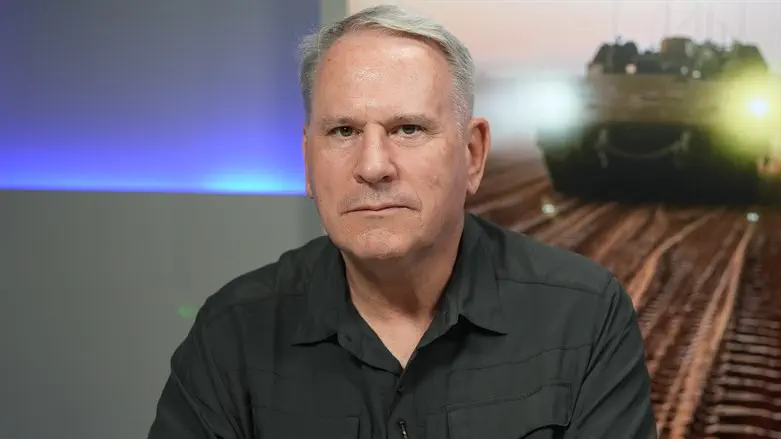
Colonel Richard Kemp, the former commander of the British military forces in Afghanistan, spoke to Israel National News - Arutz Sheva about Israel's accomplishments in 2025 and the challenges it faces in 2026.
"Israel’s accomplishments in 2025 were extraordinary, and many of them confounded its critics as well as objective experts. Perhaps the most unexpected success - and a supremely important achievement - was the release of virtually all the hostages. Prime Minister Netanyahu said he would get them back, and few believed him. Only one now remains, Ran Gvili, a heroic fighter killed defending his country on 7th October, and there is optimism that his corpse will be recovered," Col. Kemp stated.
He went on to listIsrael's accomplishments: "In Gaza, the courageous and hugely effective IDF decimated Hamas and forced them to cease fire, leaving them in control of less than half the Strip. This was achieved by fighting on the battlefield as well as the 12-day war against Iran and the strikes against Hamas leaders in Doha, both of which dramatically demoralised Hamas in Gaza and brought external pressure on them."
"The 12-day war itself was decisive. It effectively removed Iran’s nuclear weapons programme, degraded its air defences and ballistic missiles armoury and eliminated senior members of Tehran’s high command as well as key nuclear experts. With very limited damage against Israel, this war exposed Iran, a major regional power, as a paper tiger. That effect has played a significant role in the current uprisings in Iran. We don’t yet know whether this will lead to regime change but that is a distinct possibility given the intensity and spread of the protests.
"Last year, Israel also inflicted severe damage against the Houthis in response to terrorist aggression against Israeli territory and shipping.
On the northern front, "Israel has also built on its 2024 successes against Lebanese Hezballah, working to constrain their attempts to rebuild lost capability. And in Syria, a buffer zone has been created to protect the country as well as Syrian minorities against future threats, while at the same time working diplomatically to reduce the potential for aggression."
"Overall Israel’s military actions in 2025 have built on its successes in 2024, re-shaping the Middle East, reducing the threats against it and gaining increasing strength for itself. Despite a global campaign to undermine and delegitimise the country, Israel’s battlefield successes have been consolidated by a strengthened economy and some remarkable achievements in international trade including a multi-billion dollar gas deal with Egypt and significantly boosted arms sales with Germany and the UAE," he said.
He noted that "on top of all that, Israel’s historic recognition of Somaliland at the end of 2025 may have immense strategic benefits for Israel in the region."
According to Col. Kemp, the Trump Administration, which came into office in January 2025, deserves some of the credit for Israel's successes over the last year.
"The Trump Administration played a major role in Israel’s successes in 2025. It supplied vital munitions and military hardware, some of which had previously been hampered by the Biden Administration. Trump also provided essential diplomatic cover for Israel in a world characterised more by animosity than support for the Jewish state. Critically, Trump backed Israel’s defensive war against Iran, even putting his money where his mouth was by sending B2 bombers to bolster the assault on Iran’s war machine. Trump also leveraged Israel’s battlefield success in forcing through the Gaza ceasefire and enlisting the support of many international players, including countries like Turkey and Qatar which sided with Hamas against Israel," he said.
He added: "Despite the hopes and fake predictions of many journalists and so-called experts that the year would have seen a growing wedge between Trump and Netanyahu, there was not any significant daylight between the two. That itself was a remarkable achievement between two countries with very different national interests, achieved largely by the diplomatic skill of Netanyahu and his brilliant Minister of Strategic Affairs, Ron Dermer. The maintenance and development of the US-Israel strategic relationship in such difficult circumstances has perhaps been the shining light of diplomacy in 2025."
Despite Israel's successes over the last year, there were failures and setbacks on the international and diplomatic front. "In 2025 Israel has been unable to rally the support of many countries who should be her natural allies. That includes Britain, France, Australia and Canada, all of whom opted to turn their backs on Israel and reward Hamas terrorism by recognising a non-existent 'Palestinian state'. Each of these countries turned against Israel not because of foreign affairs but to satisfy elements of their anti-Israel domestic electorates."
"Likewise, the anti-Israel clamour in much of the international media, international bodies like the UN and so-called human rights groups has only grown in 2025, fed by a highly effective and long-standing political warfare campaign," Col. Kemp said.
Look ahead to 2026, Col. Kemp said: "In the coming year, Israel will have to disarm Hamas and remove them from control of Gaza. That should be the role of the International Stability Force under Trump’s peace plan. However, the prospects of any international forces confronting Hamas if they fail to voluntarily disarm are extremely slim."
"Likewise, Hezballah will have to be dealt with. Despite Israel’s efforts to contain them they continue to regenerate. Unless international pressure can prevail - which looks unlikely - Israel is likely to have to launch major operations against them in 2026.
"The Houthis remain a serious threat to Israel and global shipping. Again, in the absence of efffective international action, Israel is likely to have to return to the charge against the Houthis.
"Judea and Samaria remain volatile. So far, during this war, Israel has succeeded in preventing the major explosion there that many predicted and some malicious players have been working to ignite. That situation will remain extremely volatile in 2026.
"Turkey too represents an ongoing threat to Israel, with Erdogan’s imperialist ambitions in the region. In particular Turkish interference in Syria and Lebanon will need to be watched carefully this year, and countered when necessary.
"Depending on how the current protests develop in Iran, Israel, perhaps with US support, may also need to re-launch significant military operations there. It is possible the ayatollahs may attempt to rebuild their nuclear programme but probably the most urgent threat will come from current efforts to regenerate their ballistic missile arsenal.
He stated that "the challenges in 2026 will be many and serious but, going on the successes of 2025, we can be confident that Israel will again prevail, especially with the continued backing of President Trump."
While challenges remain, "there are also opportunities, including the potential for diplomatic normalisation with Islamic countries in the region and beyond, many of whom have been increasingly impressed by Israel’s actions since 7th October 2023. Of course, that runs counter to the predictions of many, especially those who wish Israel ill but do not understand regional dynamics."
"We can also expect Israel to build further on its economic success as well as its achievements in international trade, including arms sales," he added.
"European countries themselves should be looking at Israel as an exemplar, as they continue to grapple with dramatically growing internal problems, not least uncontrolled immigration, plus the threat from Russia. I’m not talking about copying Israel’s battlefield successes in 2025, but the national spirit in the country, especially among its young people, that has enabled them," Col. Kemp concluded.