
Jews and anxiety have long been anecdotally linked. For good reason.
After years of a relative lull in antisemitism, following a long persecution that culminated in the Holocaust, that anxiety has been reawakened. Jews feel trapped by a global antisemitism that seems to be closing in on us. Worse, we feel trapped by the realization that antisemitic are no longer anomalies.
Perhaps most frightening is the dawning awareness that Jews can no longer firmly rely on the friends we once thought had our back.
For more than a decade, American Jews watched the slow but steady erosion of support for Israel in the Democratic Party. After October 7th, that loss of support corresponded with an uptick in antisemitism on college campuses, city streets, synagogues and elsewhere.
Jews were alarmed. Many of us criticized antisemitic progressives in politics, media and education systems. We also called out so-called moderate Democrats for not standing up to them. We lobbied congressmembers and signed petitions. Then, we largely wrote them off. At least, we thought, we have the Republicans.
Now we’re not so sure.
The rise of antisemitism and conspiracy theories reviling Israel and Jews on the other side of the political aisle has multiplied over the last year. Most Republicans and conservatives remain strong supporters of Israel, led by the most supportive administration headed by President Trump. Indeed, Prime Minister Netanyahu announced at his meeting with Trump this Monday that Israel would award Trump the Israel Prize, the nation’s highest cultural honor. It would be the first time the award would go to a non-Israeli.
However, Jews shudder at the rise of anti-Israel rhetoric by America First isolationists within the Republican Party. And Jew hatred is threatening to unravel the conservative movement. A recent poll by IMEU Policy Project, and conducted by YouGov, found a precipitous drop in support for Israel among young Republicans.
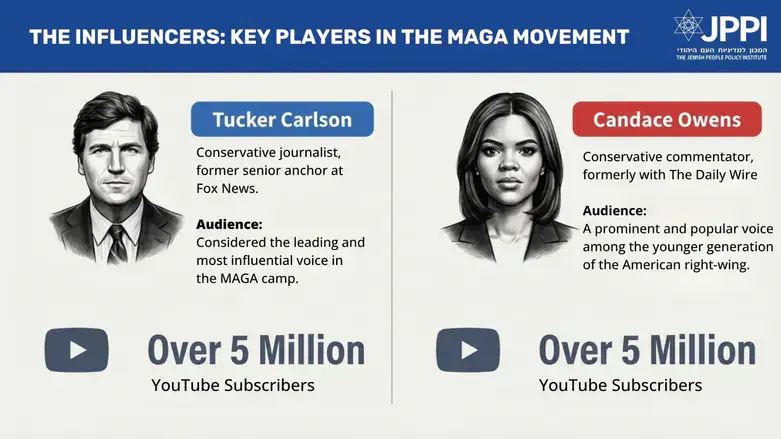
Tucker Carlson was just awarded “Antisemite of the Year" by activist group StopAntisemitism for his antisemitic rhetoric and for cozying up to Hitler-loving Nick Fuentes. Candace Owens was named the same in 2024 for spreading wild conspiracy theories targeting Israel and Jews. Their millions of viewers are augmented by some in the MAGA camp who are too weak to confront the bigots.
A week ago, Daily Wire founder Ben Shapiro laid bare the intraparty rift over Israel and antisemitism. He lambasted Carlson and Owens during Turning Point USA’s year-end AmericaFest conference and blasted those on the right for shielding them in the name of friendship rather than speaking the truth.
I was reminded of the interview with Harmeet Dhillon I heard several weeks ago at the Israel Hayom summit in Manhattan. The assistant attorney general for civil rights at the Justice Department spoke of her role in in “fighting antisemitism wherever we find it" and described the Trump administration’s “zero tolerance policy towards antisemitism." She was loudly applauded when she said that “the future mayor of NYC is an antisemitic demagogue."
Except a funny thing happened when she was asked about antisemitism on the extreme right. She replied, “What we say in First Amendment world is: The antidote to speech that you don’t like is more speech. It isn’t shutting down speech. So, I don’t agree with a single word that Nick Fuentes says or has to say, and the decision of whether or not to platform that person is one for my friend and former client, Tucker Carlson."
But friends don’t let friends use hate speech. Or sully their political party through hate speech.
Constructive criticism is not cancelling. In the realm of rising Jew hatred, it is leveling the playing field.
It is all well and good to say antisemitic speech should be drowned out by philosemitic speech. In an ideal world, where we shouldn’t have to defend Jews or Israel in the first place, this might be the answer. But considering Jews make up roughly 2% of the U.S. population, with a shrinking base of supporters due to relentless negative media coverage of Israel and indoctrination against the one Jewish state in the education system, it would hardly be fair.
Dialogue of the type Dhillon espouses should be backed up by action. The main reason universities clamped down on antisemitism is because they were threatened with actual and substantial financial loss by the Trump administration.
However, if one truly believes in fighting speech with speech, then it needs to be done in earnest. That begins with using one’s words to denounce antisemites on the right in the same way one denounces them on the left.
If a public persona chooses not to denounce an antisemite for speaking falsehoods and spreading hate speech, they themselves can be guilty of amplifying it. And as evidenced by rising attacks against Jews, antisemitic rhetoric never ends in just words.
International Holocaust Remembrance Day will be commemorated at the end of January. As a member of the International Holocaust Remembrance Alliance (IHRA), the United States uses the IHRA definition of antisemitism that was adopted in 2016. That definition includes Holocaust denial, Jewish world conspiracies, denying Israel’s right to exist, comparing Israeli policy to Nazis, and other classic and contemporary rhetorical accusations against Jews.
In other words - that means current rhetoric used by antisemites on the right and left to dehumanize Jews. Though the IHRA definition is non-legally binding, at the very least this speech needs to be recognized for what it is and condemned rhetorically. Otherwise, silence for whatever reason is acquiescence.
For years we have been told, “if you see something, say something." If we are to follow that directive, it has to cut across party lines.
Sara Lehmann is an award-winning New York based writer. For more of her writings please visit saralehmann.com.
This article first appeared in Hamodia.