
Fern Sidman is Senior News Editor at The Jewish Voice, published in New York.
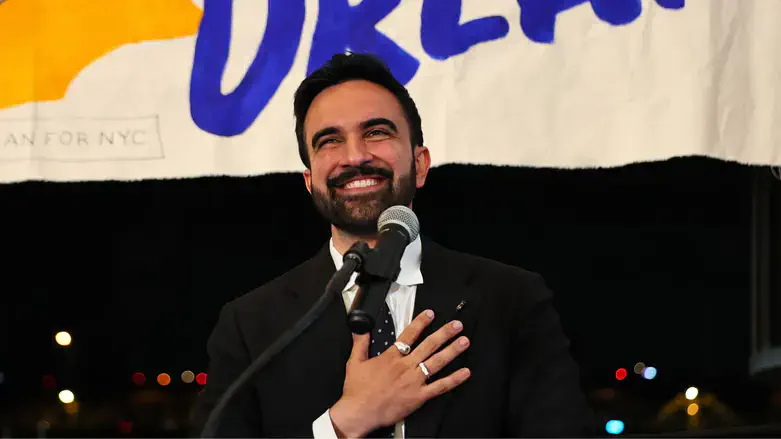
By any traditional civic measure, the inauguration of New York City’s 112th mayor should have been a moment of sober continuity - a ritual reaffirming democratic stability in the nation’s most complex metropolis. Instead, the swearing-in of Zohran Mamdani on a frigid New Year’s Day unfolded more like a choreographed ideological rally, an exercise in radical pageantry that was designed to project not pragmatism but rupture.
From the seven-block street party to the roster of left-wing luminaries flanking the podium, Mamdani’s ascent was framed less as a transfer of municipal authority than as the symbolic capture of City Hall by a democratic socialist movement eager to re-engineer the city’s economic and political DNA.
“I was elected as a democratic socialist, and I will govern as a democratic socialist," Mamdani declared, drawing thunderous applause from a crowd steeped in the rhetoric of class struggle and cultural grievance. This line marked the emotional apex of the speech - a moment carefully calibrated to announce that New York City is no longer merely flirting with socialism but embracing it as an operating philosophy.
The stagecraft was unmistakable. Senator Bernie Sanders, the high priest of American democratic socialism, administered the oath after delivering a sermon on taxing the wealthy, castigating what he called the “billionaire class." Chants of “tax the rich" echoed through the Canyon of Heroes, reverberating off buildings that house some of the world’s most powerful financial institutions.
Rep. Alexandria Ocasio-Cortez, who introduced Mamdani to the strains of Bad Bunny’s “NUEVAYoL," framed his election as a civilizational pivot away from “the barbarism of extreme income inequality." Public Advocate Jumaane Williams followed with a tear-laden exhortation for local governments to resist Washington, positioning New York City as a moral counter-regime to the Trump administration.
On paper, this was a celebration of working-class solidarity. In practice, the rhetoric veered perilously close to demonization - a narrative that identifies shadowy “entrenched elites" and “billionaires" as the city’s principal villains. Such language is not new on the American left, but in a city with the world’s largest Jewish population outside Israel, its implications are uniquely combustible.
For many Jewish New Yorkers, the spectacle raised an uncomfortable question: when socialist leaders speak of predatory elites exploiting the masses, who do their followers imagine?
There is a historical reason Jews bristle at the language of financial scapegoating. In Europe, and later in the Middle East, the rhetoric of wealth concentration metastasized into conspiracy theories about Jewish control - myths that fueled pogroms, exclusionary laws, and genocide.
Mamdani did not name Jews. Sanders did not name Jews. Yet the applause lines - railing against billionaires, “entrenched elites," and “the wealthy and powerful" - were delivered in a city where antisemitic incidents have spiked dramatically since 2021.
What troubled Jewish observers most was not only the rhetoric but the selective empathy woven into Mamdani’s speech. The loudest ovation came when he spoke of Palestinian Arabs in Bay Ridge being “marginalized." The line was framed as a plea for social justice, but it landed with bitter irony for many in the Jewish community.
Bay Ridge is not simply a neighborhood of under-served immigrants; it has been a focal point of anti-Israel agitation for years. In May 2021, a group of men, several of them identified as Palestinian Arab residents of Bay Ridge, brutally assaulted Joseph Borgen, a Jewish man wearing a yarmulke, while screaming antisemitic slurs. That attack was not an abstraction - it was a visceral reminder that rhetoric about “marginalization" can obscure acts of violence against Jews.
To hear Mamdani single out Bay Ridge Palestinian Arabs as symbols of victimhood, without acknowledging the neighborhood’s role in fomenting violent anti-Israel demonstrations, felt to many Jewish New Yorkers like a distortion of moral reality.
The anxiety is compounded by Mamdani’s own record. He has aligned himself openly with anti-Zionist activism, repeatedly framing Israel not as a democracy defending itself against terrorism but as a colonial oppressor. While campaigning, he supported resolutions that equated Zionism with racism - language Jewish leaders across the political spectrum consider intrinsically antisemitic.
Mamdani’s electoral coalition was energized in part by student-led movements that embraced slogans like “From the river to the sea," a chant that translates into a call for Israel’s erasure. Though Mamdani has attempted to soften this history since winning office, he has never convincingly repudiated it.
For Jews who are not part of the radical left - a demographic that includes Orthodox families in Brooklyn, middle-class professionals in Queens, and elderly Holocaust survivors scattered across the boroughs - this is not a theoretical discomfort. It is existential.
They watched an inauguration in which Mamdani swore on the Qur’an, led the crowd in prayer with an imam, and spoke passionately about Palestinian Arab marginalization, yet said nothing about the fear Jewish children feel walking to school. They saw a coalition celebrate its diversity while excluding their trauma from the narrative.
In their coverage, media outlets tried to strike a neutral tone, highlighting Mamdani’s housing agenda and his promise to “unleash the public sector." Deputy Mayor for Housing Leila Bozorg told USA Today that the administration would cut red tape and freeze rents, while advocates like Ruben Rodas expressed hope that landlords would finally lose their grip on City Hall.
But between the lines, the paper captured the magnitude of the gamble: a 34-year-old democratic socialist inheriting a city still reeling from corruption scandals under Eric Adams, facing the most expensive housing market in the nation, and buoyed by a base that equates governance with permanent revolution.
Housing policy is not Mamdani’s only test. He has pledged free buses, universal childcare, and city-run grocery stores - an agenda that would expand municipal power to levels unseen in modern New York. Skeptics, including several economists quoted by USA Today over the course of the campaign, have questioned whether such promises are financially sustainable or politically wise.
Yet for Jewish New Yorkers, the deeper fear is not fiscal insolvency but cultural alienation. When Mamdani says “they want to know if the left can govern," he frames his administration as an experiment - a proving ground for a movement that sees entrenched institutions not as safeguards but as enemies.
The new mayor also made it a point of denigrating the age-old American ideal of “rugged individualism" in favor of the purported power of collectivism.
Mamdani’s defenders insist that the inauguration was merely symbolic, that his real work will be measured in zoning changes, transit improvements, and budget line-items. But symbolism matters. In a city scarred by hate crimes, the optics of whom a mayor chooses to uplift - and whom he forgets - reverberate far beyond City Hall.
Mamdani’s coalition was designed to project unity among working-class New Yorkers. Yet unity built on class antagonism is inherently unstable. When every problem is blamed on “the rich," the rhetoric inevitably searches for faces to attach to the grievance. In New York, those faces too often belong to Jews.
This is not alarmism; it is memory. It is the lesson of European socialism in the early 20th century, when Jewish bankers and shopkeepers were cast as avatars of capitalist decay. It is the lesson of the Soviet Union, where Zionism was criminalized as bourgeois nationalism. And it is the lesson of the present moment, when anti-Zionist slogans migrate effortlessly into antisemitic assaults on city streets.
Mamdani closed his address by proclaiming that New York would “make an example for the world." The crowd cheered, cameras flashed, and the media dutifully chronicled the historic firsts: first Muslim mayor, first South Asian mayor, youngest mayor in decades.
But examples cut both ways.
New York is now the most prominent American city governed openly by a democratic socialist who has allied himself with movements hostile to Zionism and comfortable with rhetoric that vilifies wealth in ways that echo old hatreds. That reality is not lost on Jewish parents wondering what their children’s classrooms will look like, or on synagogue boards debating whether to hire even more private security.
Mamdani’s inauguration was meant to herald a new era of hope. For a significant segment of New York’s Jewish population, it felt instead like a warning flare - a sign that the city they love may be drifting toward a politics that sees them less as neighbors than as symbols of an enemy class.
The real story will not be the length of the street party or the novelty of the Qur’anic oath. It will be whether a mayor who rose on the shoulders of radical rhetoric can govern a city of eight million without turning class resentment into cultural fracture.
For now, the applause has faded, the confetti has been swept from Broadway, and New York waits - anxious, divided, and painfully aware that symbolism, once unleashed, rarely remains symbolic for long.