
There are two songs that you must sing at your Shabbos table this week, both connected to the parsha: Yesimcha Elokim, sung by Avraham Fried, and Hamalach Hagoel, by Dveykuss, with the one and only Abbie Rotenberg.
This parsha is all about blessing the children and continuing the derech (path). Yaakov blesses Ephraim and Menashe, and later he blesses all of his twelve sons, who become the tribes of Israel.
Every Friday night, fathers bless their children with the words “Yesimcha Elokim ke’Ephraim ve’chiMenashe” (May God make you like Ephraim and Menashe). We then all continue with the words of Birkat Kohanim (the blessing of the Kohanim), even though Birkat Kohanim does not appear in this week’s parsha. Why do we add the blessing of the Kohanim to Yesimcha Elokim if they come from a different section of the Torah? We will return to this question later.
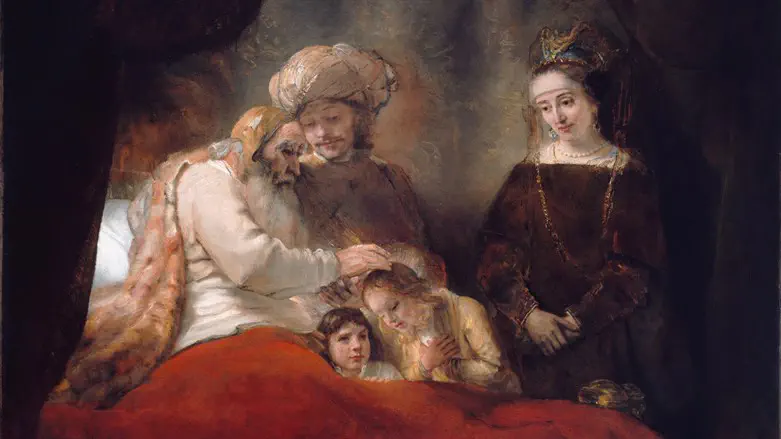
When Yosef brings Ephraim and Menashe to Yaakov to be blessed, he intends that the firstborn, Menashe, receive the blessing with Yaakov’s right hand, and the younger Ephraim receive the blessing with the left. Yosef therefore positions them accordingly.
Yaakov, however, prefers to switch the order. He “sikel et yadav” (crossed his hands) (Bereishit 48:14), placing his right hand on Ephraim’s head, who was standing on Yaakov’s left, and his left hand on Menashe’s head, who was standing on Yaakov’s right.
The question is obvious: why did Yaakov not simply switch their places? If he wanted Ephraim to receive the greater blessing, why keep Menashe on his right side?
The Netziv of Volozhin explains that Yaakov intentionally did not move them. Ephraim indeed received the primary blessing through the right hand, while Menashe, the firstborn, received his primary blessing through the right leg.
By remaining on Yaakov’s right side, Menashe was blessed by Yaakov’s right knee with the firstborn blessing. This explains the wording of the verse: “sikel et yadav ki Menashe habechor” - he crossed his hands because Menashe was the firstborn. The crossing was not despite Menashe’s status, but precisely because of it.
This also explains why Yaakov crossed only his hands and did not switch their places.
What, then, is the difference between a blessing given through the hands and a blessing given through the knees?
The Netziv explains that a blessing through the hands refers to shamayim (that which comes from above), while a blessing through the legs refers to teva (the natural, physical world).
Developing this further, the hands are closer to the head and thought, representing spiritual influence, while the knees and legs relate to the lower part of the body, symbolizing physical strength and continuity. A yoresh (heir) is described as “kara de’avuha” (the leg of his father), meaning the continuation of his father in the natural world.
These two types of blessings parallel two familiar practices.
The first is Birkat Kohanim, in which the Kohanim raise their hands to bring blessing from above. This is why one should not look at the Kohanim’s hands during Birkat Kohanim (Shulchan Aruch, Orach Chaim 128:23, and see Mishnah Berurah there).
The second is the Sandak. During Brit Mila, the Sandak holds the child on his lap, on his knees. The source for this is found in this week’s parsha: “yuldu al birkei Yosef” (they were born upon Yosef’s knees), as explained by Targum Yonatan (Bereishit 48:20).
This connects to the idea of taharat habrit (the purity of the covenant). It is customary to receive a blessing from the Sandak while he remains seated on the Kisei Eliyahu (Elijah’s Chair). The process of Brit Mila sanctifies the lower part of a Jew’s body.
As we conclude Sefer Bereishit, we see how Yaakov blesses his children and grandchildren. He recognizes each one’s uniqueness, character, strength, and particular aspects, while pointing to events of the past and directions for the future. He gives them both spiritual blessings from shamayim (hands) and physical blessings within teva (legs), preparing them to continue his derech through the challenges ahead.
And now we reach the final scene (Pesachim 56a): Yaakov, with all his children surrounding his bed, reciting Shema Yisrael together.