
We are sorry to inform readers that Rabbi Mann was niftar this week. He had written several additional divrei Torah for the next few parshiyot and we will be posting them in his memory.
This week’s Parsha, VaYechi, concludes the first Book of the Torah. More specifically, it brings to a close the epic saga of Yosef and his brothers. Although there had developed great animosity between them, the magnanimous spirit of Yosef, the Righteous, acting with the assistance of Divine Providence, enabled a reconciliation to take place.
It appears from the words of Yosef that he was totally sincere in the assurance that he was at peace with what had happened and had no desire for his brothers to suffer. His main point was that he viewed everything that had transpired as the Will of G-d, in which his rise to power in Egypt was an essential factor in saving the budding Jewish nation.
He also displayed great kindness in facilitating the family’s relocation to Mitzrayim (Egypt) and providing for all their needs there. Seventeen years had passed, and Yosef had been nothing but kind and caring in his dealings with them. Was his behavior truly sincere, or was it merely a ruse designed to demonstrate to Yaakov that he harbored no ill will against his brothers? Now that Yaakov was dead, would Yosef continue to get along with his siblings or would his desire for revenge burst to the fore?
A Misunderstood Act and a Renewed Fear
Upon returning to Egypt from the burial of Yaakov:
“The brothers perceived that their father was dead, and they said, ‘Perhaps Yosef will nurse hatred against us; and then he will surely repay us all the evil that we did to him’. And so they instructed that Yosef be told; ‘Your father gave orders before his death’, saying. ‘Thus shall you say to Yosef, O please, kindly forgive the spiteful deed of your brothers and their sin, for they have done you evil, and now, please forgive the spiteful deed of the servants of your father’s G-d’; and Yosef wept when they spoke to him”. (Bereishit 50:15-17)
The renewed fear of Yosef’s brothers at this time appears irrational and manifestly unwarranted, so the question arises, what did they “see” that triggered this reaction? Various answers to this query are provided by the Sages.
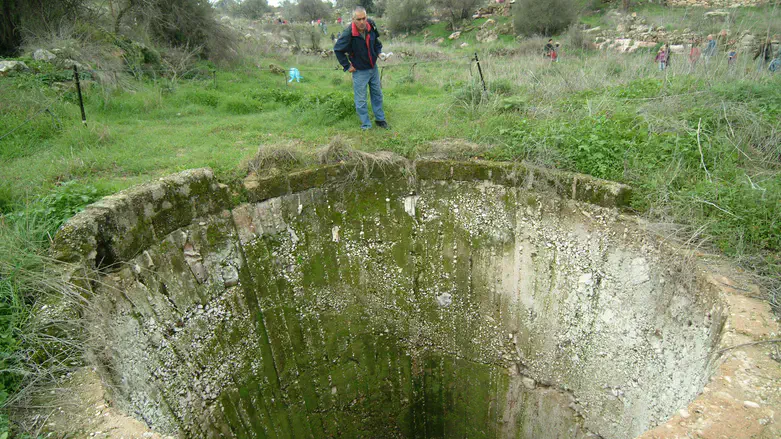
“Rav Yitzchak said, ‘When they returned from Yaakov’s funeral, Yosef went and peered into the pit into which the brothers had cast him’. Rav Tanchuma said, ‘His intention was only for the sake of heaven [in order to bless and express gratitude to Hashem] for when a person comes to the place where he experienced a miracle he must say, ‘Blessed is the Omnipresent who performed a miracle for me in this place’. But the brothers did not say this, but rather, ‘Perhaps Yosef will nurse hatred.’” (Midrash Tanchuma VaYechi 17)
Returning to the Pit: Trauma, Memory, and Healing
This was just another of the serious misunderstandings which had plagued the relations between Yosef and his brothers. But what, in point of fact, was Yosef’s real intention in returning to the dreaded hole into which he had been left to die?
Many years had passed since Yosef had been rescued from the hands of his brothers. Against all odds, he had risen to the highest position in Egypt and had acted with great wisdom and integrity in saving Egypt and other nations from the consequences of the devastating famine which had afflicted the world. It is safe to say that Yosef had blessed and praised Hashem numerous times for the great miracle of his salvation. So why was it necessary to return to the place of that great happening?
Many people who have been harshly mistreated, physically or emotionally, cannot control themselves from reliving the terrible trauma in their minds, yet we must ask, does this serve any beneficial purpose?
Hashem has placed in man the ability to heal from his physical wounds as well as his emotional violations. There is much truth to the popular adage that “Time heals all wounds”. But that is only if a person removes his attention from the suffering he went through. The more he replays the calamity, the more he experiences the pain it caused, and this prevents the healing process from taking effect. Therefore, in my opinion, it is not good for a victim to replay the horror he experienced and to keep active the pain he has gone through.
He must instead remove the traumatic event from active consciousness. I don’t mean that he should completely repress it. He knows that it happened, but he refrains from thinking about it, as that arouses feelings of insecurity and depression. He must seek to act as though it never happened and direct his energy to the matters that concern him in the present. The more he functions in a constructive manner, the more he restores his natural sense of confidence and self-worth.
It seems that Yosef never nurtured feelings of anger or depression after he was brought to Egypt. Almost immediately he experienced unusual success in the house of his master Potiphar who finally gives him total control over his holdings. Yosef recognized that in order to retain his sanity he could not afford to mourn over what had happened but had, instead, to pour all of his energy into the tasks that confronted him. It was also vital to retain his faith in Hashem.
The picture of Yosef that is conveyed is that of an active, confident individual who arouses the admiration of those around him and even the (unwanted) attraction of his master’s wife. Yosef clearly was not wallowing in the wounds of the past. He had left that behind and directed all his energy toward his current situation.
Indeed, the name which Yosef gave to his firstborn son, Menashe expressed the idea that, “G-d has made me forget all of my hardship and all my father’s household” (Bereishit 41:51) The Akeidah explains that Yosef expressed gratitude that Hashem had enabled him to forget the hardships his brothers had inflicted on him in his father’s home.
Mastery of Thought and the Discipline of the Tzaddik
In response to my contention that one should refrain from reliving traumatic occurrences, you might ask, but isn’t doing so an automatic, non-voluntary response? Is it not inevitable that a victim will have no ability to refrain from replaying the horrible experiences that he suffered?
I do not believe that one cannot control his thoughts. There is such a thing as mental discipline and Judaism maintains that if one makes the effort he can gain mastery over his mental activity. Thus, the Rambam explains that prior to reciting the Shemoneh Esrei (Amidah, prayer of eighteen blessings), one must focus his thoughts.
“What is to be understood by Kavanah (concentration)? He should free his mind from all extraneous thoughts and should envision himself as standing before the Divine Presence”. (Laws of Prayer 4:16).
Even more compelling are the Rambam’s words pertaining to the Jewish soldier:
“He should not think about his wife or children, but to the contrary, erase their memory from his heart and remove all thoughts from his mind except those pertaining to the war.” (Laws of Kings and Their Wars)
This Rambam is certainly counter-intuitive. When a person is preparing to enter a dangerous battle, it is only natural that he will think about those he loves. However, we must be able to control our thoughts and not allow them to wander to subjects that will cause us to become weak and cowardly in battle. Thus, the Torah expects man to be able to be the master of his mental life.
The true Tzaddik (righteous person) does not simply follow the path towards which his emotions lead him. So while there is a strong impulse to relive the humiliating event, he does not give in to it. He realizes that it is not beneficial to place himself in the position of pain and weakness and thereby keep the wounds open and prevent them from healing. He resists the urge to see himself as a victim and a “loser”.
Furthermore, he does not allow himself to be defined by what others may have said to him or done to him. He proceeds with his life on the basis of his relationship with Hashem. He does not seek the approval of man but only of G-d.
From Yosef to Our Time: Strength, Faith, and Forward Vision
In 2019 Bruno Dey who had worked for the Nazis as a guard for the dreaded Concentration Camp Stutthof was put on trial in Hamburg, Germany. In his excellent book, Final Verdict, Tobias Buck, recounts that a number of still living survivors were brought in to testify. Among them was eighty-nine-year-old Rosa Bloch, who traveled to the trial from Holon, Israel.
In the course of her interrogation, she was asked how she had managed to deal with her memories. She answered,
“Of course I suffered from this, it impacted me,” she replied. But Bloch had also proven herself surprisingly resilient, both in the camp itself and in the years that followed. She had to take care of her mother, who found living and surviving at Stutthof even harder than her daughter (and who died very shortly after liberation). “I am a very strong person, I am always optimistic. That is my character,” Bloch said. “After the war I met a man, we married, we started a family, I had children. I always thought you must look ahead, not backward. Life runs forwards not backward. You have to understand that.” Her priority, she said, was to take care of her children, not to dwell on her memories. That changed only later. “Later I could recount what I had lived through, but first I had to be strong. That was a lesson for all of us. We had to be strong.” (Final Verdict by Tobias Buck p. 99)
There are distinct similarities between the approach of Rosa Bloch and the Biblical Yosef. With this philosophy to guide him, Yosef recuperated from the psychological blows that were visited upon him by his brothers. He relied on his faith in Hashem and on the utilization of the formidable natural talents with which he had been endowed. As a result, he was completely cured of any residual effects of the disaster he had gone through.
When he returned to Canaan for his father’s burial, he was reminded of what had taken place so many years before. He wanted to review it, not from the standpoint of a victim but from that of one who had overcome it, so he could gain a greater appreciation for the miracle of his survival. A survival in which he had continued to grow and ultimately attained the highest level of achievement of which he was capable. A level he might never have attained had he not been forced to contend with adversity.
Therefore, he returned to the pit in order to fully apprehend what Hashem had done for him. He recognized that what had happened was not a cruel twist of fate but part of a Divine Plan to save Klal Yisrael (the Nation of Israel) in which he had played a central role. At that moment, he had a profound sense of gratitude and wanted to express his wholehearted appreciation to the Creator, Who in his greatest moment of need did not abandon him.
Unfortunately, at this point, the brothers still did not fully recognize the greatness and moral perfection of their younger sibling. It was only after they threw themselves at his mercy and he reassured them that he bore them no ill will that they were comforted.
Yosef the righteous, is one of the great role models of our history, which is infinitely rich in genuine Tzadikim (the righteous) of every kind. How fortunate are we to be able to partake of this unmatched spiritual heritage. Let us renew our resolve to emulate the example of the great heroes who have come before us.
Let us not be troubled by the extreme hatred of base and corrupt people. They cannot recognize the greatness of the exalted spiritual legacy of Klal Yisrael. Nor do they realize how much they could gain from us if they could somehow get past their insatiable desire to hate. We do not need them to like or approve of us. All we require is to be true to the Torah and find favor in the Eyes of Hashem.
May He assist us in this endeavor.
If you have comments or questions, contact Mitch Rosner on WhatsApp at 054-426-3419 or by email at mitchrosner@gmail.com.