

Nearly 200 countries recently adopted a series of far-reaching decisions under the international tobacco treaty, aiming to eliminate smoking worldwide.
The most notable step is an explicit call for countries to file civil lawsuits against cigarette companies to recover the health costs caused by smoking. According to an expansion of Article 19 of the treaty, these suits could generate hundreds of millions of dollars in revenue for national health funds.
"In Israel, these lawsuits could yield amounts of NIS 40 billion and even more, given the heavy burden of smoking on Israel's health systems," said Attorney Amos Hozner, an activist on the issue, in an interview with Arutz Sheva - Israel National News..
"In Israel, smoking prevalence is relatively high at over 20%. The damage requires multiple costly health services funded by the state, allowing the damage caused by smoking to be calculated. Meanwhile, cigarette companies earn vast sums from smoking."
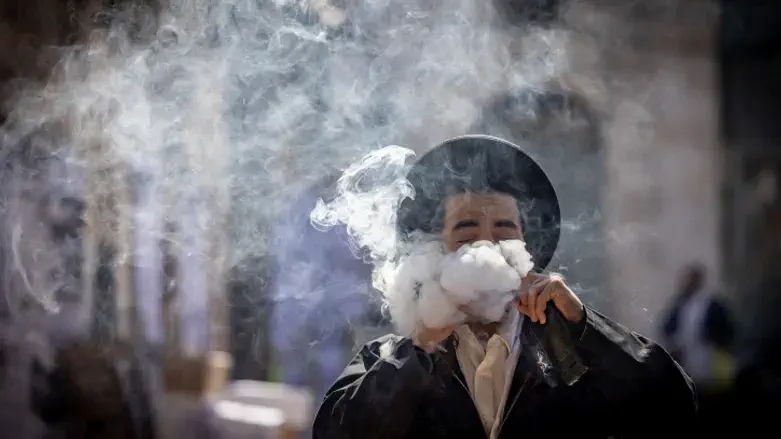
Hozner pointed to a recent study conducted in haredi yeshivas, which indicates unusually high levels of smoking among young haredim. "The smoking rate among young people in the haredi community is up to four times higher than the smoking rate among adolescents in the general population. 54% of students in haredi yeshivas and 80% of students in secondary schools for haredi youth have tried smoking. These are youths aged 12 to 18."
He said the findings among ages 17-24 are even more serious. "77% have tried smoking, and 56% of them smoke regularly. For comparison, only 22.4% of all IDF recruits smoke actively, and in the general sector 13%-23% of adolescents smoke."
"Smoking kills 1 in 2 users who do so exactly according to the manufacturer's intentions and expectations, and causes about 8 million painful deaths a year worldwide."
In Israel alone, he said, this amounts to about 8,000 deaths a year, plus another 800 people who die as a result of exposure to secondhand smoke. "In the United States, a similar lawsuit resulted in compensation of $246 billion to the funds of 50 states."
The treaty decisions also include calls to bring criminal charges against tobacco companies, a sharp restriction of nicotine levels, a ban on additives - a measure currently under legislative discussion in Israel - and applying the "polluter pays" principle to cigarette companies for environmental pollution from cigarette butts.
Under Article 2.1 of the treaty, there will be a special law protecting residents of apartment buildings from second-hand smoke from other units. According to the experts' committee report, about 74% of Israel's residents live in shared housing, and many report cigarette smoke entering their homes - a matter pending before the Supreme Court since 2021.
"As stated in the Ministry of Health's 2024 smoking report," Hozner concluded, "it is also possible to establish an obligation to deposit a bond by anyone wishing to sell or import cigarettes into Israel, to guarantee future damages. The bond obligation could also immediately bring substantial sums into the state's coffers."