
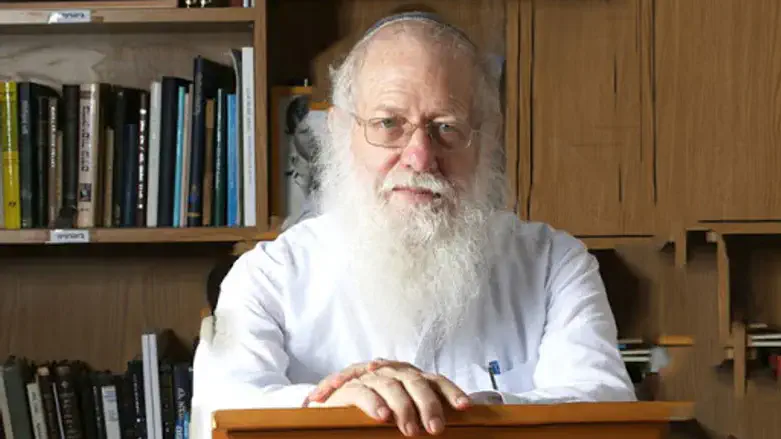
Rabbi Dov Begon is head of Machon Meir Yeshiva in Jerusalem
One shepherd for all
The Torah recounts years of crisis between the brothers and Yosef, to the point of brotherly hatred, as it is written, “And they hated him and could not speak to him peaceably” (Genesis 37:4).
In this past Shabbat’s Torah portion, peace returns to the household of Yaacov, our father. The family is reconciled and unified, and they speak with one another, as it is written: “And Yosef said to his brothers, I am Yosef… and he kissed all his brothers and wept upon them, and afterward his brothers spoke with him” (Genesis 45).
Not only among the sons of Yaacov, our father, were there crises and repairs, ascents and descents. Rather, throughout all the generations we find similar difficult times. In the First Temple period we underwent a terrible crisis in the days of Jeroboam son of Nebat when the people of Israel split into two kingdoms, Yehuda and Yisrael. And in the Second Temple period we suffered from baseless hatred, which brought upon us the destruction of the Temple and an exile of two thousand years.
Because of our many sins, we were exiled from our Land. Nevertheless, our Sages assure us that in the end we will be redeemed by nullifying the cause of the destruction - baseless hatred - replacing it with baseless love (see the Maharal of Prague, Rav Kook, of blessed memory, and others).
At present, in the Haftorah, the prophet Ezekiel, in a prophecy of consolation, describes our generation, the generation of the ingathering of the exiles:
“Thus said the Lord God: Behold, I will take the children of Israel from among the nations where they have gone, and I will gather them from all around and bring them to their Land. And I will make them one nation in the Land, on the mountains of Israel, and one king shall be for all of them as king” (Ezekiel 37:21-22).
Indeed, the deeds of the fathers are a sign for the sons. Just as the brothers were reconciled and unified and spoke one with another, so too in our generation the People of Israel, who are being gathered from among the nations, must become unified in the Land of Israel. We already have a State, and we have, thank God, a government, even if there are still disputes and misunderstandings among the different factions from which the nation is composed.
But that which unites is immeasurably greater than that which divides, and the day is not far when we will merit to see eye-to- eye the fulfillment of the prophecy: “And My servant David shall be king over them, and one shepherd shall be for all of them; and they shall walk in My ordinances, and keep My statutes and do them.”
Mashiach son of Yosef and Mashiach son of David
The vision of the prophet Ezekiel concerning the unity of Israel in the Land of Israel stands between the Vision of the Dry Bones and the war of Gog and Magog (Ezekiel 37-38). In the vision of the dry bones, the prophet prophesies the revival of the Jewish People in the Land of Israel after thousands of years of exile:
“Behold, I will open your graves and bring you up out of your graves, My people, and I will bring you to the Land of Israel… and I will place My spirit within you and you shall live, and I shall set you upon your Land” (Ezekiel 37:12, 14).
The prophecy of the war of Gog and Magog expresses the opposition of the nations of the world to the national revival of Israel, and cites their failure, as it is written: “And it shall be on that day, Gog shall come upon the Land of Israel,” but the outcome will be, “Upon the mountains of Israel you shall fall, you and all your bands and the peoples who are with you” (Ezekiel 38-39).
In between stands the vision of the unity of Israel illustrated by the parable of the stick of Yosef and the stick of Yehuda becoming one: “Behold, I take the stick of Yosef, which is in the hand of Ephraim and the tribes of Israel his companions, and I place upon it the stick of Yehuda, and I make them into one stick, and they shall be one in My hand” (Ezekiel 37).
The Malbim explains that the prophet hints to Mashiach son of Yosef, and afterward Israel will again unite under the kingship of the House of David.
Rav Kook, of blessed memory, in his reference to these two saviors, explains that the Mashiach ben Yosef represents the quality of the inchoate nationalism of Israel in its building stages, whereas in Mashiach ben David there is revealed the aspiration to unite everyone in the world into one family until all of mankind will call in the name of the Lord (Orot Yisrael, p. 160). This was promised to Avraham our father: “Go forth to the Land that I will show you, and I will make you into a great nation, and you shall be a blessing.” And through this, “and all the families of the earth shall be blessed through you” (Genesis 12).
At present, we see eye-to-eye how the vision of the prophet Ezekiel - describing the revival of the People of Israel and the ingathering of the exiles in the Land of Israel - is being realized. Although we are in the midst of the process, and we are still at the stage of national consolidation, namely the establishment of the State and the struggle for its existence in the face of the opposition of the nations of the world, these are days of Mashiach ben Yosef, according to the interpretation of the Malbim and Rav Kook, of blessed memory.
But our eyes must also be lifted toward the future and the end goal, toward the days of Mashiach ben David, when the matter of constricted nationalism will pass and we will also turn to all of humanity, to be a light unto the nations, as we pray day after day: “Cause the shoot of David Your servant to speedily flourish.”
All this will be when the People of Israel and the State of Israel assume the place promised to them and fitting for them, in the words of the prophet: “And it shall be in the end of days that the mountain of the House of the Lord shall be established at the head of the mountains, and shall be exalted above the hills, and all the nations shall flow unto it… for from Zion shall go forth Torah, and the word of the Lord from Jerusalem” (Isaiah 2).
Looking forward toward the complete Redemption.