
After Yossef reveals himself to his brothers, he sends them to tell Yaakov that he is still alive. When they arrive, he can hardly believe them, as it says (Bereshit 45:26-27):
"And they told him, saying, 'Joseph is still alive,' and that he ruled over the entire land of Egypt, and his heart changed, for he did not believe them."
And then:
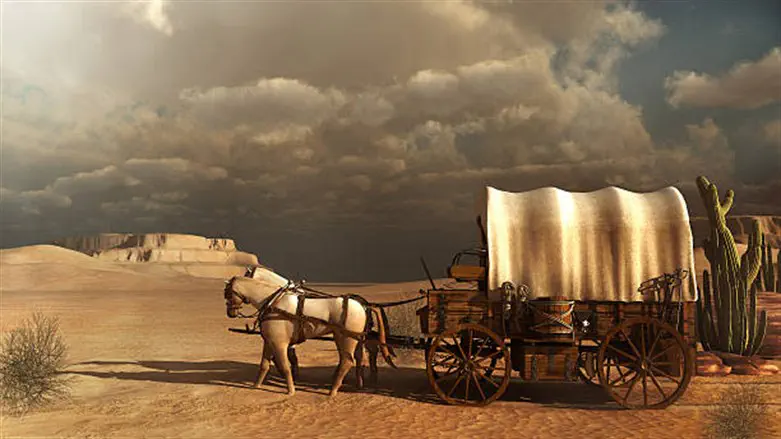
"And they told him all of Joseph's words that he had said to them, and he saw the wagons that Joseph had sent to carry him, and the spirit of their father Jacob was revived."
After speaking to him and seeing the wagons, he is revived. It seems these wagons convinced him or helped explain something. What exactly was it?
The Rashbam (Bereshit 45:19, 27) explains that no person was allowed to have wagons leave Egypt; only the king of Egypt himself was permitted to do so. Therefore, once seeing the goods and the wagons, Yaakov understood that Yossef must truly be the ruler over Egypt.
But more lies behind these wagons. They hint at a deeper message being conveyed.
Agalot - wagons and Eglot - heifers
The word wagons in Hebrew is agalot; these are the same letters as eglot, which means heifers (see Rashi and Siftei Chachamim 45:27). Egypt is known as "Egla Yefefiya Mitzrayim" (Yirmiyahu 46:20), the beautiful calf. When the Erev Rav - the Egyptians who joined Am Yisrael - made the golden calf, it was a calf of all animals.
Yossef himself has a connection to this world of Mitzrayim. He was blessed and compared to a bull, "Bechor shoro" (Devarim 33:17). Chazzal (Rashi, Shemot 32:4) teach that there was an inscribed plate that said on it "aleh shur" - "Ascend, ox" - which Moshe used to miraculously bring up Yossef’s coffin from the Nile. That same plate was used by the Erev Rav to create the golden calf.
Back to our Parsha, Yossef is showing and hinting to Yaakov how he dealt with the Egyptian world successfully.
Rabbi Shmuel Bornsztain, the Sochatchover Rebbe explains (Shem MiShmuel Vayigash, Shnat 677 and 681) that the phrase "agalot asher shalach Yosef laset oto," the wagons he sent to carry him, is precise. Yossef is telling Yaakov that coming to Egypt will not be a yerida (descent), but will lift him. Yossef is not controlled by Egypt; he is the ruler over Egypt. Yossef’s personal life proves this point. The experiment was successful: Yossef being in Mitzrayim did not assimilate. He remained a 100% tzaddik, capable of dealing with the Egyptian world without being influenced. He controlled his yetzer hara and ruled over the entire Egypt.
Yaakov, hearing and understanding this, has several questions in his life answered. Yossef is alive, physically and spiritually. There is no tribe which is “mudach” - wasted, lost, or left behind - like Yishmael and Esav (chas v’shalom). Yossef is able to prove his unique derech (path) in avodat Hashem. His dreams came true. His special hashkafa (outlook, philosophy) - which the brothers refused to accept - has been proven part of Hashem’s plan. He is a leading tribe.
Not only do these wagons teach him about the past, they also show him the future. Am Yisrael will go down to Egypt for slavery but will not be erased; they will rule and be masters there (Zohar Vayigash). The whole story will “carry” and uplift them.
After being hinted at this and realizing Yossef’s power in the past and the future, Yaakov can now announce, “Od Yossef Chai.” Yossef is fully alive in every way.
Rabbi Yonatan Kirsch was born in New Jersey and made Aliyah as a child. A musmach of Rabanut Ir (Chief Rabbinate of Israel), he served as a rebbe at the Hesder Yeshiva of Sderot and taught at Yeshivat Hakotel. He currently teaches at Yashlatz in Jerusalem and is the author of Maalot HaMikve. A combat soldier, he served in Lebanon.