
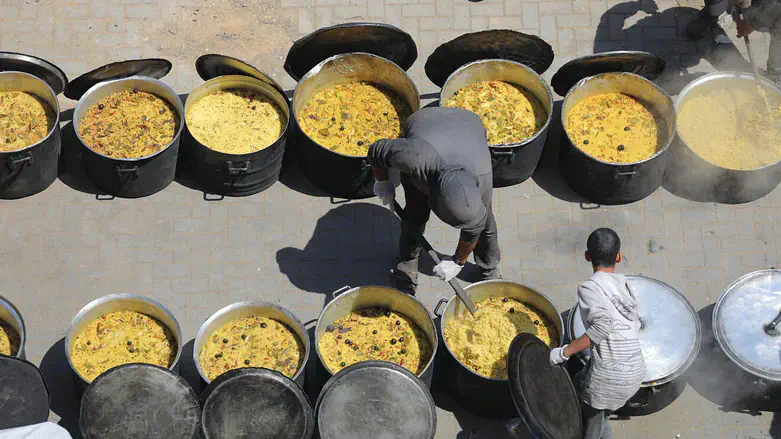
In light of the publication of the IPC food security analysis report on Gaza, the Coordinator of Government Activities in the Territories, Maj. Gen. Ghassan Alian, issued a rebuttal to the biased claims that disregard the volumes of food that entered during the ceasefire, indicating that the report’s conclusions were predetermined and saying it showed “a blatant, biased, and deliberate disregard for the volumes of food that entered during the ceasefire - the distorted conclusions were written in advance.”
At the same time, despite the IPC’s previous false claims regarding the existence of famine in the Gaza Strip, the authors of the report now formally acknowledge that there is no famine in Gaza, while asserting a situation of acute food insecurity - whatever that vague phrase is meant to infer.
COGAT's response:
COGAT strongly rejects the claims of food insecurity and conclusions presented in the IPC report published last week, which once again portray a distorted, biased, and unfounded picture of the humanitarian situation in the Gaza Strip. The report relies on severe gaps in data collection and on sources that do not reflect the full scope of humanitarian assistance. As such, it misleads the international community, fuels disinformation, and presents a false depiction of the reality on the ground.
First, we emphasize that, contrary to the claims in the report, between 600-800 aid trucks enter the Gaza Strip every day, approximately 70 percent of which carry food. The remainder carry medical equipment, shelter supplies, tents, clothing, and other essential humanitarian assistance. This is in accordance with Israel’s commitment under the ceasefire agreement to allow and facilitate the entry of 4,200 aid trucks per week. In this context, nearly 30,000 food trucks carrying more than 500,000 tons of food entered the Gaza Strip throughout the ceasefire period.
We also note that throughout the war, approximately 100,000 food trucks entered the Gaza Strip until the start of the ceasefire. These quantities significantly exceed the nutritional requirements of the population in the Gaza Strip according to accepted international methodologies, including those of the UN World Food Programme (WFP).
These data are presented daily as part of joint situational assessments to the mediators, the UN, and international organizations, which are directly aware of Israel’s commitment to upholding the agreements, even in the face of Hamas’s blatant and ongoing violations. Any attempt to present the data otherwise or to claim a shortage of food constitutes a deliberate distortion of the facts.
It should be clarified that humanitarian assistance, including food, enters in full coordination with the UN, international organizations, donor countries, and the private sector. However, it should be noted that only about 20 percent of the humanitarian aid entering the Gaza Strip is delivered via the UN, while the remainder is delivered by countries, additional international organizations, and the private sector. This fact illustrates the severe gap between the actual volume of aid and the partial data on which, among other things, the IPC report relies.
Furthermore, the manner in which the IPC conducted itself during the preparation of the report raises serious questions regarding its credibility and professional integrity. The authors of the report agreed to meet with Israeli professional officials and representatives of the U.S. Civil-Military Coordination Center (CMCC) only after the report had already been written and its conclusions formulated. During the meeting, the authors were presented with complete, daily, and verified data regarding the volume of food trucks entering the Gaza Strip.
Despite this, the IPC chose to present a series of excuses regarding the use of the data and relied only partially on the information provided. This conduct does not reflect a legitimate professional disagreement, but rather biased writing based on partial and skewed data, indicating that the report’s conclusions were determined in advance.
The publication of statements and warnings that are not based on complete and verified data does not advance the humanitarian response. Instead, it harms it and diverts the discussion from the real challenge - improving collection and distribution mechanisms within the Gaza Strip and preventing Hamas from taking control of the aid.
It is important to recall that this is not the first time IPC reports regarding the Gaza Strip have been published with extreme forecasts and warnings that do not materialize in practice. Time and again, IPC assessments have proven to be incorrect and disconnected from the data on the ground, contradicting verified facts, including aid volumes, food availability, and market trends. The international community must act responsibly, avoid falling for false narratives and distorted information, and refrain from legitimizing a biased and unprofessional report.
Responsible humanitarian discourse must be based on facts, data, and realities on the ground, not on biased foregone conclusions that in practice serve the interests of the terrorist organization Hamas.
COGAT will continue to act, together with international actors and regional partners, to ensure the entry of humanitarian aid into the Gaza Strip and its transfer to the civilian population, while preventing the exploitation of the aid by the terrorist organization Hamas.
Barry Shaw is at the Israel Institute for Strategic Studies.