
“God be gracious unto us and bless us; may He cause his countenance to shine upon us; Selah…” (Psalm 67:2)
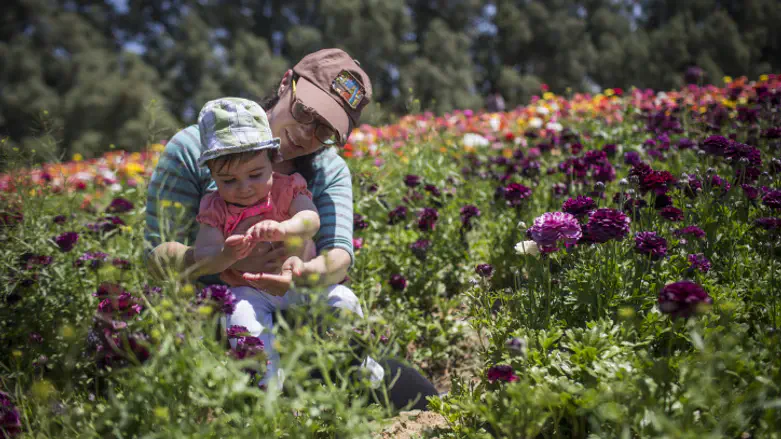
It is late afternoon, and I am sitting in a field of wild flowers. Surrounded by a profusion of pink, white and yellow. A small path winds its way among a variety of colorful blossoms. A black and white cat is lying calmly in the grass next to me. Close enough to keep me in view, far enough away so as to be untouchable. Silently, peacefully enjoying the tranquility of the moment with me. Sunlight glistens through the branches of overtowering trees. Shimmers off their profusion of leaves. Soon the sun will set and all will be dark, but for now, a bright glow of yellowish white is clearly seen on the horizon.
I sit and listen to the birds, to the wind, to the rustle of the leaves. To the calmness and tranquility.
Am I in a dream? Is this reality? Or do we have within us the ability to choose? The power to create the inner reality in which we find ourselves, the power to choose in which direction we are looking.
It has been more than two years now, since words disappeared from my lips, clouds took the place of thoughts, the world turned upside down, and has not yet reversed its position.
I think of the many times that I have said to my sister, I wish I could speak with Dad (z’l). Ask him, how did he do it?
Live his life, even after the Holocaust, in the spirit of “O Lord, open my lips, and my mouth will declare Your praise” (Psalm 51:15)
Once again, I am a small child, first encountering the Beauty of Life. A robin is building her nest outside the windowsill next to my bed. Then she lays a few eggs. And after they hatch, I watch in fascination as she feeds the little baby birds.
Once again, I am in the garden of enchantment, of memory. Purple and white azalea bushes are growing grow gaily against the walls, an abundance of climbing red roses add to the scene’s splendor. A cat strolls about the garden carefree with her little kittens. And there is a swing set, with a delightful slide, for us children to play on.
My father would sit in the garden, peaceful, tranquil, alone. We never disturbed him. Never thought to pull out a chair and join him. He would sit with his face towards the sun.
There was a red Cardinal on a nearby tree, who would have a lively conversation with my father. He would call, and my father would whistle back, the same tune. Then the bird would call again, and my father would again answer him. A musical dialogue, as if from another world.
Our home was calm, quiet, serene. I never remember a voice being raised. In those years, my Dad never spoke of the Holocaust. He never spoke, we never asked. He closed the door, put the past behind hime, and was determined to build a new future.
That was my father (z’l). And by his side, my mother (z’l), the supportive hero. Together facing life with faith, with optimism, with strength and determination. “Looking towards a brighter future”, he would always say.
But the question remains, in the face of unspeakable tragedy, and in the encounter with such pure evil, from where does one get the strength?
In all my years of childhood, there was complete silence on the subject of the Holocaust. It was a door that was shut and locked with a key.
But some things are transmitted to children without words.
Carl Jung, the great psychologist and philosopher, spoke of a collective unconscious. A collective, inherited layer of the human psyche which we are all a part of. There is a memory which is passed from father to son wordlessly. Maybe that is what is meant when it is said that we all were actually at Mount Sinai. Somewhere in our memory, if we listen closely enough, we can hear the Voice which spoke and proclaimed that we are to be God’s Chosen People, that we are to be a Holy Nation.
“You must be holy for I, the Lord your God, am holy” (Leviticus 19:2)
When we were children, my Dad never spoke about the past. He would just ask us how was school today. What did we learn today.
But. As children, we used to play. Like Janusz Korczak, I was the head of the orphanage (our home), my younger sisters were the orphans. One day we decided to run away. There is a six year difference between me and my youngest sister. We put the baby in the carriage, the other one in a stroller, and my second sister and I rescued our siblings. Ran away determinedly, along the side of a busy highway, until we reached the safety of my aunt’s home.
And when I was in elementary school, we used to travel to school on a cheerful yellow schoolbus. But as we passed the synagogue on our way to school, in my eyes I would see it going up in flames, as in the Warsaw ghetto. I was no longer on the bus with the other schoolchildren but rather, I rushed inside to help save the holy Torah scrolls from burning.
And so…
Two years ago the grandchildren were playing outside. It looked amusing, they were all running around chasing each other. And then I discovered that they were playing terrorists and captives.
And just recently, when they were all together, they built a lovely house in the hallway with pillows. Delightful. All kinds of colorful pillows. Then I asked what they were doing. They had built a walled fortress. I won’t describe to you what they were playing…
Something in that scene reminded me of my own childhood.
We are now facing a surrealistic reality. And an age-old question which repeats throughout Jewish history.
How does one maintain goodness in the face of such evil? How does one maintain faith, kindness, generosity, knowing that the world is otherwise?
And what is the message we want to give the next generation?
A generation that understands more than we could imagine, a generation that is being exposed to horrors they do not have the ability to cope with.
It is now the beginning of Tevet. The month in which occurs the fast of the Tenth of Tevet, in which we mourn the siege of Jerusalem which led to the destruction of the Holy Temple. This day has been designated also as Yom HaKadish Haklali, when we recite Kaddish for Holocaust victims and those whose date of death is unknown.
And so, we are now in transition, from Hannukah, the holiday of light and celebration, to a day of fasting and mourning.
But perhaps, a memory of the glow of the Hannukah candles will flicker in the darkness of the days to follow.
As we go from Kislev to Tevet, we read Parashat Miketz. In the Parasha, Pharaoh had a dream. And in the dream, as interpreted by Joseph, seven years of prosperity were to be followed by seven years of famine.
It was the seven good years which enabled the Egyptians, under the guidance of Joseph, to prepare for the seven years of famine which were to follow. Perhaps it was also the memory of the seven good years which enabled them to endure the time of difficulty of the next seven years.
A knowledge of good, a faith in the possibility of a different reality,
if only we have the courage to wait. To strive, to hope, to believe. If only we keep inside ourselves the unswerving conviction, that life is meant to be, can be, will one day be otherwise.
An awareness of goodness helps sustain us in the face of evil. A spark of the sunlight is reflected in the stars of the night, if only we look up.
The month of Tevet begins with the last day of Hannukah. And the month of Tevet shares its root with the Hebrew word “tov,” which means “good”.
As prophesied, one day “The fast of the fourth, the fast of the fifth, the fast of the seventh and the fast of the tenth, shall be to the house of Judah joy and gladness, and cheerful seasons, therefore love ye truth and peace.” (Zechariah 8:19)
In the darkness, a flame burns brighter. In the face of evil, kindness and goodness brings the Divine into our lives.
One night, I was speaking with my father on the phone. He was at the time about the age of 100. He was talking about red roses growing outside the window. I thought we were doing telepathy, for at the moment I was looking at red roses climbing outside my window, here in Israel. And then I gradually realized, he was speaking of his own life, of his childhood home in Poland.
I guess the future really does have its roots in the past. Memory, a visual, virtual memory, is transmitted from one generation to the next, even without words. And hope, faith, strength and belief are also transmitted, sometimes wordlessly.
In the darkness, the light of a candle glows brighter. In the face of evil, goodness and kindness shine brighter, as a beacon. As an expression of the spark of the Divine which is within us. We choose. How to enable it to glow. We choose, in which direction to look.
A touch of Heaven may be found here on Earth.
Reach out our hands and we touch it, open our hearts and we receive it.
The sun is setting now, as day melts into night. The brightness of the sun still shining, as the white orb of light sinks slowly, gently in the distance, its glow sparkling off the leaves of darkening treetops.
“…to give them a garland for ashes, the oil of joy for mourning, the garment of praise for the spirit of heaviness; that they may be called trees of righteousness, the planting of the Lord, that He may be glorified.” (Isaiah 61:3)