
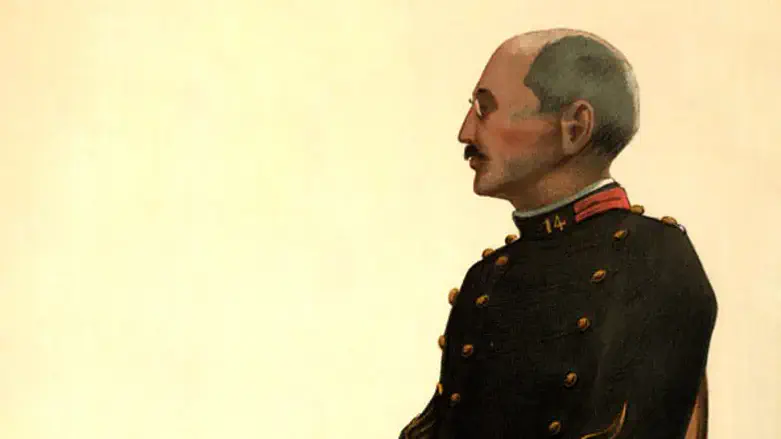
When I was a young lad, my parents decided to send me to after-school “Hebrew High” in order to ensure that I got the bare minimum of a Jewish education. It was there that I was first introduced to the history of the Dreyfus Affair. For those who didn’t have the pleasure of sitting through Mrs Schneiderman’s lecture, let me present a quick history lesson.
The Dreyfus Affair was a political and judicial scandal in France that lasted from 1894 to 1906 and revealed deep divisions in French society over antisemitism, nationalism, and justice. It began in a tense post-post-Franco-Prussian War climate, when suspicion and hostility toward Jews were widespread, especially within the French military. Alfred Dreyfus, a Jewish artillery captain from Alsace serving on the General Staff, became a convenient suspect when French intelligence discovered a document offering military secrets to Germany.
In 1894, Dreyfus was accused of treason based on weak and circumstantial evidence, including a questionable handwriting comparison and secret documents shown only to the judges. Despite the lack of proof, he was convicted in a closed court-martial, largely influenced by antisemitic prejudice. In 1895, he was publicly humiliated in a degradation ceremony in Paris and sentenced to life imprisonment on Devil’s Island, a remote and harsh penal colony off the coast of French Guiana.
Doubts about Dreyfus’s guilt soon emerged. In 1896, Lieutenant Colonel Georges Picquart, head of military intelligence, discovered evidence pointing to another officer, Major Ferdinand Walsin Esterhazy, as the true author of the incriminating document. Rather than admit error, army leaders suppressed the new evidence, protected Esterhazy, and removed Picquart from his post. Esterhazy was later acquitted in a staged trial, while forged documents were added to the case to reinforce Dreyfus’s supposed guilt.
The affair became a national crisis in 1898 when the writer Émile Zola published his famous open letter, “J’Accuse…!”, accusing the military and government of antisemitism and deliberate injustice. Zola’s intervention ignited fierce public debate and divided France into two hostile camps: the Dreyfusards, who demanded justice and upheld republican values, and the anti-Dreyfusards, who defended the army and promoted nationalist and antisemitic views. Zola was convicted of libel and forced into exile, but public pressure continued to grow.
In 1899, Dreyfus was brought back to France for a retrial. Despite clear evidence of misconduct and forgery, the military court again found him guilty, though with “extenuating circumstances.” To calm the political turmoil, the president issued Dreyfus a pardon, which freed him but did not clear his name. Dreyfus continued to seek full justice, insisting on complete exoneration rather than mercy.
Finally, in 1906, France’s highest court overturned the conviction, officially declaring Dreyfus innocent. He was reinstated in the army with the rank of major, and the officers who had defended him were vindicated.
The Dreyfus Affair left a lasting legacy, exposing the destructive power of antisemitism and institutional corruption. It also had international consequences, influencing thinkers such as Theodor Herzl and shaping modern debates about justice and minority rights.
It also changed the way that French Jews viewed themselves and their relationship with the gentile world. The Dreyfus Affair showed that many Jews who believed they were safe and fully accepted in France were living under a fragile and conditional security.
French Jews had largely embraced emancipation, republican values, and integration into French society, trusting that citizenship, education, and loyalty to the state would protect them from persecution. Alfred Dreyfus himself embodied this belief: a patriotic army officer who saw himself first and foremost as French. Yet the speed with which he was accused, convicted on flimsy evidence, and targeted because he was Jewish revealed how deeply antisemitism still operated beneath the surface of a modern, democratic state.
The affair demonstrated that legal equality did not guarantee social acceptance, and that in moments of national fear or crisis, Jews could still be cast as outsiders and traitors. For many Jews in France and across Europe, the Dreyfus Affair shattered the illusion that assimilation alone ensured safety, forcing a painful reassessment of their place in societies they had trusted.
I will admit that at the time, I completely missed the point. I listened to the tragic story as I would have any other historical event, as something tragic but consigned to a long-ago age and a world that no longer was. If I thought about its connection to the modern world at all, it was only with relief that we were living in a more enlightened age, where something like the Dreyfus Affair could never happen.
It seems like I was not the only one who missed the point. Western Jews collectively assumed the affair was nothing more than another chapter in the Jews’ tragic story. But it was something in the past, not anything that could occur today. The irony of the mode of thinking was staring us all in the face, yet we refused to see it.
The essential factor in the Dreyfus affair was that it was a story of the Jews of the time who felt that something like that could never happen in the modern world, until it did. And Western Jewry looked at the story and decided that nothing like that could happen in the modern world, until once again, it did.
And now we are again living through a period sure to be studied by future generations of students. It’s certainly an amazing time to live through. Within 48 hours, we saw the Bondi Beach terror attack, a Jewish home in California was shot at , a Jewish New Yorker was attacked on the subway, and A Jewish MIT professor was shot dead in his home. There was also the Brown U. shooting, which now seems to be an antisemitic hate crime.
This is to say nothing of what could have happened. A terror plot was foiled in Los Angeles. Another was stopped in a German Christmas market and a third in a Polish Christmas market.
In America, despite having the most pro-Israel in US history, Jews are more unsafe than ever. Antisemitism is at record levels, hate crimes are a daily occurrence, and many Jews now feel the need to hide any signs of their Jewishness.
It’s even worse in Europe, where violence against Jews is becoming the new norm, while politicians, the media, and the gentile community turn a blind eye. On the other side of the world, Australia is still reeling from the recent attack, but it’s hardly the first time Jews have been targeted. All while Prime Minister Anothy Albanese and Foreign Minister Penny Wong offer empty platitudes and suck up the ever-growing Muslim community.
Things didn’t have to be this bad. Forearmed is after all forewarned. Jews around the world had years, decades to prepare for what was coming. But almost without exception, we did nothing and left ourselves totally vulnerable.
For the Jews in Dreyfus’s time, what happened was a new experience. They might therefore be forgiven for being surprised at what happened. Not so us. We had the luxury of learning from history, yet we choose to ignore it. Worse still, we ignore it with a bit of caustic hubris that allowed us to look at a case of people who thought “it could never happen here” and decide that “it could never happen here.”
It's time to learn from our history. Not only can it happen here, but it is happening here. The longer we ignore this, the more examples we’ll be given. Western Jews around the world need to take this lesson to heart so that this really will be the last time.
Now is the time for Jews of the world to take action. To understand the world they live in and make the appropriate choices. To plan for a future based on the reality of the present, however unpleasant. To stop saying that it could never happen again and ensure that it never does.
And to any Jews in the future who stumble upon this piece, I implore you. Don’t make the same mistakes we did. Don’t ever assume that you’re safe, that it could never occur where you are. Plan, prepare, create a different outcome. Learn from history and learn from our mistakes. History might have harsh and unpleasant lessons, but it is a far gentler teacher than experience.
Ilan Goodman is a museum collections professional and exhibition curator. He also serves as a rabbi and educator. He made Aliyah to Israel in 2011 and lives with his wife and children in Beit Shemesh.