
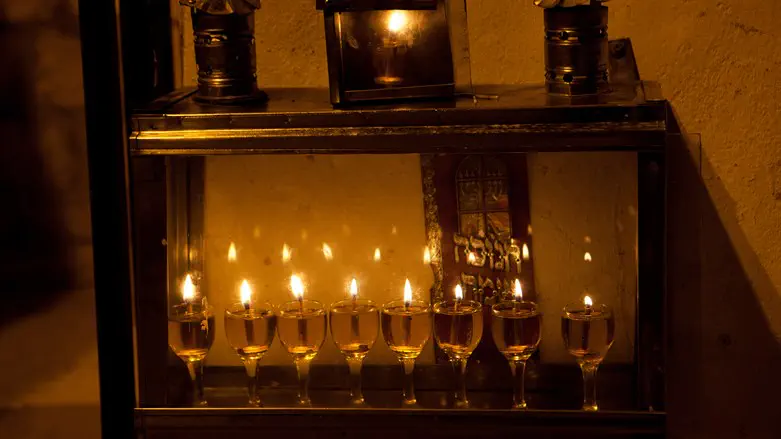
One of the great spiritual and sensory highlights of Hanukkah is the oil: the practical, sizzling oil in our potato latkes and sweet, fried doughnuts, and, far more importantly, the miraculous oil that fueled the Temple Menorah for eight days instead of only one, and the lighting of the Menorah every night of the Holiday.
In Judaism, there is a core and ancient teaching that we should strive to learn an important lesson from every experience in our lives, especially when that experience is connected to a significant and Divinely inspired holiday like Hanukkah.
The primary and essential fuel commanded by our Holy Torah for lighting the Menorah in the Temple was pure olive oil, and its unique physical and chemical qualities serve as a profound spiritual metaphor for our personal growth.
Olive oil has several seemingly contradictory qualities: it is made by crushing and firmly squeezing the olive-an act of extraction-yet it quietly seeps into everything it touches; it fundamentally does not mix with other liquids, but because of its low density, it always rises to the surface.
Before delving into the core spiritual lesson, it is worth pausing to share some of the outstanding, little-known qualities of olive oil that made it the perfect, prescribed fuel for the Temple's sacred lamp.
Olive oil offers significant practical advantages over common vegetable and petroleum-based oils, especially in terms of cleanliness, longevity, and safety for use in lamps.
The primary benefits come from its remarkably high purity and specific chemical composition.
Pure olive oil is often considered the cleanest-burning natural oil, producing little to no smoke or bad smell because it is up to 99% pure fuel with very few volatile impurities. Additionally, olive oil has a relatively high flash point compared to more volatile fuels like kerosene. This means it needs a much higher temperature to vaporize and ignite. If an olive oil lamp is accidentally knocked over, the large volume of liquid oil is not flammable at room temperature, and the existing flame will simply go out, making it a very safe fuel source.
Being a natural, renewable fuel, its combustion does not produce the toxic byproducts typically associated with petroleum-based oils.
Compared to kerosene, olive oil's flame produces a warm orange-gold glow, distinguishable from the brighter, often harsher white flame generated by highly refined, petroleum-based fuels. The yellow-orange hue commonly seen in oil and candle flames results from incandescent soot particles (unburnt carbon) glowing hot within the flame.
While olive oil is a notably clean-burning fuel, its flame still exhibits this warm glow, which is often preferred for its ambiance and resembles the light produced by the alternative fuel recommended by our Sages for the Hanukkah Menorah: pure beeswax candles.
This purity and the oil's paradoxical nature provide the essential spiritual lesson we seek.
Oil is an ancient and powerful metaphor for wisdom because it fuels light. As the Bible teaches: "A fool walks in the dark" (Ecclesiastes 2:14) and "Your word is a lamp to my feet and a light to my path" (Psalms 119:105).
Thus, Oil, Wisdom, and Light all form an inseparable triad, just as Darkness and Foolishness are paired.
Oil is made by crushing olives. Similarly, when a person is “crushed” by life's hardships or chooses to humble their ego and embrace a moment of brokenness, they become refined and receptive to true wisdom.
Only humble people-those who have a place in their hearts for others and are sensitive to their feelings-can truly combine their individual knowledge to produce the collective wisdom that acts as the fuel for light in the world.
In Hebrew, the word for wisdom, Chochma (חָכְמָה), is sometimes interpreted as the phrase, "What am I?"-a profound sign of humility and self-nullification.
True wisdom, therefore, is only gained through self-awareness and self-effacement that come with humility. When someone develops this quiet quality of humility, they will be genuinely heard by others because people intuitively sense their modesty and unassuming nature. Like oil, they will quietly saturate everyone with their genuine influence, becoming a true example and a natural leader.
Conversely, an arrogant and self-centered person who believes he is bright and full of himself hinders his own spiritual and intellectual growth. His ego is a source of darkness and foolishness, and as the Sages state: “I (God) and he [the arrogant person] cannot dwell together.”
Furthermore, like oil that naturally rises to the surface, wisdom genuinely emerges when we live with humility. They do not believe they know everything; they recognize that everyone has something unique to offer the universe, so they consciously seek to learn from everyone.
A humble person knows they must continuously learn; they look out for lessons they can acquire daily, and because of that, they not only expand their own knowledge but also learn to respect everyone and everything around them.
This combination of humility and continuous receptivity to learning leads directly to gratitude.
This is why on Hanukkah (The holiday of oil), we explicitly "...acknowledge and give praise to His great name" in our prayers.
Humble people naturally show gratitude for all the good they have in life, recognizing the miracles God grants them and not taking anything for granted. Those who are grateful for what they have and know how to count their many blessings tend to be happier, more well-rounded, and live longer.
For more information about my workshops, please contact me at rsezagui@gmail.com & www.rabbishlomoezagui.com.