
One of the familiar and well-established customs of Hanukkah is the spinning of the dreidel. As long as the dreidel is turning, the letters are unclear. One cannot read what is written, nor know how it will fall. Only when the dreidel comes to a stop does the message appear: “A great miracle happened here.”
So it is with life. While events are unfolding, we do not always understand what is happening. At times, matters appear confusing, difficult, and even threatening. Yet when time passes and the picture settles, it becomes possible to see in retrospect that nothing was accidental. Everything took place under the guidance of the Holy One, blessed be He.
This idea lies at the heart of Parashat Miketz. Pharaoh’s dreams disturbed him not only because of their content, but because they overturned the natural order of the world: weak cows consuming strong ones, thin ears of grain swallowing full ones. Rav Samson Raphael Hirsch explains that the words “Vayikatz Paro” do not describe an ordinary awakening, but an awakening of fear and alarm. Pharaoh sensed that the natural order had been reversed, that weakness was prevailing over strength - something that can occur only when the hand of G-d is at work.
When the dream was repeated, Pharaoh understood that this was no coincidence. Years later, Yosef himself states this truth explicitly: “It was not you who sent me here, but G-d.” The repetition of the dream demonstrated that what was unfolding was part of a Divine process guiding the course of history.
When Yosef is brought before Pharaoh, he speaks with complete humility: “It is not I; G-d will answer for Pharaoh’s welfare.” Even Pharaoh recognises this, declaring: “Can there be found such a man, in whom there is the spirit of G-d?” The dreams, their interpretation, and their fulfilment all testify to one reality: history is not ownerless; it is directed by the Ribbono Shel Olam.
It is no coincidence that Parashat Miketz is read almost every year during Hanukkah. Hanukkah, too, is about that which lies beyond nature. A small and weak nation overcomes a mighty empire. A small cruse of oil burns far beyond its natural capacity. As we say in Al HaNissim: “You delivered the mighty into the hands of the weak.” What appeared impossible became reality through the will of G-d.
And yet, darkness has not vanished from the world. Even in our own generation, we encounter great pain. Jews were murdered and many injured in Sydney, Australia, while lighting the first Hanukkah candle - at the very moment that symbolises the triumph of light over darkness. Hanukkah does not offer simple answers, nor does it lessen the pain. Instead, it asks something deeper of us: to hold on to faith even when matters are unclear and the Hand of G-d seems concealed.
Another Hanukkah custom reflects this idea - the sufganiyah. Its name may be heard as “sof Gan-Yah” - the end of G-d’s garden. From the moment Adam and Chava left Gan Eden, the world ceased to be whole and transparent as it once was.
Like the sufganiyah, the world has an outer layer and an inner core. The outer layer is filled with effort, responsibility, and struggle. The inner core is the essence - the soul, the Divine spark planted within every Jew. This inner light teaches that nothing is accidental. A person may live entirely on the surface, absorbed in daily pressures and concerns, or may turn inward and recognise the guiding hand of G-d.
The sweetness of the sufganiyah is found within. From the outside it is not immediately apparent, yet it is always there. So too, the goodness and purpose of the Holy One, blessed be He, are present even when concealed by confusion or suffering. As the Midrash teaches: “Even when I hide My face from them, I am with them in their distress.”
The prophet expresses the same idea when he says: “In all their suffering, He was afflicted with them.” This theme is echoed in the ancient piyut sung onShabbos “Baruch Hashem yom yom ya’amos lanu”, which speaks of how G-d carries His people even through times of suffering and servitude.
And so the dreidel brings us back once again to this truth. While it is spinning, the letters are blurred. While life is in motion, meaning may remain hidden. But when the spinning stops, clarity emerges: nothing was accidental, nothing was wasted, and nothing was without purpose.
This is the lesson of Hanukkah. When life is difficult, when events appear confusing or threatening, we do not break. The pain is real - but so is the presence of G-d. A small light drives away much darkness. A single mitzvah performed with sincerity illuminates a wide space. And even when the light is hidden, the soul continues to shine.
We continue to light. We continue to live with emunah. And one day, when the dreidel finally comes to rest, we will see clearly that even the darkest nights were not devoid of light - but filled with hidden light.
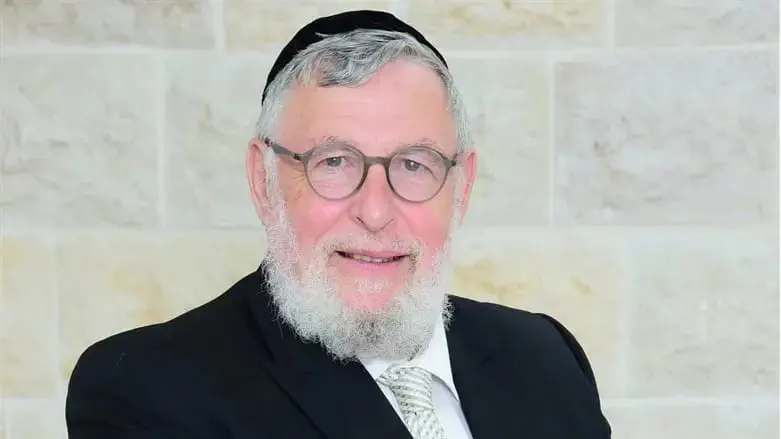
Rabbi Eliezer Simcha Weisz is a memberof Israel's Chief Rabbinate Council.