

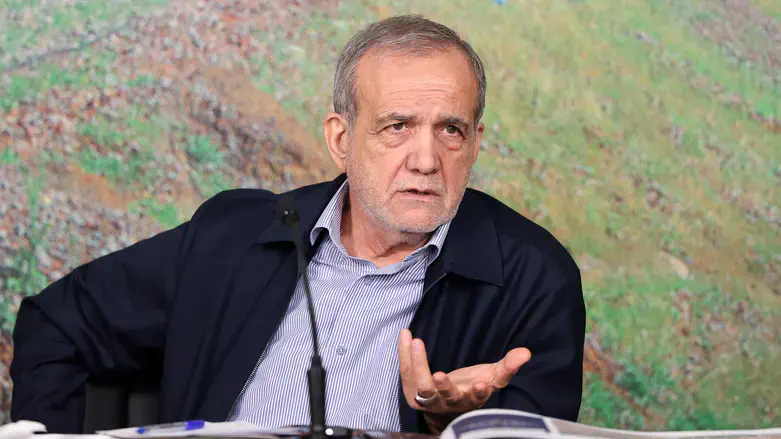
Iranian President Masoud Pezeshkian has publicly conveyed what amounts to a near abdication of responsibility, openly telling Iranians that he is unable to solve the country’s mounting crises.
In a series of strikingly candid speeches cited in a New York Times report, Pezeshkian has repeatedly signaled that he has exhausted both options and authority. Speaking to students and academics in early December, he dismissed expectations for leadership outright. “If someone can do something, by all means go for it,” he said. “I can’t do anything; don’t curse me.”
In meetings with senior officials, Pezeshkian reportedly acknowledged that the government is “stuck, really badly stuck,” adding that “from the first day we came, catastrophes are raining down, and it hasn’t stopped.” The remarks, delivered publicly and on camera, have been widely interpreted as an admission of surrender in the face of Iran’s overlapping crises.
Rather than presenting a path forward, Pezeshkian has placed responsibility elsewhere, arguing that Iran’s predicament is the product of years of mismanagement, corruption, and political infighting. “The problem is us,” he said on several occasions, explicitly rejecting the notion that the country’s failures could be blamed primarily on the United States or Israel, according to the report.
His sense of resignation was underscored this month when he told provincial governors to assume that the central government “did not exist” and to deal with their problems on their own. “Why should I solve them?” he asked. “You shouldn’t think that the president can make miracles happen.”
The New York Times noted that footage of these remarks spread rapidly across Iranian media and social networks, reinforcing public perceptions that the president has effectively stepped back from governing. Critics across the political spectrum have accused him of projecting weakness at a time of severe national strain.
Pezeshkian, who assumed office in September 2024 after the death of President Ebrahim Raisi, has repeatedly emphasized the limits of his power, stressing that ultimate authority rests with Iran’s supreme leader, Ayatollah Ali Khamenei. According to The New York Times, he has shown little hesitation in publicly acknowledging his subordination on key policy issues.
Despite his bleak assessments and statements suggesting institutional paralysis, Pezeshkian has insisted he will remain in office. “I will stand until the end,” he said, even as he continued to warn that Iran’s situation is dire and largely beyond his control, the report concluded.