

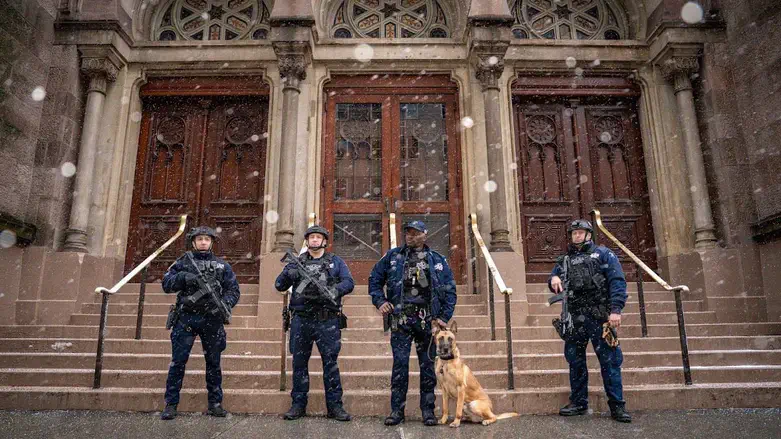
Despite the rise in antisemitic attacks, including the massacre at a Hanukkah event in Sydney, Australia, a Jewish organization is calling on communities and congregations not to utilize security guards or police for protection.
A post published by the Jewish far-left and anti-Israel organization, IfNotNow, claims that armed security and law enforcement outside of synagogues put certain populations at risk.
The post's author, Dean, IfNotNow's BIJOCSM (Black, Indigenous, Jews of Color, Sephardi, and Mizrahi) & Israeli-American Organizer, acknowledgs the fear felt by Jews following the attack in Australia: "I feel the fear in my chest as I think twice about placing my Hanukkiah/Menorah near a window facing the street, out of concern that someone with ill intentions might view my family and me as a legitimate target because of it."
The author also confirms that security guards and law enforcement make "some of us, specifically those who have benefited from the protections of the state," feel safe. However, the post goes on to claim that the same protection "puts many of us Black and Brown Jews, alongside our non-Jewish Black and Brown siblings, at risk of physical injury, emotional and mental duress, and possible death."
According to the Dean, security guards and law enforcement in the US learn to treat brown and black people as a threat. He adds that "the current climate, under the Trump administration, makes it even worse, when being brown or black is enough of an excuse to tackle you to the ground, cuff you, and disappear you into a prison or detention center."
Dean laments, that as a Brown Jewish man, he is afraid to "even walk near a synagogue, let alone go into one, at a time like this. This experience is not mine alone. It is shared by many Jews of color across the US."
Addressing Jewish communities, he implores: "Keep in mind those of us who do not benefit from the so-called 'protection' of armed security guards and police officers. I am asking you to choose the Jewish present and future, where 1 in 7 Jews under 30 identify as non-white or multiracial, and 17% of Jewish adults live in a multiracial household. And these numbers are growing. I think of my son, who is an Eastern European Ashkenazi Jew on my wife's side and a Bene Israel Jew from Mumbai, India, on my side. I think of whether he has a future in a community that doesn't have someone like him in mind."
He continues: "Ask yourself: do I care about the safety of all Jews or just the ones with only European-Ashkenazi heritage? Skin color cannot be used to determine who is Jewish or not, nor who deserves to be safe in their bodies and communities. Caring for the well-being of all Jews necessitates caring for the well-being of all Black & Brown people, whether they are Jewish or not."
Not to leave Jewish communities defenseless against antisemitic and radical Islamic terrorists, Dean suggests alternatives: Community safety initiatives, such as Community Violence Intervention teams trained in non-violent de-escalation tactics or Community Mediation Centers to resolve conflict and disagreements.
He also urges Jewish communities to "reach out to your neighboring mosques, churches, and other houses of worship to work together towards solutions that keep us all safe."
He concludes by confirming that "safety has never been achieved through violence. Shared safety, though, can challenge fear, distrust, and violence. Shared safety can lead to collective liberation."