

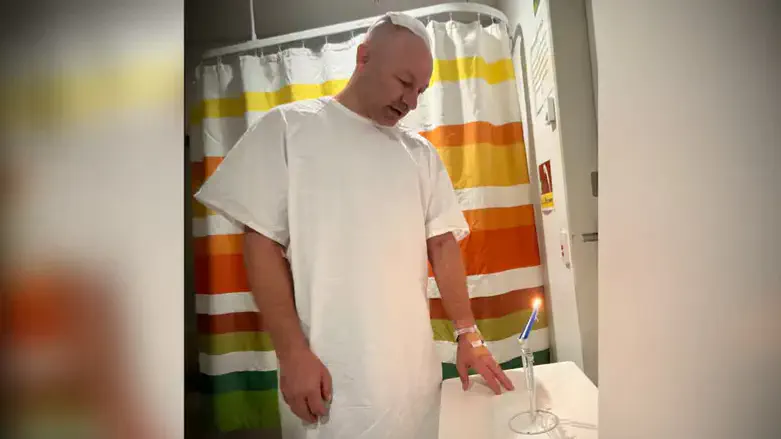
Arsen Ostrovsky, a survivor of the Bondi Beach shooting, spoke with Ilana Dayan on Galei Zahal about the attack. Ostrovsky is Chairman of the Australia-Israel & Jewish Affairs Council.
"It was a difference of millimeters between life and death. The bullet grazed my head, almost to the bone. The doctors said it was a miracle that I survived, and I used the moment to explain what a Hanukkah miracle really is," he recounted.
"It was a surreal experience. The horrors there were unimaginable. There was blood and bodies everywhere, and it immediately evoked images of the October 7th massacre, the Supernova festival in particular."
Arsen, who lived in Israel for thirteen years before moving to Australia to combat antisemitism, said that his first thought was of his family: "When it started, my wife and children had just gone to sit down. Initially, I thought it was balloons, but very quickly realized what it was. It went nonstop for fifteen minutes. I started by taking cover, but quickly realized that my wife and children weren't with me and started to run towards them instead."
"The shooting was still going on. I saw one of the terrorists with my own eyes, repeatedly reloading and firing from a bridge. Another one was firing from the other side, shooting from multiple directions, and from an elevated position. My wife and children were in the middle. I got up to rush towards them and got hit in the head. Blood started gushing, and I could almost feel my bone. I fell to the ground yelling, 'I'm hit,' but no one could help."
A nearby couple helped Arsen, with the man bandaging his head with a shirt. The photos of Arsen at the scene would later go viral as emblematic of the attack.
Arsen had told his children that the move to Australia would be very different from Israel. "I told them that Australia was a very different place from Israel, but I was wrong - the same forces of hate and evil will try to kill us here or in Israel. I did not expect that."
He denounced Australia's leadership as having ignored warning signs, noting, "The political leadership in Australia has failed on a wholesale level. For years, the Jewish community has been pleading with the government to listen to us." Despite the leadership failing, though, Arsen noted that what he saw from the people around him gave him hope as ordinary citizens risked their lives to help one another. He particularly praised Ahmed el-Ahmed, the Arab man who rushed one of the terrorists and seized his gun despite being wounded himself.