
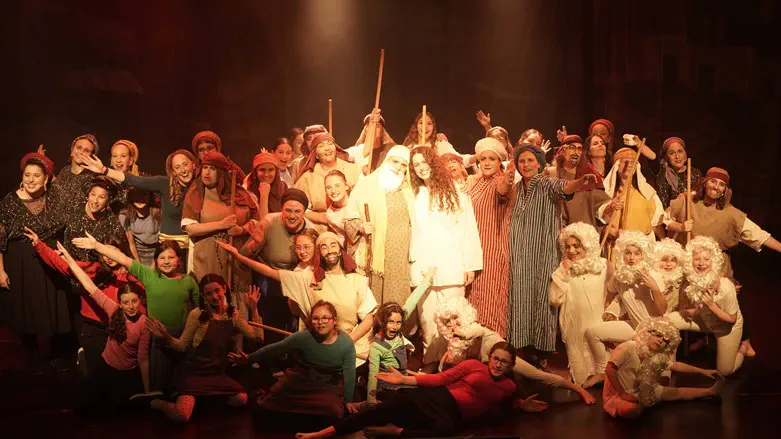
Yosef’s Unbreakable Spirit
The most surprising aspect of the sale of Yosef by his brothers at the tender age of seventeen is that he was not broken by the experience. To the contrary, he elevated himself in the home of his master, Potiphar, until he was in charge of all his operations. Subsequently, of course, Pharaoh appointed him as ruler over all of Egypt. The meteoric rise of Yosef was a result of his indomitable spirit and the protective guidance of Divine Providence.
Imprisonment and a Critical Misstep
As long as Yosef was confident and fully anchored in the proper Bitachon BaHashem (trust in G-d), he functioned smoothly. He did not view himself as a victim deserving of pity, but as a talented and dedicated worker who was a great asset to anyone’s enterprise. However, something changed during his imprisonment for the fictional accusation of rape by Potiphar’s wife.
An opportunity for release came when Pharaoh’s Chief Butler and Chief Baker each had similar perplexing dreams on the same night and were visibly disturbed in the morning. Yosef’s offer to interpret the dreams was accepted by the Butler, who then described his nocturnal vision to him. Yosef interpreted it to mean that in three days he would be exonerated and restored to his previous position in Pharaoh’s household.
After reassuring the Butler with his optimistic outlook, Yosef said,
“But if only you could remember me when all is well with you and do for me an act of Chesed (loving-kindness); and remember me to Pharaoh to remove me from this house. For I was stolen from the land of the Hebrews; and I did nothing here to warrant putting me in the hole.” (Bereishit 40:14-15)
Yosef quite understandably sought to leverage his favor with the Butler as a means of gaining his release from prison. And so,
“It was on the third day, Pharaoh’s birthday, that he made a party for all his servants… and he restored the Chief Butler over his beverages… And he hanged the Chief Baker, as Yosef had deciphered.” (Bereishit 40:20-22)
The Butler had to have been very satisfied, for it had all gone according to the prognostication he had received from the young Hebrew prisoner. But what about the request that this wrongfully incarcerated fellow had made? “The Chief Butler did not remember Yosef and he forgot him.” (Bereishit 40:23) So much for gratitude!
Rashi, Rabbi Chait, and the Nature of Trust
It appears that Yosef’s gambit to extricate himself from the dungeons failed simply because of the ingratitude of the Chief Butler. That was certainly a major factor, but an intriguing Rashi cites another element. He says that Yosef was wrong to place his trust in this Egyptian when he should have relied solely on Hashem.
At first glance, this Rashi is difficult to comprehend. That is because it is a fundamental doctrine of Judaism that one is not permitted to rely on miracles. Rather, we must do everything in our power to deal with our problems practically and then pray that Hashem will bring all our efforts to fruition. Yosef viewed the intercession of the Chief Butler with Pharaoh as a viable option to attain his parole, and he took it. Why did he deserve punishment for that?
HaRav Yisrael Chait (Rosh Yeshivah, Yeshivah Bnei Torah, Far Rockaway, New York) explained it in the following manner. Yosef had every right to do whatever he could to secure his freedom naturally. But in turning to the Chief Butler he displayed a certain desperation which prompted an excessive dependence on him.
In point of fact, his sense of emotional dependence caused him to act irrationally. This is because, in interpreting the dreams brilliantly, Yosef had built up a powerful image of himself in the mind of the Butler. At that point, the Butler must have been amazed at this brilliant and bold Jewish kid who was not afraid of taking the risk of telling these two important servants of Pharaoh what would happen to each of them in three days.
The Ramban (Nachmanides) points out that if he had been wrong about either of them, he could have been killed. Nevertheless, Yosef proceeded because he was Batuach BeChochmato (confident of his knowledge). But suddenly that confidence dissipated as he placed himself at the mercy of the Sar HaMashkim (Chief Butler).
Instead of being the independent and confident young man who had firmly told him, “Hashem has (dream) interpreters. Please tell it to me,” (Bereishit 40:8) he transformed himself into a victim who had been kidnapped from his father’s house and here too had done no crime but was falsely imprisoned. Suddenly the Butler did not look at Yosef in the same way. Instead of regarding him as a self-assured charismatic individual, he now saw him as weak and dependent, and he lost interest in him and forgot about him.
We may ask: If it was wrong to implore the Butler in that way, what should Yosef have said to him? Rabbi Chait explained that Yosef should have said nothing at all. The Butler would have then returned to the Palace and would have raved about this amazing kid he had encountered while in the dungeons. Thus, Yosef’s imploring of the Butler revealed certain flaws in his Emunah (faith), which had to be repaired, and that is why he had to remain in prison for another two years.
[Note: Actually the Butler did finally remember Yosef as we read in this week’s Parsha, Miketz. When Pharaoh had his strange dreams and there was no one who could adequately interpret their meaning, the Butler “suddenly” remembered the Jewish kid who had been so prescient regarding his own dreams two years ago. Thus, the Butler finally did remember Yosef, but that was only when he deemed it to be in his own interests to do so. That is the nature of those who lack true HaKarat HaTov (appreciation of the good someone has done for us).]
The story of Yosef’s encounter with the Chief Butler contains many relevant lessons. Sometimes we feel very desperate, and this can cause us to act in a self-defeating manner. We must always be careful and measured in what we say and do, and remain fully cognizant of the image of ourselves that we are leaving in the minds of those who observe us.
As religious Jews especially, we must be very careful in how we behave in the public sphere where others will be judging us and will form an opinion about the moral value of Judaism based on what they see. Certain public behaviors by members of various religious sects may convey a very negative impression about the spiritual value of Torah Judaism, and this constitutes a serious failure to sanctify the Name of Hashem in the eyes of people.
Faith in Hashem, Not in Man
We also learn from this story not to ever put our faith in man. HaGaon Rav Yosef Dov Soloveitchik, zt”l said that American Jews put their faith in President Franklin Delano Roosevelt during the years of the Holocaust and therefore did not pressure him enough to take measures to rescue Hitler’s victims. They believed in the ultimate goodness of F.D.R.
He explained that sometimes people are worthy of our trust but never of our faith. That is something that we must reserve exclusively and indivisibly for HaKadosh Baruch Hu (The Holy One, Blessed is He).
Shabbat Shalom VeChanuka Sameiach.
Questions? Comments?
Please reach out to Rabbi Mann on WhatsApp at 050-709-2372 or by email at rebmann21@aol.com.
Alternatively, contact Mitch Rosner on WhatsApp at 054-426-3419 or by email at mitchrosner@gmail.com.