
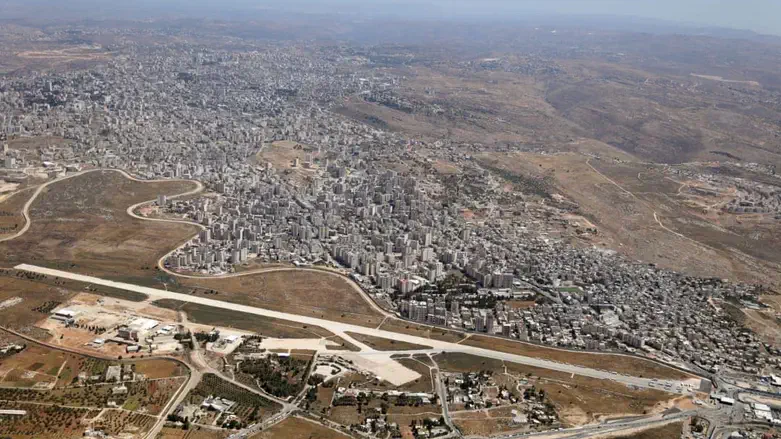
Today (Wednesday), the Jerusalem District Planning and Building Committee is scheduled to convene to decide on one of the largest and most strategic new neighborhoods ever to be built in the Holy City.
The plans to build up Atarot, in north-northwestern Jerusalem, call for no fewer than 9,000 housing units for over 30,000 residents - though it is likely to reach 50,000. By way of comparison, Har Homa in southern Jerusalem initially began with only 2,500 housing units. Har Homa's approval by the Netanyahu government in 1997 was seen as a controversial but brave move to secure "the southern gateway to Jerusalem" (in Netanyahu's words); the neighborhood now has a total of 25,000 residents.
Along those lines, Atarot can be called "the northern gateway to Jerusalem," and the need to secure it as such is equally acute. Just this past week, a security incident occurred there, involving the wounding of an Arab infiltrator. But of course, this is merely the shadow of an inkling of the threat posed by the tens of thousands of Arabs living in areas surrounding Atarot.
The area was long home to a British airport built just over a century ago. After the Six Day War in 1967, Israel decided to incorporate it into the municipal borders of Jerusalem - but then was compelled to close it in the face of the violence of the Second Intifada (2000) and the densely-populated Arab areas surrounding it. However, its lone runway is still there, and in fact, the new neighborhood - a sizable town, actually - is set to be built along its northwest-southeast footprint, on an area of over 300 acres, or 1.24 square kilometers.
Designed to be a haredi or largely-haredi community, its plan was originally submitted in 2021. The Chief Municipal Engineer at the time wrote that the area, though directly north of the Atarot industrial zone, is detached from the city at large, and would have to be planned accordingly. This is still true, as Atarot is separated from the northern Jewish neighborhood of N'vei Yaakov by the Arab neighborhood of A-Ram, and from the Yesha town of Kokhav Yaakov/Tel Tzion by Kafr Akeb. For this reason, the 2001 plan also included a tunnel road to Atarot under Kafr Akeb from Kokhav Yaakov. Today, however, the tunnel may not be necessary, as the upgraded east-west Route 45 will connect Atarot with both Yesha and central Israel.
In any event, the original plan was abruptly shelved due to American pressure, under George Bush-the-son's administration.
Instead, to the consternation of advocates of Jewish settlement throughout the Land of Israel, other plans began to take shape - such as a major initiative to restore Atarot as an industrial bio-tech and hi-tech park. In 2015, a state-of-the-art waste recycling plant for the 1,300 tons of garbage collected daily in Jerusalem opened as Israel's first recycling center for household waste. Just this past summer, a new energy recovery and/or construction waste recycling plant was opened in Atarot by the famous Israeli entrepreneur Rami Levy.
If, however, today's Zoning Committee meeting goes as hoped, Atarot will once again be classified as home for tens of thousands of Jews. Atarot is, in fact, a critically strategic area in the struggle to ensure that united Jerusalem remains under Israeli sovereignty. Mentioned first in the Bible in the Book of Joshua, Atarot was resettled in modern times in the 1910s. Its pioneers had their fair share of difficulties, however, and after just three years, they had no choice but to give up and leave.
In late 1919, another group of hardy Jewish farmers tried again, under harsh conditions that included a lack of water, rock-filled fields, eight years of temporary housing, and the confiscation of large areas by the British construction of the above-mentioned airport. Still, Atarot gradually began to prosper, until suffering a devastating blow in March 1948: Arabs ambushed a small convoy carrying supplies and soldiers, and brutally murdered 14 Jews. A month later, just before the War of Independence, Atarot was hurriedly evacuated and abandoned.
It remained in ruins for 19 years, until Israel liberated the area in the Six-Day War of 1967 - and remained uninhabited since then. Instead, in 1970, Israel built the successful Atarot Industrial Zone, including no fewer than 350 factories, plants and businesses, employing in its heyday up to 3,500 Jews and 3,000 Arabs from Judea and Samaria.
Industry is No Substitute for Settlement
However, an industrial zone, no matter how successful, cannot serve the same purpose as Jewish homes - and thus the importance of this month's Zoning Committee session. An Israeli industrial zone in Atarot can simply not dyke the ever-present threat of the division of Jerusalem - i.e., a Palestinian state - nearly as effectively as 9,000 Jewish housing units there can. An industrial zone can always keep operating even under PA sovereignty, if the negotiators are sufficiently imaginative. But the presence of nearly a myriad Jews living in Atarot will be an insurmountable obstacle to those who would seek to create a PA state there.
The claims made by opponents of the current Atarot plan reveal that their interests actually lie in the formation of conditions that would enable a Palestinian state. Spokesmen for the "Bimkom Planning and Human Rights" Association bemoan the use of the land solely for Jewish settlement and not to improve the living conditions of the Arab populace in the vicinity - as if the latter has preference. They acknowledge that the motivation for constructing Atarot is partly to "rush to create facts on the ground" - i.e., to prevent Arab growth that would impede Jewish access to Jerusalem from the north and facilitate the formation of an Arab Palestinian state.
In the current version of the plan, the planners included appendices on the topics of development and socio-economics - and these are expected to help enable the plan's approval. That is, the planners foresee the dedication of a large area for employment, and thus an increase in municipal income that can then be used for the benefit of services provided to the public. Other areas are to be used for general municipal and regional purposes, such as storage and logistical spaces.
Jerusalem Grows - Historically and Sensibly
There is no doubt that the meteoric growth of Jerusalem over the past 50 years is of great historic, even Biblical, significance - but it is clearly also a very down-to-earth process: Planning, zoning, construction, job creation, the building of schools, synagogues, parks and much more all come together to create yet another stage in the "liberation" of Jerusalem and its unification under Israeli sovereignty.