
Ruthie Blum, a former adviser at the office of Israeli Prime Minister Benjamin Netanyahu, is an award-winning columnist and a senior contributing editor at JNS. Co-host with Ambassador Mark Regev of the JNS-TV podcast “Israel Undiplomatic,” she writes on Israeli politics and U.S.-Israel relations. Originally from New York, she moved to Israel in 1977. She is a regular guest on national and international media outlets, including Fox, Sky News, i24News, Scripps, ILTV, WION and Newsmax.
(JNS) Former Israel Security Agency (ISA) director Ronen Bar has some nerve. A mere two years after presiding over the worst intelligence and security collapse in Israel’s history-and far less than that refusing to resign or be ousted-he’s lecturing the rest of us on accountability. With an emphasis on the current government, of course.
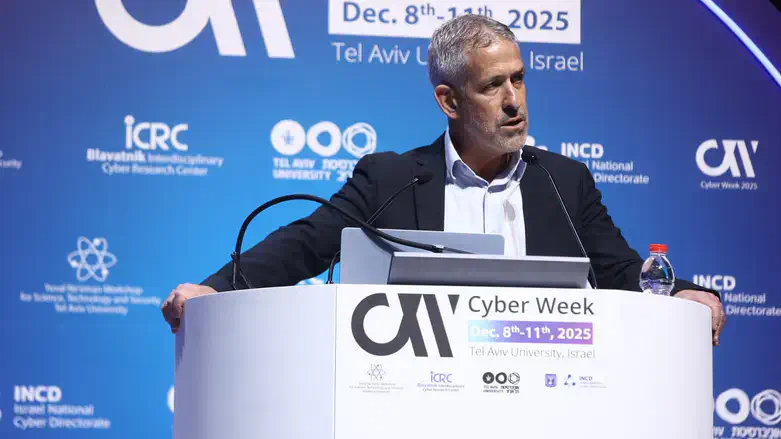
In his address this week at Tel Aviv University’s CyberWeek 2025 conference, Bar pontificated: “Responsibility is infinite; you cannot distribute it, only take it. And in leadership, it is better to take responsibility for failures than credit for achievements.”
He then asserted, with air of moral superiority, that the “only way to conduct a comprehensive investigation into this failure [to anticipate and prevent the events of Oct. 7, 2023]-to know what really happened, to dispel the conspiracies that endanger our continued existence, to learn what to fix and to ensure that it does not happen again-is through a state commission of inquiry.”
These were indirect, though obvious, jabs at Israeli Prime Minister Benjamin Netanyahu, whose government decided last month to establish an independent commission to probe the Oct. 7 disaster with “as broad a public consensus as possible.”
Bar’s loud support for a state commission is no coincidence. Its members would be selected and overseen by Yitzhak Amit, self-appointed president of the Supreme Court-the very institution that, along with swaths of the security and political establishment, shared the delusional conceptzia that helped pave the way to Oct. 7.
It’s unfathomable that the court would scrutinize its own role in the catastrophe, or that it would flag Bar as a key culprit among many. No, entrusting the investigation to the almighty bench would be tantamount to preserving the old order. In other words, it would be a “deep state” commission of inquiry.
Back to Bar.
He’s the same ISA chief who, at the 2022 annual World Summit on Counter-Terrorism at Reichman University in Herzliya, bemoaned that [Israel’s] political instability and growing [societal] schism constitute an injection of encouragement to the axis-of-evil countries, terrorist organizations and lone wolves.”
Rather than focusing on the expertise that landed him the coveted job, he summoned his inner social worker. “Our historical comparative advantage-the one that was to our credit for thousands of years-is fading away,” he said, adding that the ISA “can warn about but not treat it. [That’s] up to each and every one of us.”
Consider what that meant in practice: that Israel’s external threats were less dangerous than its internal malaise. With his flashlight pointing in the wrong direction, it’s no wonder that he missed Hamas’s long-planned invasion and didn’t even phone the defense minister or Netanyahu when it began.
To make matters worse, he practiced the opposite of what he now preaches. He paid lip service to his “responsibility,” yet didn’t step down. Furthermore, when Netanyahu finally moved to fire him (a lawful prerogative of the prime minister), he initially refused to go-with backing from the Supreme Court, that is, which blocked his removal. Only later did he “voluntarily” depart, but not with humility, heaven forbid. Or contrition. Certainly not with grace.
His chutzpah, thus, doesn’t come as a surprise. Still, his hypocrisy warrants highlighting.
Yes, he is the last person who has the right to sermonize about accountability and leadership. Since hanging his head in shame is out of the question for the complacent has-been, at the very least, he could have considered keeping a low profile.