
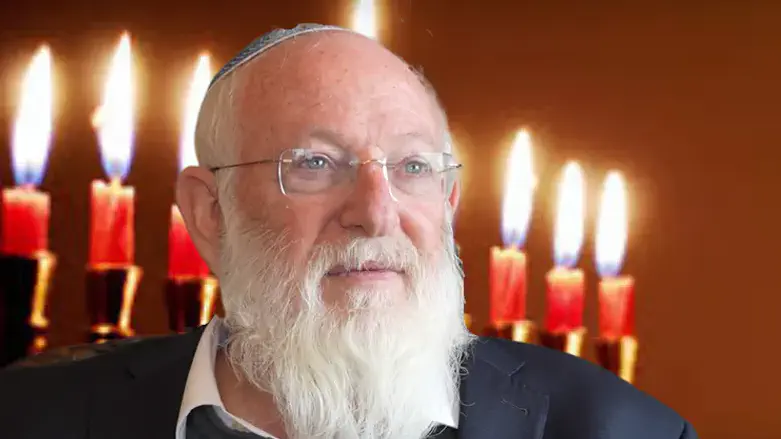
Rabbi Samson has founded several innovative yeshiva high schools in Israel for “youth at risk.” He has published several commentaries on the teachings of Rabbi Kook including the recent “Torat Eretz Yisrael Anthology.” In addition, he writes and lectures about Jewish Meditation according to the Kabbalistic system of Rabbi Avraham Abulafia.
Question:
Once again, Israel is talking about new elections. It seems to me that the instability of Israeli governments results from the plethora of small parties that Prime Ministers need to court in order to stay in power. Wouldn’t the country run more effectively if it had a two-party system like in America?
Answer:
The country would run more effectively if the Kingship of David were re-established, with the coming of the Mashiach, may it be soon.=
Since Hanukkah is approaching, perhaps we will answer your question with a little something about the “Holiday of Lights.”
In an essay about Hanukkah, Rabbi Kook offers a profound understanding of the purpose of plurality [Olat Re’iyah, Part One, p. 435]. The sages during the time of the Hasmonean decreed that the blessing “to light the Hanukkah light” be recited, in the singular, rather than in the plural. Since many lights are lit during the eight days of the holiday, why don’t we say Hankukah “lights?”
Rabbi Kook answers that a multitude of lights must shine in the nation, such as the lights of Torah, of prophecy, of wisdom, of justice, military valor, joy, kindness, and love. In truth, he explains, all of these lights are one, emanating from the same Divine Source. However, until Israel reaches its exalted goal of revealing this Divine Unity in the world, all of these lights seem to be separate. In fact, during the process of cohesion, as the scattered nation returns home from exile, the lights must remain apart to prevent each individual flame from becoming engulfed by the others.
“Often, this separation causes conflict,” writes Rabbi Kook. “An individual believes that if someone else is drawn to a light different from his, then the power of his light is diminished. However, as each individual strives to strengthen and enhance the light he favors, the overall light of the nation is increased and the nation is greatly fortified.”
Diversity and competition help build the nation and bring out all of its dormant talents. Yet this period of multiplicity will not extend forever, Rabbi Kook assures us. For when the parts of the whole exist in antagonism, holiness and Divine Unity cannot be firmly established in the world. Just as the prayer for peace is the culmination of the Amidah prayer, encompassing all of the other blessings, so too the wholeness and harmony of our nation is our ultimate aspiration.
“Peace will prevail in the future,” Rabbi Kook concludes, “when people come to recognize clearly that all of the different, individual lights are truly one single light. Therefore the Hanukkah blessing, which is directed toward the distant and exalted future, is not Hanukkah lights, but rather Hanukah light.”
The same is true with the different Jewish political parties in Israel. They represent the broad spectrum of aspirations and beliefs found in the nation. A two-party system would prevent other important national lights from growing. If there were only the Labor Party and the Likud, who would guard the interests of Torah? Who would fight for the wholeness of Eretz Yisrael?
If Yehuda the Maccabee, the hero of Hanukkah, were around today, it is unlikely that he would be a member of the Labor Party or even the Likud. Instead, he would be the leader of a religious party whose platform championed Torah and the Land of Israel for the Jews!