

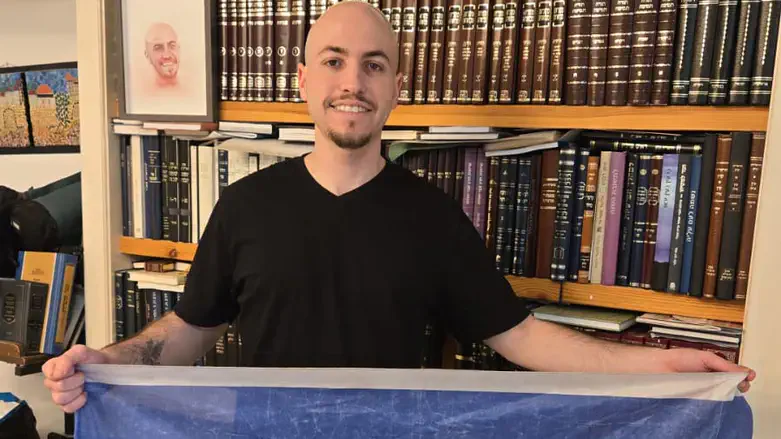
After two years in Hamas captivity, in an interview with Makor Rishon, Eitan Mor recounts his abduction, the severe starvation in the tunnels, and the Hanukkah songs in captivity.
Mor relived the moments of his abduction: "We saw a ton of Gazans coming in groups, with knives. 'Non-combatants' who decided to join the combat. We hid there. Some wanted to go back in the direction of the party, but I told them not to. We saw fires from there, we heard shooting. I told Rom Braslavski, who was also abducted, that I saw the bodies of girls and I wanted to evacuate them. Some were already half undressed, and I didn't know what else they would do to them. The two of us went and began to carry the body of Shira Ayalon OBM. I asked two others to come help, and we put her in an alcove. Then we came to take another girl, who underwent severe violence, but we didn't get to. I sent a message to Elyakir (Elyakim Libman OBM): 'Where are you?' He answered that he was in the tent with the wounded. That was the last message that I got from him. I told Rom that I was going to look for him. I went back to the festival site, and he came with me. I told him that if we see terrorists, we should run as fast as possible."
The scenes he saw continued to be shocking: "On the way, we saw two people who were dying, and there was no way to help them. We couldn't do anything. Suddenly, three terrorists in vests approach us and yell at us in Arabic to stop. They were 30 meters away. We began running, and the truth is that I have no idea how I stayed alive. They shot at us, and the bullets whizzed by my head. We saw security ATVs, and Rom asked if we could start them. I told him that we wouldn't have time, and it's better to keep running. We managed to fell them, but later the 'non-combatants' caught us."
"Five people caught Rom and brought him down to the ground; two people got me. One left and went to Rom, and I managed to push the second one. I punched him and continued to run. There was a small ditch in the ground with brush, and I jumped in. But then eight 'non-combatants' caught me, some of them were children, maybe 3rd graders. They had knives, saws, and hammers. Everyone together beat me with everything they had. They held a knife to me. I was certain that I was going to die right then. Then the largest one said in English: 'Either you die now, or you come with us to Gaza.' I said 'Gaza,'"
While in captivity, Eitan's mood would fluctuate between hope and despair. "At the beginning, I was more optimistic. As time went by, I understood that Hamas wasn't giving up, and neither was the government. I understood that the best thing to make things easier was to just accept that I would die in Gaza. I would either die or return after many years. This acceptance helped me live the moment. That, and saying thanks every night that I survived another day. I forgot about Israel already. I would sometimes think about my parents, my family, my dog, my friends, but it was a very distant dream."
Recounting the starvation in captivity, he said: "You tell yourself, 'Think about your family,' but your brain only thinks about food. You try to think about your grandmother, but somehow your thoughts travel to her meatballs. Their taste. And despite all this, we made sure to say thank you every night. Thanks for everything that happened that day. Thanks that the pita that we got didn't have sand on it. Thanks for the coffee pot that they gave us. Even though it's bad and I'm hungry, even though I lost 15 kilograms, I said thank you every day for what there is. Because we thought about the bereaved families and the wounded. Thanks that our body is whole, maybe not our full weight, but we are still alive."