
Stephen M. Flatow is President of the Religious Zionists of America (RZA.) He is the father of Alisa Flatow, who was murdered in an Iranian-sponsored Palestinian terrorist attack in 1995 and the author of A Father’s Story: My Fight for Justice Against Iranian Terror now available in an expanded paperback edition on Amazon. Note: The RZA is not affiliated with any American or Israeli political party.
In recent weeks, two American states have said out loud what many in the Middle East have known for nearly a century.
Texas Governor Greg Abbott and Florida Governor Ron DeSantis signed orders designating the Muslim Brotherhood-and the Council on American-Islamic Relations (CAIR)-as terrorist and transnational criminal organizations under their state laws. Lawyers objected that only Washington can designate a foreign terrorist organization, and CAIR has gone to court. The media filed it under “culture war” and moved on.
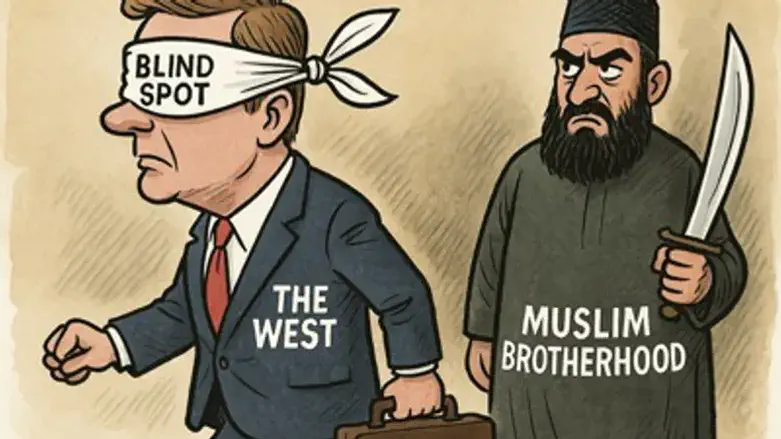
For Israelis-and for anyone who watched Hamas’s atrocities on October 7-the real question is different: Who is the Muslim Brotherhood, and why are so many Western elites still pretending it is moderate?
The Muslim Brotherhood was founded in Egypt in 1928 by Hassan al-Banna. From the start, its goal was not “reform” but Islamic rule: societies governed by its interpretation of Sharia law and, ultimately, a wider Islamic caliphate. Over the decades, it built branches in dozens of countries and spawned thinkers, especially Sayyid Qutb, who supplied the ideology later used by jihadist groups: the West as decadent, Jews as enemies, and violence as a legitimate tool.
Several Arab governments, having watched the Brotherhood destabilize their own societies, now classify it as a terrorist organization.
If you want to understand Hamas, you don’t start in Gaza in 1987. You start with the Palestinian Arab branch of the Muslim Brotherhood. Hamas emerged out of that network at the start of the First Intifada. Its ideology blends Palestinian Arab nationalism with the Brotherhood’s Islamist program: “resistance” framed as jihad, “liberation” defined as the eradication of the Jewish state. Its original charter did not call for an end to “occupation.” It called for Israel’s destruction as a religious duty and trafficked in antisemitic conspiracy theories.
That is not a bug in the Muslim Brotherhood worldview; it is a feature.
In the West, the Brotherhood is often described through its charities, schools and political parties. But beneath that respectable surface is a transnational movement whose affiliates and offshoots include organizations that are officially designated terrorist groups-Hamas among them. This is its dual strategy: a political face that talks about “democracy” and “rights” when it suits its interests, and an ideological core that never abandoned the goal of Islamic rule and the rejection of Jewish sovereignty.
Nor is this just a Middle Eastern story. The Brotherhood’s networks reached Europe and North America decades ago through student associations, mosque leadership and advocacy groups.
Now back to Texas and Florida. Under U.S. law, only the federal government can formally list a “Foreign Terrorist Organization.” Neither the Muslim Brotherhood nor CAIR is on that federal list, so the state designations operate in a legal gray area. But the orders bar these organizations from receiving state contracts, funds or other benefits, and in Texas’s case, from purchasing land. More importantly, they force a long-delayed conversation:
Is the Muslim Brotherhood a legitimate “civil society” actor-or a hostile ideological movement that produces groups like Hamas and works to soften Western resistance to them?
Brotherhood-linked organizations insist they are simply defending civil rights. They call the designations defamatory and Islamophobic and promise to sue. They have every right to go to court. But courts or no courts, the underlying question will not go away: Should a democracy treat a movement dedicated to undoing that democracy as just another stakeholder?
We should care because the ideas incubated by the Muslim Brotherhood do not stop at Rafah or Cairo. They shape the preachers justifying murder, and, increasingly, the activists and academics in Western capitals who portray that violence as “resistance.” Some of the same networks that give ideological cover to Hamas also help frame the story on American campuses and in the media. They push narratives in which Israel is always the aggressor, Jews are colonial interlopers, and any criticism of Islamism is bigotry.
Israel has seen the Brotherhood’s worldview in action through Hamas’s suicide bombings, rocket fire and massacres. The real question is whether Western democracies will continue pretending there is a bright line between that worldview and the institutions that promote it in their own backyard.
Many Muslims are victims of this ideology long before a Jew is. That is precisely why clarity matters. You cannot defeat an enemy you refuse to name. Texas and Florida, whatever their legal limitations, have said the quiet part out loud: the Muslim Brotherhood is not a misunderstood “social movement.” It is the ideological mothership of some of the most dangerous anti-Jewish and anti-Western groups on earth.
Israelis learned that the hard way. Maybe the rest of the West is beginning to notice.