

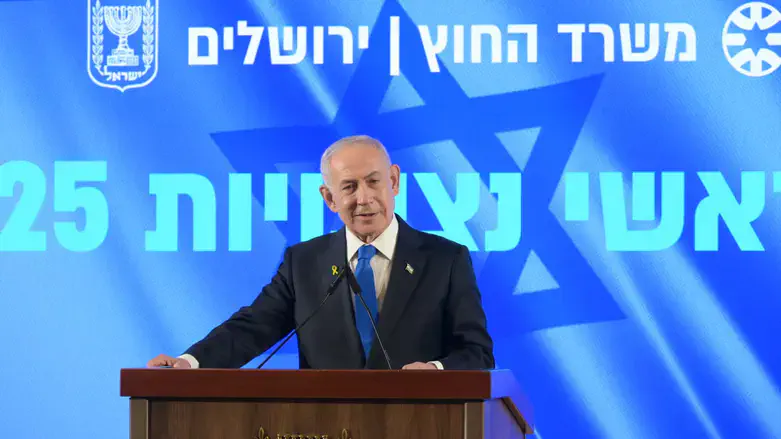
Prime Minister Benjamin Netanyahu addressed ambassadors and legation heads in Jerusalem on Sunday, outlining Israel's expanding military capabilities, strategic partnerships, and ongoing regional challenges.
Speaking at the Foreign Affairs Ministry Conference, Netanyahu said Israel had proven itself "not just a very powerful country, but an exceptionally powerful country," and emphasized the need to continue strengthening military and security resources. He noted efforts to expand domestic armaments production, stressing the importance of independence alongside international alliances.
Netanyahu underscored the central role of the United States, calling it Israel's "strongest and most important alliance," while acknowledging interest from other nations seeking closer cooperation. According to the Prime Minister, countries across the world are approaching Israel with security-related requests, pointing to growing international recognition of Israeli capabilities.
He also addressed the ongoing public diplomacy efforts, urging representatives abroad to continue countering hostile narratives and strengthening Israel's position in global opinion.
Turning to Gaza, Netanyahu said the second stage of operations focuses on demilitarization and disarmament. He referenced US efforts to assemble a multinational task force, welcoming the initiative while noting that certain responsibilities may exceed the force's capabilities. Netanyahu added that he would discuss the matter further with President Trump at the end of the month.
The Prime Minister pointed to normalization efforts as one of Israel's significant strategic opportunities, cautioning that public discourse does not always reflect the realities behind the scenes. Drawing on the example of the Abraham Accords, he argued that progress can be achieved despite external skepticism.
Netanyahu highlighted ongoing activity on multiple fronts, including Lebanon, Gaza, and against the Houthis, noting that Israel no longer maintains a policy of containment but acts directly against emerging threats.
He urged diplomats to emphasize justice when engaging with the public, describing Israel's struggle as part of a global fight "of the civilized world" against "barbarians" threatening regional and international stability.
Netanyahu concluded by pointing to the unity shown by Israelis during times of crisis, saying national resilience remains key to Israel's future. Consolidating strength, he said, would enable the country to secure its place for decades to come, adding that he expects "very good things" to emerge in the years ahead.