
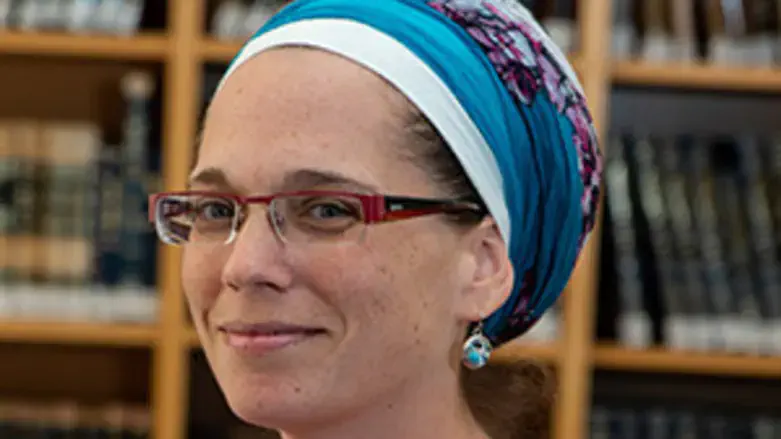
Adina Ellis is a graduate of the Matan Bellows Eshkolot Educators Institute. She has been teaching Tanakh and machshava over the last two decades, initially on college campuses and in Hebrew Schools in the New Jersey area. Since making aliyah in 2005, she has given weekly shiurim in Hebrew and English to women in her community. Adina has taught in the ALIT program and Rosh Chodesh seminars run by the OU Women's Initiative as well as in the mother-daughter "learn and art" program of OU Israel. She is known for her unique ability to facilitate in-depth textual learning along with engaging and relevant discussions. Adina lives with her husband and children in Yad Binyamin.
Joseph Campbell teaches that every great story begins in the ordinary world. Yosef the son of Yaakov started life as a beloved child in Canaan, favored by his father but shunned by his older brothers. He did not set out to be a hero.
But the Torah tells us that even in youth, he sensed there would be a spotlight on him, he dreamt that he would be singled out, of elevated stature over his family: “Behold, my sheaf arose and stood upright, your sheaves gathered and bowed down to my sheaf” (Bereishit 37:7) and “the sun, moon and eleven stars were bowing down to me (Bereishit 37:9). Joseph Campbell, in The Hero with a Thousand Faces, writes that “the standard path of the mythological adventure… begins with the call to adventure” (p. 23). Yosef’s dreams were that call-a whisper that life would demand more of him than he could yet understand.
The call to become a hero almost always leads first into darkness. Yosef’s brothers cast him into a pit, and the Torah spares no detail: “The pit was empty; there was no water in it” (Bereishit 37:24). Campbell teaches that every hero must pass through a moment of deep isolation: “No one can help the hero through the ordeal of the abyss. He must face it alone” (pp. 83-84). Yosef knew this solitude intimately-not just once, but again and again: in the pit, in Potiphar’s house, in the prison. These were the crucibles that refined him, where his moral courage was tested and ultimately helped form him into the great person he became.
The Chashmonaim, heroes of the Hanukkah story, walked a different path but followed the same inner pattern. They, too, began in the ordinary world-priests serving quietly in the Temple. Their “call to adventure” was the desecration of the Mikdash and the cultural pressure to abandon Torah. Like Yosef, they could have refused the call. They could have kept their heads down. But they chose courage. Campbell teaches: “The hero is the one who has been able to battle past his personal and local limitations” (Power of Myth, p. 151).
The Maccabees fought not only a mighty empire but the despair and fear within themselves. Their heroism lay in rising above comfort to fight for what mattered most. Both Yosef and the Hanukkah heroes believed that individuals could make a difference and they acted with God’s name on their lips.
Both Yosef and the Chashmonaim embody a distinctly Jewish form of the hero’s journey: the belief that God is present in every chapter of our lives, even in the challenges we did not ask for. When Yosef finally reveals himself to his brothers, he offers one of the most healing statements in the entire Torah: “You intended me harm, but God intended it for good” (Bereishit 50:20). This is the voice of someone who has greatly evolved from a victim mindset and sees purpose in his journey and Hashem as his partner.
Lori Gottlieb, psychotherapist and author, encourages individuals to grapple with their inner narrative, empowering individuals to let go of outdated identities or roles and make space for a braver more authentic self. This is what Yosef did. He was no longer the bullied younger brother, ostracized and humiliated. Yosef chose to transform his identity through a profound spiritual process, undergoing a personal transformation which led him to be the hero of Egypt and save his own family as well.
The Maccabees, too, saw their victory not as personal triumph but as Divine partnership. When they rallied the troops in the spirit of Moshe Rabbenu, perhaps echoing his cry after the sin of the golden calf: “whoever is for Hashem, come here!” And all the men of Levi rallied to him (Shemot 32:26), they saw themselves as fulfilling a much greater destiny than living their lives as individuals.
The truth is that every human being is invited into a hero’s journey, maybe not quite as dramatic as Yosef’s or the Maccabees,’ but equally holy.
The daily decisions to stay kind, to rise after disappointment, to repair relationships, to stand for truth, to build a Jewish home-all of these are thresholds we cross. We may not always feel ready. Campbell reminds us: “Where you stumble, there lies your treasure.” Our stumbles are not proof that we are unworthy of heroism; they are the very places where God waits for us to grow.
As we move towards Hanukkah and we read the story of Yosef in the parasha and retell the miraculous military and spiritual victories, there is a shared message: your life is not random. Your trials are not meaningless. Your choices matter. You, too, have a pit to climb out of, a darkness to transform, a light to ignite. There will be many enemies, many of them the stories in your head.
When you choose to be brave, God partners with you. And like Yosef in Egypt and the Maccabees in the time of the Temple, you have everything it takes to become the hero of your journey.