
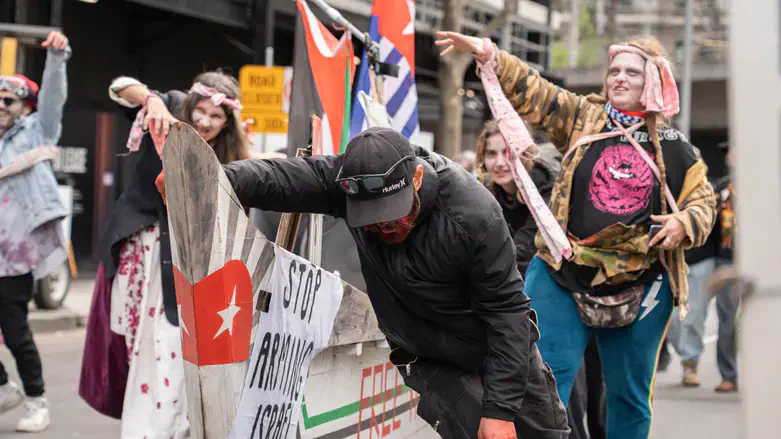
In May 2024, I wrote an opinion piece in this newspaper in my capacity as chancellor of Western Sydney University about the rise of antisemitism.
I did this as protests and encampments raged across our universities, driven in many cases by profound hatred and antisemitism. As Jewish students and academics felt increasingly afraid to step on to a university campus, I felt the need to speak out.
I needed to remind people that universities must be places of enlightenment and knowledge, that universities are places where there is a contest of ideas, and they can never be places of fear and intimidation. That free speech is a profoundly different concept to hate speech, and that hate speech and antisemitism or any other form of racism has no place in Australian universities or society.
I wasn’t sure what impact my opinion piece would have, if any. But by that afternoon I had received hundreds of emails and many, many text messages. These were messages of support, of sadness, of fear and of hope.
They were messages from across the nation, from grandparents, from parents, from community and political leaders and, sadly, from very frightened students from other universities. At the end of the day I still don’t know if it made a difference but the reaction was remarkable.
In turn, my university, led magnificently by Professor George Williams and his leadership team, took the following actions. We stopped protests where people engaged in antisemitic chants and used antisemitic placards. We made it clear to anyone wanting to protest that we would not tolerate antisemitism - and we did not.
We acted on proven complaints of antisemitism. We suspended students and took disciplinary action against staff. We strengthened our policies about all forms of hatred and racism, and we acted quickly to make our campuses safe.
Many people have asked me: “Why did you do this?” First, I could not believe what was happening in our country, as I watched our social fabric dangerously unravelling. I watched the unleashing of an ancient and, to me, incomprehensible hatred of Jewish people.
I was so distressed by the celebration, in some quarters, of the torture and murder of over 1200 Jewish people in Israel; the greatest loss of Jewish life since the Holocaust. I saw this up close and personal on October 9 in the Domain in Sydney. I was walking with my grandson who, by the way, is an Afghan asylum-seeker.
The hatred in that crowd was visceral. People with children in strollers holding antisemitic placards. But the sense of celebration of this loss of life shook me to the core. Over the next few months I watched people use the actions of nation-states to justify antisemitic and racist attacks.
What context warrants placards calling for the murder of Jews? I watched institutions hiding behind free speech to avoid taking action against antisemitism. I was bewildered by the national pile-on against Jewish people by sections of the community who themselves experience hatred, ostracisation, intimidation and discrimination. Communities Jewish people have defended and supported for a very long time. And I was rattled by the escalation of violence designed to silence, designed to engender fear.
My second reason is one of leadership. Leadership for me is a collective dynamic, but leaders have two fundamental responsibilities. To act for positive purpose, driven by positive values. And to act with moral clarity and consistency.
Sadly, what unfolded in Australia was a failure of collective leadership. With notable exceptions, we failed to urgently align and drive a whole-of-nation rejection of antisemitic actions.
My third reason was my own journey. One of a belated understanding and insight into the deep-seated nature of antisemitism and the scale and horror of the Holocaust.
I won’t go into detail about my early life, but it was characterised by disadvantage, by moments of family dysfunction and by sporadic but often severe violence. So, as a young person, I had a lingering sense of anxiety and fear. I remember seeing an image when my parents were watching TV. This showed two people in striped prison clothing, hanging by their necks in a street somewhere. I have never been able to shake off the image of their faces.
I must have been very distressed because my father said something to me like: “Don’t worry, that only happens to the Jews.” My father was many things but, most profoundly, an antisemite.
All my life I have questioned my own morality of not challenging his views. But I was a child. My fear and my own lack of understanding meant that even as I got older, I was afraid to or incapable of saying anything.
Tragically, it is now evident to me that his views were and still are, in some sections of our society, commonplace. As I went to university and began to understand the absolute horror of the Holocaust, when I met and befriended Jewish people whose lives were destroyed by it, my sense of disappointment in my own lack of action in my family has stayed with me.
And then I went to the Holocaust Museum in Jerusalem and to Wannsee in Berlin. These were life-changing experiences. When I saw the list of attendees at the Wannsee Conference I was shocked to see that educated people sat around that table.
Ten had university educations, eight held academic doctorates and eight were lawyers.
These were people in positions of authority, in positions of trust, who sanctioned the most wicked, the most purposeful, industrialised slaughter of the Jewish people.
So for all these reasons, I decided that day to act. To do something in my own small way. Over my lifetime I have been active on many issues. Justice and equality, mental health, Indigenous issues, LGBTQ advocacy and the struggle against insecure housing and homelessness.
I have also had the privilege of occupying many leadership positions. So as I saw the events unfold after October 7 in my sector, the sector that I was meant to lead, I knew it was my responsibility to do something. But speaking out and taking action in my own sector was not enough. So when Josh Frydenberg asked me to join The Dor Foundation, as one of the guardians, I did not hesitate to say Yes. The Dor Foundation is the Hebrew word for generation, and our aim is to make generational change.
Nothing short of our social cohesion is at stake. You see, when you unleash one kind of hatred, you open the door for many others. When I see the rise of extremism dressed up as national security. When I see our national institutions being used to ridicule and humiliate people for their religious beliefs. And when I see the rise of authoritarianism around the world and calls for the adoption of the principles of authoritarianism in my country, I know this - they are attacks on our way of life. They are an attack on every Australian.
It is time to reflect on what kind of society we want to be. Australians are overwhelmingly decent people. Australia is overwhelmingly a decent country. Australians believe in fairness and freedom. But we can only harness these values if we act together.
It is our collective responsibility to attack antisemitism at its roots and to act with unity.
Reposted from The Australian.