

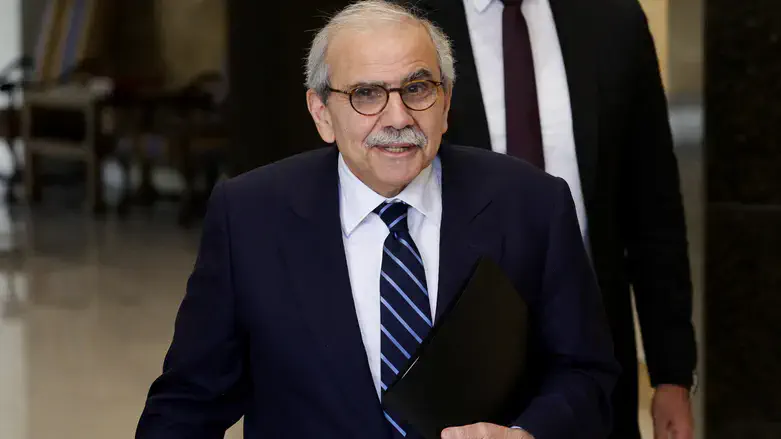
Lebanese Prime Minister Nawaf Salam addressed recent developments surrounding the monitoring mechanism committee for the ceasefire between Israel and Lebanon, telling Al Jazeera that the decision to add a former Lebanese diplomat to the delegation is "politically protected and enjoys a national umbrella." He also stressed that Israel has "gone too far" in portraying the move as a step toward normalization, underscoring that Lebanon is not entering peace negotiations with Israel.
His remarks came ahead of Wednesday's meeting in Naqoura, where the committee will convene with civilian representatives from Israel and Lebanon for the first time. Until now, sessions were attended only by military officials.
The Israeli delegation will be led by Dr. Uri Resnick of the National Security Council, while the Lebanese team will be headed by attorney Simon Karam, a former Ambassador of Lebanon to the United States. The discussions are expected to focus on advancing civilian-economic dialogue in the presence of international representatives.
According to diplomatic sources, this phase of the talks is intended to "allow the actual advancement of the discussions and to convey the appearance of a normalization process." The move followed pressure from US Deputy Special Envoy to the Middle East, Morgan Ortagus on Beirut to include civilian figures.
Prime Minister Benjamin Netanyahu's office confirmed the meeting and stated that he instructed the Acting Director of the National Security Council to send a representative on his behalf. The office added that the initiative represents an initial attempt to lay a foundation for relations and economic cooperation between Israel and Lebanon.
Responding to Netanyahu's characterization of the Lebanese move, Salam told Al Jazeera that the Israeli prime minister "went too far" in portraying Beirut's inclusion of a former diplomat as a step toward normalization. He underscored that Lebanon is not entering peace negotiations with Israel and reiterated that any discussion of normalization remains strictly contingent on progress in the wider peace process.
Salam said Lebanon has received Israeli messages warning of a possible escalation, though he noted that these warnings "are not linked to specific timelines." He added that envoys who recently visited Beirut assessed the situation as "dangerous and liable to escalate."
The prime minister also reiterated his position on Hezbollah's role, stating that the group must hand over its weapons as part of its participation in the state-building project. "Hezbollah's weapons did not deter Israel and did not protect Lebanon," he said, adding that the state has reclaimed the authority to decide matters of war and peace.
Salam emphasized that Lebanon will not permit "adventures that lead us into a new war," saying the country must draw conclusions from the experience of supporting Gaza.