
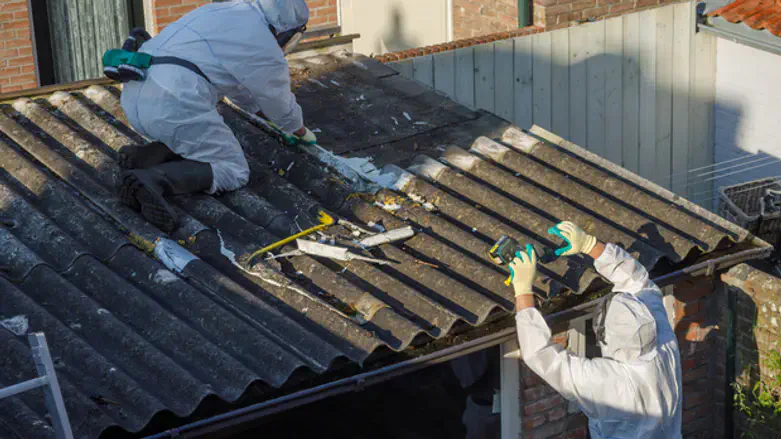
The Ministry of Environmental Protection published today (Tuesday) the implementation report of the Asbestos Law for 2011-2023, reviewing the state's achievements in combating exposure to one of the most dangerous substances to public health - asbestos.
The data show that during the period, about NIS 1.5 billion was invested in asbestos removal, and more than 17.8 million sq. meters of cement asbestos were removed from public spaces, alongside thousands of tons of friable asbestos.
The law to prevent hazards from asbestos and harmful dust came into force in 2011, and since then the ministry has worked with a range of bodies to implement it, including the IDF, government ministries, heavy industry, local authorities, and environmental NGOs. Removal was carried out by licensed contractors under strict supervision, with the aim of preventing public exposure to the carcinogenic material.
Asbestos, which was used for decades as an insulating building material, is recognized as a definite carcinogen. According to the report, concentrations of excess illness in mesothelioma - a rare and deadly cancer - were recorded mainly in the western Galilee, near the Eitani" plant that operated in Nahariya and spread asbestos waste into the area's soils.
Over the years, contaminated soils in the western Galilee were also cleaned, including residential sites and Nahariya's northern beach. According to the report, about NIS 325 million was invested in the first phase of soil removal, of which NIS 150 million was financed by the plant itself under the "polluter pays" principle. Phase B of the project began in 2023 and is expected to be completed in 2026.
The report also includes a forecast for the future: completing the removal of all cement asbestos in Israel is expected to cost about NIS 5.3 billion. In addition, there is a shortage of disposal capacity for asbestos, which is expected to be sufficient for only four years.
The Minister of Environmental Protection, Idit Silman, commented on the findings: "The fight against asbestos is an example of the state's commitment to public health. To date, more than NIS 1.5 billion has been invested in removing the carcinogenic material. We are determined to continue the mission until the goal is achieved - an asbestos-free Israel."
Reut Rabi, director of the Air Pollution and Asbestos Prevention Department at the Ministry of Environmental Protection, noted that "The ministry will continue to work decisively to remove asbestos from public spaces, while rolling out an action plan for an asbestos-free Israel and completing mapping of roofs in at-risk areas".