

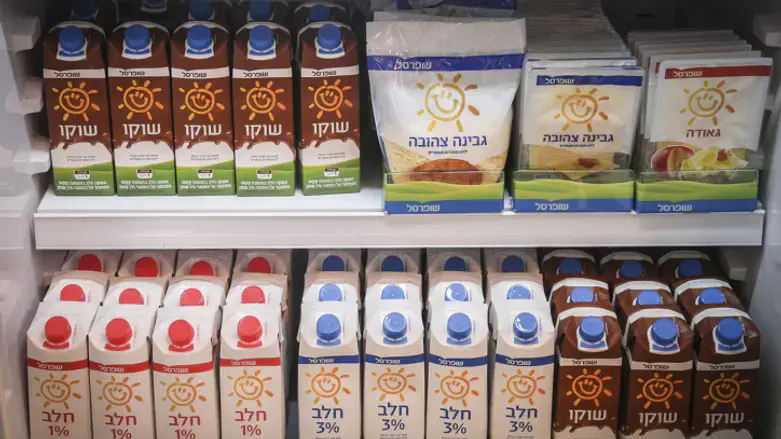
Israelis have long contended with cost-of-living issues, one of which has recently come to a head - the price of milk. Prices that remain stubbornly high despite repeated government interventions and longstanding price controls have turned the nation's dairy industry into a flashpoint of economic frustration. At the heart of this crisis lies what critics - and now, Finance Minister Bezalel Smotrich - call a "communist dairy cartel," a tightly controlled network of producers, farmers, and regulators that has long shielded itself from competition while keeping consumers in a perpetual state of shortage and overpayment.
Smotrich is waging an unlikely battle against this entrenched system in advance of the 2026 budget vote - a vote that could potentially topple the government. His proposed reforms, unveiled amid a wave of public outrage over milk prices and production, aim to dismantle decades of protectionism by slashing import tariffs, boosting competition, and freeing farmers from what he describes as a culture of intimidation. "This is another milestone in our ongoing fight against the high cost of living," Smotrich declared in a November statement, vowing to ensure "milk is available at a fair price." Yet, as coalition partners balk and industry giants mobilize, the minister's push reveals deep fissures in Israel's economy, including a deep disconnect between the ranchers producing the milk and the corporations selling it.
Background: Israel's Dairy Cartel
Israel's dairy sector dates back to the earliest days of the kibbutz movement, and includes many of the same socialist founding principles. State intervention was the norm to ensure food security in a resource-scarce nation surrounded by hostile neighbors. Established under the Israel Dairy Board (IDB) - a tripartite body jointly managed by the government, major processors, and farmers - the industry operates under a quota system that caps milk production at around 1.3 billion liters annually, roughly matching domestic demand. Farmers receive a guaranteed "target price" for their milk, while processors like Tnuva, Strauss, and Tara - which control over 90% of the market - handle distribution and sales.
This setup, proponents argue, has sustained about 600 family-run dairy farms, many in vulnerable border areas like the Gaza and northern borders. Many such farms suffered extensive damage during the last two years of war, sustaining direct hits from Hamas and Hezbollah shelling, extended abandonment as their owners were forced to evacuate, and takeovers by IDF forces using them as makeshift bases. "These farmers have protected Israel's milk security with their own bodies," lamented Dagan Yarel, director of the Israeli Cattle Breeders’ Association, in response to early reform signals. The system also enforces kosher standards and prioritizes local self-sufficiency, a nod to historical vulnerabilities like wartime blockades.
But beneath this veneer of stability lies what Smotrich and economists decry as a monopolistic stranglehold. High import tariffs - up to 40% on raw milk - effectively bar foreign competition, allowing domestic processors to charge premiums that dwarf European prices: Israelis pay nearly double for butter and 30-40% more for milk overall. The IDB, often labeled a "cartel" by detractors, wields outsized influence, dictating quotas and prices in ways that favor processors over producers and consumers alike. Ayal Kimhi, a professor of agricultural economics at the Hebrew University of Jerusalem, notes that this overconcentration extends to retail chains, creating a "one-sided" market where farmers bear the brunt of inefficiencies.
The cartel's grip tightened post-2011, when the infamous "cottage cheese protest" erupted after a 25% price hike on the ubiquitous dairy staple. Supermarkets rolled back their costs and implemented minor changes, but the larger systemic issues went unresolved and left the sector ripe for exploitation. Processors, facing fixed prices on regulated products like fresh milk, have shifted output to higher-margin items like cheese and yogurt, which aren't price-capped. This misallocation has led to absurd outcomes: In October 2025 alone, farmers were forced to destroy six million liters of excess milk due to unprocessed quotas, exacerbating nationwide demand during the holiday season. "There's no actual shortage in milk," insists Dudu Demri, a veteran industry observer. "Local production exceeds consumption. If shelves are empty, it's because someone has an interest in that shortage."
The Leket Israel organization joined the outcry with a recent report decrying massive food waste in Israel, prompting the Ministry of the Environment to promise to implement policies against waste.
Smotrich's Reform
Finance Minister Bezalel Smotrich has pursued liberalization across sectors, from cement to poultry, especially in light of the ongoing costs of the war. His plans have been heavily focused on finding a way to keep the IDF funded, compensating reservists who have been enlisted for several hundred days, and paying out damages to families and businesses affected by the war. The needed funding has been taken from several other places, including taxing a single workday from every paid employee, raising Israel's VAT by 1%, and sweeping reforms to various industries.
Smotrich has defended his decisions by arguing that "abusive monopolies" inflate living costs for ordinary Israelis. His dairy reforms, embedded in the 2026 budget framework presented to Netanyahu on November 24, represent the most aggressive assault yet on the sector.
The plan's cornerstone is for Israel to permanently waive the 40% import tariff on raw milk, building on temporary exemptions Smotrich has issued since 2023 - most recently extended through February 2026 to cover the High Holidays. This would flood the market with cheaper imports from Europe (Poland has been a key supplier), theoretically lowering prices by 20-30% and stabilizing supply. Smotrich envisions a quota-free future where farmers sell directly to multiple buyers, ending the IDB's "culture of intimidation." "Farmers who support the reform are afraid to speak out due to retaliation from large producers and the IDB," he charged in a fiery Knesset address, accusing the cartel of perpetuating "huge price gaps" on basics.
This isn't Smotrich's first rodeo with dairy woes. In May 2023, facing a threatened 16% price hike amid soaring feed costs from the Ukraine war, he brokered a compromise: a 9% increase spread over three years, coupled with promises of "thorough reform." Subsequent shortages prompted repeated tariff slashes - three months in July 2023, six months in September 2023, and another six in August 2025 - each hailed as a "milestone" but criticized as band-aids. Logistical hurdles, like kosher certification and wartime shipping delays, have limited their impact, with imports covering just a fraction of the gap.
Now, with the Economic Arrangements Law set for a vote alongside the budget on December 4, Smotrich is doubling down. In a satirical November 24 social media post - a milk carton emblazoned with Chinese characters - he mocked protectionists, implying even global rivals could undercut Israel's inefficiencies. "We will not bow to campaigns of fear or slander," he insisted, framing the overhaul as essential for families "shopping without going broke."
Battle Lines
Dairy giants Tnuva, Strauss, and Tara, alongside the IDB, decry the plan as a betrayal of food sovereignty, warning of farm closures and vulnerability to foreign disruptions. "It hurts local producers and will raise prices in the long run," the United Torah Judaism (UTJ) party warned on November 24. Their opposition represents a larger concern in Israel's religious Jewish public for milk with special stringencies in its Kosher certification, a process that can introduce costs not capped by the government.
The issue of local production has been a significant concern for Israel since the COVID-19 pandemic left many Israelis without eggs, and the Ukraine war caused a serious wheat shortage. More recently, the issue has resurfaced in the defense sector due to fears of American embargoes, with Prime Minister Netanyahu warning that Israel must become as independent a manufacturer as possible in his 'Sparta' speech.
The Agriculture Ministry, under Avi Dichter, has floated an alternative: Targeted subsidies for efficient farms and worker quotas to boost output, without gutting protections. Advocacy groups are planning protests, echoing the 2011 unrest, while Haaretz opined that Smotrich's "partial and complicated" proposal - riddled with limitations - merely swaps one set of problems for another, failing to address processor oligopolies. Even Smotrich's war-era expansions of foreign worker visas for farms have drawn fire for not going far enough to alleviate the labor shortages caused by sweeping cancellations of Palestinian Arab work permits.
The ranchers themselves have claimed that the move is politically motivated, with the intent of weakening the cattle-heavy northern region and diverting funds to Smotrich's other plans in Judea and Samaria. Ranchers recently held a protest rally against the reform at the Knesset, demanding that many smaller family farms be protected against moves intended to work against much larger, national distributors.
Implications
Smotrich's dairy showdown means more than a change in grocery prices. The reform tests the fragility of Netanyahu's government, already strained by war costs estimated in the tens of billions of shekels and the fierce internal tensions surrounding the haredi draft. Success could mean a much-needed domestic victory for a coalition facing wave after wave of criticism for the handling of the war and hostage deals, and a concrete victory against the costs of living that have only been exacerbated by attempts to finance Israel's security needs. Failure could be a key indicator for the upcoming budget vote and a harbinger of the coalition's collapse.
If reforms pass, prices could drop 15-20% by mid-2026, per Finance Ministry estimates, easing household budgets amid stagnant wages. There are dangers as well - if imports flood unchecked, as in past poultry liberalizations, domestic output might plummet, threatening jobs and security in a nation where agriculture employs 1.5% of the workforce.
The impact of the reform is also likely to be unevenly distributed, disproportionately affecting some smaller farms that cannot readily absorb a significant drop in their demand as opposed to larger national distributors who have economic reserves prepared to help them recover and adjust to a new market reality. In this way, the reform may actually encourage larger corporate monopolization of the sector as smaller farms are forced to either join a collective or declare bankruptcy.
For some, there is also an important aspect of national history and pride involved - farming and agriculture are still heavily identified with both the earliest days of the state and the culture of starting new Israeli homesteads in Judea and Samaria.