

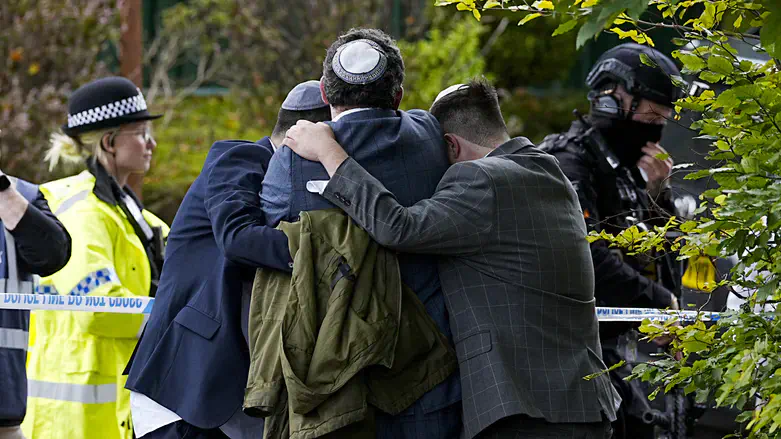
A Jewish father wounded in the deadly attack on Heaton Park Synagogue last October said the assault marked the moment “many in Britain’s Jewish community had feared,” describing an atmosphere in which antisemitism has been “allowed to fester” while Jewish residents feel increasingly unsafe across the country.
Speaking to The Guardian and The Times, Finlay detailed the harrowing events of Yom Kippur, when a terrorist rammed the synagogue gates, attacked worshippers outside, and tried to force his way into the building while shouting threats. “He just wanted to kill Jews,” Finlay said, recalling how he and others held the synagogue doors shut as they shook violently under the attacker’s weight. “I have never been that close to evil. You could feel it radiating off him.”
The terrorist, armed with a “huge knife” and wearing what appeared to be a bomb belt, was shot by police moments after trying to storm the synagogue. A police bullet penetrated the synagogue door, striking Finlay in the chest before fatally wounding worshipper Adrian Daulby. Another congregant, Melvin Cravitz, was killed outside.
Finlay underwent a seven‑hour operation and spent days in the hospital. “I knew immediately I’d been shot,” he told The Times. “It felt like a really hard punch.” Weeks later, he said the emotional burden remains heavy. “I’ve been told it’s survivor’s guilt. I survived, and they didn’t. Why?”
He warned that the attack cannot be separated from the wider climate facing British Jews. According to the Community Security Trust, antisemitic incidents have surged since Hamas’s 7 October massacre, with monthly reports doubling - and at times tripling - previous levels. Finlay said hostility toward Jews has become “normalized,” driven by political rhetoric and reactions to the Gaza conflict. “There’s so much anger and so much hate,” he said. “It’s become hard to recognize the UK anymore.”
He expressed concern that the government’s response has focused on increased security rather than confronting the roots of antisemitism. “The answer isn’t to keep putting up more walls and gates. We’re not tackling the real issue.”
Finlay also revealed he has begun discussing with his former partner whether to move to Israel for the safety of their four children, who he said have also faced antisemitism. “I can’t bring my kids up in this environment,” he said, though he admitted leaving Manchester - his hometown - would be painful.
Yet he stressed that thousands of messages of support arrived from across the city, including from Muslims and other non‑Jewish residents. He called them the “silent majority” who reject hate and want to live in peace.
Despite his injuries and grief, Finlay said he remains committed to ensuring some good emerges from the tragedy. “I saw evil, but let’s combat it. Love, care, and good, that overcomes hate. Humans have an immense power to bring light and combat darkness.”