
Since the truce between Hezbollah and Israel took effect on November 27, 2024, there has been virtually no day when it has been fully observed.
On the contrary, there has only been an escalation of the current conflict between the two archenemies which has become even greater recently.
As I described in an analysis that appeared on this website on November 8, the IDF and IAF are employing a relatively new doctrine aimed at crushing any Hezbollah attempt to re-establish itself in the border region with Israel through preemptive strikes.
This campaign also includes eliminating the new top leaders of Hezbollah, which saw its leader Hassan Nasrallah and many other top commanders of the Lebanese terrorist organization assassinated by Israel more than a year ago. The replacement of Hezbollah's top leadership took some time, but as the increased attempts to rehabilitate Hezbollah in southern Lebanon in recent months demonstrated, the Iranian-sponsored terrorist group had managed to recover and to continue its "resistance" against Israel's existence.
However, Israel made it clear in both words and deeds that these rehabilitation attempts would be prevented at all costs and placed its army on even higher alert.
Extermination of Hezbollah's New Chief of Staff
On Sunday, November 23, the conflict escalated further when the Israeli Air Force carried out a precision strike on a building in central Beirut. This was the first time since the start of the shaky ‘truce’ that the IAF had carried out such an attack on a Hezbollah target in Beirut.
Sometime later, it was revealed that Hezbollah's new Chief of Staff, Haitham Ali Tabatabai, better known as Abu Ali Tabatabei, had been the target of the IAF strike. Tabatabai was assassinated in his hideout on the fourth floor of the building in the Hezbollah stronghold, the Dahiyeh neighborhood.
The Hezbollah terrorist, along with four other commanders of the terrorist group, was completely surprised and all were killed.
During the funeral of the five Hezbollah terrorists, Israel, through the IAF, once again demonstrated its dominance over the skies in Lebanon. Several Israeli unmanned aerial vehicles circled above the cemetery where hundreds of Hezbollah supporters had gathered.
Reaction to Tabatabei's elimination
Ali Tabatabei succeeded Fuad Shukr, who was also assassinated by the IAF at the end of last year.
Tabatabei was also the commander of Hezbollah's elite unit, Radwan, and prepared the invasion of northern Israel before Hamas launched its surprise attack on southern Israel on October 7, 2023. The Hezbollah plan was subsequently shelved as the IDF was awakened and mobilized on the northern front.
Recently, Tabatabei was responsible for rebuilding Hezbollah's military apparatus on the border with Israel. His assassination demonstrated once again that the Israeli army possesses high-quality intelligence and that Hezbollah has been infiltrated by the Israeli intelligence agencies Mossad, part of Aman (the other part is the Shabak), the IDF's military intelligence service.
These ongoing Israeli infiltrations have severely damaged Hezbollah's self-confidence and have caused paralysis in the Iranian proxy's operations. Even now, there has been no reaction to the assassination of Hezbollah's chief of staff, despite threats that the terrorist group would respond to Israel's new "red line" violation. This so-called red line has become more ‘pink’ due to the Israeli army's actions, and Hezbollah knows that since its crushing defeat in 2024, it is no longer capable of posing a serious threat to Israel. The terrorist group's leadership thus limited itself to its familiar rhetoric, claiming that a response would come at a time of its choosing.
Iran's Powerlessness
The observers now warning that Iran could order Hezbollah to wage a new war against Israel don't know what they're talking about. This also applies to the warning that Iran itself could attack Israel again anytime soon. Both entities are using rhetoric to create the misguided impression that they are now capable of doing what they failed miserably to do during the recent confrontations with the Israeli army.
Iran, for example, has still not recovered from the series of Israeli attacks on its top military leaders and the destruction of its nuclear weapons program and other key military infrastructure in June 2023. On Wednesday night the IAF gave another warning to Iran by conducting overflights along the Iraq Iran border.
Furthermore, the regime of Ayatollah Ali Khamenei is facing an unprecedented internal water crisis that could now even lead to the evacuation of the capital, Tehran, according to Iranian President Masoud Pezeshkian.
The Iranian president reiterated this warning on Sunday when it became clear that even the largest water reservoirs in the Islamic Republic were drying up. This enormous water crisis has primarily stemmed from the policy of "resistance" by the Ayatollah regime in Tehran. Iran was supposed to become self-sufficient in food supply as part of its resistance to the sanctions imposed by much of the world.
The already scarce water was subsequently used for agriculture (80 to 90 percent). This, in turn, has resulted in Iranian soil becoming saltier, and the falling groundwater level has literally led to the subsidence of the Iranian soil.
However, the regime refuses to change its policy and, just last year, approved a plan requiring that 90 percent of basic food needs to be produced domestically. This includes the production of rice, which is normally grown in countries with abundant rainfall.
Iran, therefore, has no direct interest in another large-scale confrontation with the Israeli army and must passively watch as Israel repeatedly humiliates its once powerful ally in Lebanon.
Israel on high alert
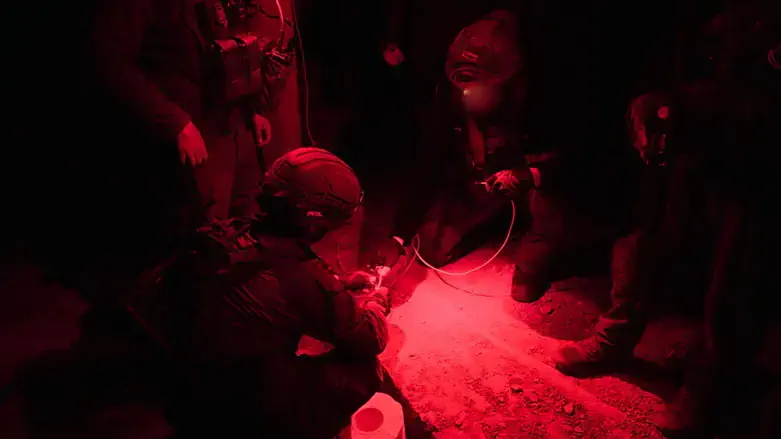
The Israeli military, meanwhile, took measures indicating it is taking Hezbollah's threats seriously and further raised its alert. The IDF held a surprise exercise under the name ‘Magen Oz’ along the border with Lebanon on Monday, which was attended by Chief of Staff Eyal Zamir, while the IAF conducted flights over northern Israel that were reminiscent of last year's war with Hezbollah. F-15 and F-16 fighter jets spent the whole day patrolling the northernmost part of the Galilee.
Yochanan Visser is an independent and experienced Middle East reporter, who wrote for many years for Dutch and American news sites, with a focus on the broader perspective in the conflict between Israel and Islamists. His substack appears in several language, including English.