

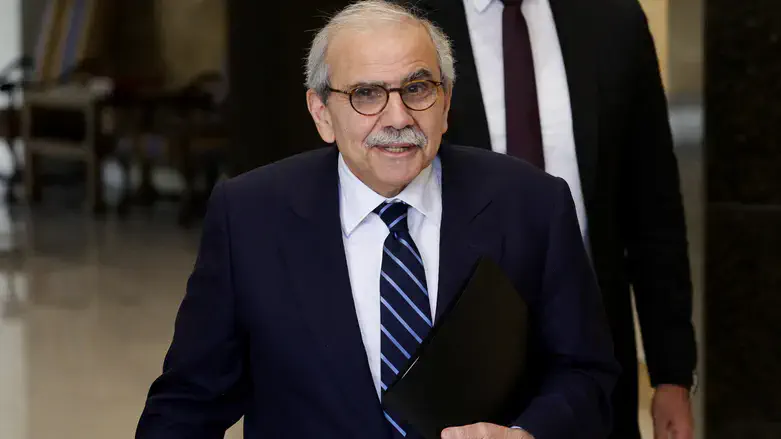
Lebanese Prime Minister Nawaf Salam criticized Hezbollah on Thursday, saying that the terrorist organization's arsenal has not shielded either the group’s leaders or the Lebanese population, insisting that the current situation represents "a one‑sided war of attrition" facing the country.
"The weapons of Hezbollah did not protect the party’s leaders nor the Lebanese and their properties," Salam stated during a meeting with members of the Press Club’s administrative board. He added that the ongoing conflict "provided no deterrence, no protection, and no victory for Gaza."
Salam noted that Lebanon does not require foreign envoys "to sound the alarm," while stressing that the picture is "not entirely bleak," pointing to signs that confidence in the country is beginning to return.
The prime minister outlined the timeline his government set for restricting weapons across Lebanon. "The first phase is supposed to end by the end of the year and includes the area south of the Litani, where weapons and military infrastructure must be removed," he said. In the area north of the Litani, the current stage requires the containment of weapons, "meaning preventing their transport and use," before moving on to later phases.
Salam said Lebanon has fallen behind in asserting state authority and implementing the conditions of the Taif Agreement. He acknowledged that "the resistance had a role in liberating the south" and that Hezbollah played "a central role" in that period.
However, he sharply criticized what he described as Hezbollah’s narrative surrounding its weaponry. "The party says its weapons deter aggression, and deterrence means preventing the enemy from attacking. But the enemy attacked, and the weapons did not deter it," he said. "This weaponry did not protect the party’s leaders nor the Lebanese and their properties, and the evidence is dozens of wiped‑out villages."
The prime minister questioned whether Hezbollah’s weapons are capable of countering "the current Israeli attacks," adding again that "this weaponry provided no deterrence, no protection, and no victory for Gaza." He also noted Lebanon’s failure to implement UN Security Council Resolution 1701, stressing that the preamble to the ceasefire agreement "defines the six entities authorized to carry weapons."
Asked about comments made by an adviser to Iran’s Supreme Leader, Salam responded that he was "not concerned" with those remarks, saying his priority is reviving Lebanon’s economy and creating jobs. He underscored the need to pass the financial gap law and address the banking sector to restore deposits.
Meanwhile, Iranian media carried comments by Ali Akbar Velayati, adviser to Iranian Supreme Leader Ali Khamenei, who said Hezbollah’s presence is now indispensable for Lebanon. According to Velayati, the "continuous crimes committed by the Zionist entity against Lebanon show that Hezbollah’s presence has become more important than daily bread for Lebanon." He argued that Israel has repeatedly violated the ceasefire and international law.
Velayati claimed that Israel’s breaches of the ceasefire demonstrate "the catastrophic consequences of disarming Hezbollah for Lebanon," adding that Iran "has supported and will continue to support Hezbollah and the resistance front."