
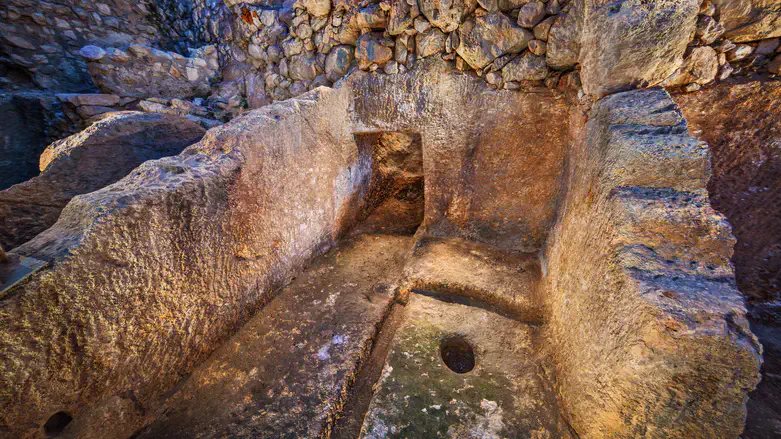
In this week’s parasha, we read about Yaakov’s famous dream. In his dream he sees a ladder with angels going up and down. Chazal teach that he slept at the Makom HaMikdash. Baal HaTurim (Bereshit 28:12) adds that the entire dream hints to the mizbeach (altar): the ladder is like the kevesh (ramp) leading up to the mizbeach, 'artza' hints to the mizbeach which was connected firmly to the land, the top reaching the heavens hints to the korban rising upward, and the angels ascending and descending resemble the kohanim going up and down the mizbeach.
I would like to add an idea connected to what learners of Zvachim in the Daf Yomi recently encountered. Rashi (Bereshit 28:17) takes us into the geography: the bottom of the ladder was in Be’er Sheva, on the southern edge of Yehuda. North of that lies Yerushalayim, on the border between Yehuda and Binyamin. Further north is Beit El, on the border between Binyamin and Yosef.
Why does Rashi emphasize these borders? In the Daf Yomi we saw two related points in the Gemara regarding the location of the mizbeach (Zevachim 53b-54a). One statement tells us there was a strip extending from Yehuda’s territory to touch the mizbeach. Binyamin, for his part, wanted to “swallow” that strip and have the entire mizbeach within his own territory. Another statement explains that David HaMelech, together with Shmuel HaNavi, learned that the mizbeach should be slightly closer to Yehuda and not in 'Ein Eitam'.
Later, the Gemara also describes a similar situation in the Mishkan of Shiloh, which was in the territory of Yosef (Zevachim 118b): there too, a strip from Binyamin entered the area of Yosef and took the location of the mizbeach.
Rav Yaakov Charlap (Mei Marom, Vayigash) explains the Gemara of the location of the mizbeach according to the deep discussion between Yehuda and Yosef about how the Shechina should be revealed in this world. Should it be through Yehuda’s leadership or Yosef’s? The mizbeach, standing exactly on the borderlines of these tribes, becomes the meeting point of these two paths of holiness.
Where does this lead? It seems that there is a deep, ongoing tension within Am Yisrael regarding which tribe represents the proper approach to the Shechina, and which tribe should host the Mikdash. This tension appears throughout our history: Yaakov’s journey to Lavan, the dynamics between Rachel and Leah and their children, the sale of Yosef, Yehuda’s guarantee of Binyamin, and Yosef’s attempt to draw Binyamin to his side. Later we see it with David HaMelech (Yehuda) and king Shaul (Binyamin), and ultimately even in the concepts of Mashiach ben Yosef and Mashiach ben David.
This longstanding pull between the tribes is already hinted at in Yaakov’s dream, where he sees the place of the mizbeach-standing literally on the borderlines, seeing the tension and unity. Binyamin connects Yehuda and Yosef. Jerusalem unites us all.