
The anti-Israel/pro-Palestinian Arab movement is powered by falsehoods. In an age when many people, especially young people, get much of their news from TikTok and other social media, rarely read books and know very little about history, geography or culture, anti-Israel/pro-Palestinian Arab lies are easily accepted. People who know nothing will fall for anything.
It may be that the best way to combat that kind of ignorance is not to write a book but to post on social media. Still, author O. Isaac has gathered an impressive array of important facts in his book The Palestinian Lie: Shattering the Myths, that clearly demonstrate that the foundational claims of the anti-Israel/pro-Palestine movement are false.
The heart of the Palestinian Arab lie is that there is a ‘Palestinian people’ and that this supposed people have a claim superior to the claim of the Jewish people to the land of Israel. Isaac packs a tremendous amount of reliable information into a mere 183 pages in this very factual self-published book (available on Amazon)..
Isaac demonstrates clearly and unequivocally that in the nineteenth century, even before the birth of the modern Zionist movement, the land was largely empty and Jews were a majority of the residents of Jerusalem. The ranks of so-called Palestinians were swelled during the nineteenth century by Moslems from other parts of the Ottoman Empire and during the British Mandate by Arab immigrants from Egypt, Syria, Iraq and elsewhere who came to participate in the Zionist building boom.
He shows that Jews did not ‘steal’ land from the Arabs of the area but rather, most of the land that is now Israel was either sold to Jews or was empty and unused land which under Ottoman law was available to anyone who would use it productively.
Isaac also addresses such important related issues as the foundation of the State of Israel, the profound fraud of the UN and UNRWA, and the 100 years war by Arabs against the Jews of Mandate Palestine and then after statehood, against the State of Israel. Isaac shows, in essence, that almost all important claims by the so-called ‘Palestinians’ and their allies are a fraud.
Isaac points out that under the Ottoman legal code of 1858 there were four categories of land: Mawat, meaning ‘dead’or unused land: Mir, state land owned by the Sultan which he could allow individuals to use but which could not be sold or passed through inheritance: Mulk, privately owned land usually in cities and in some cases orchards, and; Waqf, land dedicated to religious endowments for mosques and other religious institutions.
In the territory of Israel’s pre-1967 borders at least eighty percent (80%) of the land of Israel was Mawat, dead and unused land not owned by anyone. That included portions of all of Israel from the Negev to the Galilee where large swaths of land were unused and undeveloped. Miri land, state land owned by the Sultan and incapable of being sold or passed down by the tenant was another fifteen to eighteen percent (15-18%) of the land within the pre-1967 borders of Israel, and Mulk land made up most of the balance.
Isaac also does a good job of citing the reports of eyewitnesses, missionaries and diplomats who traveled in the Ottoman provinces of what is now Israel, as far back as 1738, all of whom, uniformly, pronounced the land essentially empty.
Amongst those witnesses there are these representative samples: ‘A land forsaken and desolate, where villages are few and far between, and vast tracts lie empty of people.’ said a 1738 British traveler. ‘[A] land reduced to barrenness and solitude….’ said another in the 1780s. ‘Thinly inhabited and ill-cultivated …the villages are miserable and poor.’ commented a different traveler in the 1760s. “A silent and mournful land with little sign of human habitation’ observed a another in the 1830s. Writing in 1832 another traveler asserted ‘Outside the gates of Jerusalem we saw nothing living.’
Moreover, Ottoman tax records from the mid-nineteenth century show that in Judea and Samaria (‘The West Bank’) the Arab towns were small, with the District of Hebron having 3,000 to 5,000 inhabitants and Nablus having 9,000 to 10,000. In short, it is a lie to say that land which belonged to the Ottoman government before it was defeated in World War One, was stolen from non-existent ‘Palestinians.’
There was also a significant influx of non-native Moslems in the late nineteenth century. Citing the work of respected demographers, Isaac shows that Egyptians, Algerians, Hauranis, Circassians, Turks, Balkan refugees, Metawali, Maghrebis and others all came to the Ottoman provinces that are now Israel after 1830. If a person does not count these late arrivals, who were not long term residents of the land, and examining the Ottoman census data and tax records from the nineteenth century, it becomes clear that ‘the native Muslim population was likely smaller than the population of the established Jewish community-showing that Jews were not newcomers but one of the oldest and most continuous populations of the land.’ Diplomats in Jerusalem in the nineteenth century all agreed that Jews there outnumbered Moslems.
The defeat of the Ottoman Empire in World War One caused the creation of multiple new nations, often with artificial boundaries like the countries of Syria, Iraq, Lebanon and TransJordan (now Jordan) that did not have an historical basis for independent nationhood in their current borders. In fact, there was no clamor for an independent ‘palestine’ during Ottoman or British rule nor in the "West Bank" during Jordanian rule: the Arab nationalists who wanted to expel the British wanted to attach to Syria or other states, and were not interested in having a state of their own. They only wanted a State of their own later, to whittle away at the little Jewish state.
According to the 1922 British census, Jews were the majority of residents of Jerusalem, outnumbering Moslems with 33,971 Jews to 13, 413 Moslems. In that same year, Ramallah, now the seat of the corrupt and malicious Palestinian Authority, had 3,000 Christians and 125 Moslems. Bethlehem was also majority Christian in that census. Both Bethlehem and Ramallah have since been Islamified. In Tiberias Jews outnumbered Moslems two to one. In Jaffa, later merged with Tel Aviv, the number of Jews and Moslems was roughly equal and in Haifa, then a small town, Moslems outnumbered Jews by a few thousand.
Because the late Ottoman rulers and early British Mandate initially allowed Jewish immigration to Israel and the Jews came in the first half of the twentieth century, they created a building boom that then drew large numbers of Arab workers for construction and other services. Isaac points out that the wages for Arab workers in Mandate Palestine were typically two to four times higher than in the surrounding Arab home countries of the recent Arab immigrants.
It is important to note that between 1922 and later censuses the Arab population of ‘Palestine’ grew in a way that is clearly the result of recent Moslem immigration in the 1916-1948 era and not the result of natural reproductive growth, a fact confirmed by respected demographers and historians.
Isaac did not point out that in order to qualify as a refugee from ‘"Palestine’ for the the purposes of receiving UNRWA welfare one’s so-called Palestinian Arab "ancestor" had only to live in the land for two years, from 1946 to 1948. That is the requirement of UNRWA. That short two year requirement for ‘Palestinian Arab’ status is a UN acknowledgement that many of the people who claim to be ‘Palestinians’ had only been in the land a little while and did not have long or deep connections to it.
Many of UNRWA’s original so-called ‘Palestinians’ had not been here even one generation, not even ten years, nowhere near as long as the Jews they denounce. Isaac also touches on the fact that there is no separate Palestinian Arab culture, distinct from the other Arabs of the southern Levant, nor anything indicating a separate pre-Moslem or Islamic ‘Palestinian’ identity in that area. But from antiquity to the present there was and is a constant almost uninterrupted archeological and textual record of Jewish connection to the land of Israel. Palestinian Arab identity developed solely as a response to the creation of the Jewish state.
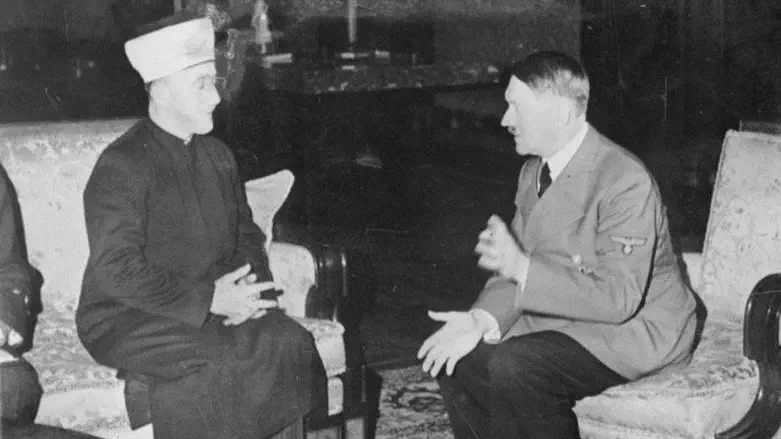
The book also gives a short and accurate history of the Jewish drive towards statehood in Israel and the persistent hate-soaked Arab resistance to the establishment of a State of Israel. No history of Arab opposition to Israel is complete without reference to Haj Amin al-Husseini, the mufti of Jerusalem, who led the Arab resistance to the immigration of Jews and the establishment of a State of Israel from the 1920s to the 1940s. Husseini was a role model for later Arab leaders because he not only desired that there not be a Jewish-majority state in the Middle East, he also desired to kill all the Jews in the Middle East and the world.
Husseini spent the war years, 1941 to 1945, in Berlin at the expense of the Nazi government making Nazi propaganda for the Arab world. That is, Arab nationalists were openly allied with the Nazis during World War Two, something they would rather forget about now. The book would be incomplete without the famous picture of al-Husseini cozying up to Hitler in Berlin, and Isaac does not disappoint.
The book also contains well-executed chapters summarizing UNRWAs and UN’s assault on truth on behalf of their Arab clients and Moslem sponsors, the ugly biases of the fake UN Human Rights Council, and UNESCO and Iran’s sponsorship of terror campaigns and wars against Israel.
Most novel of all is that Isaac cites studies from highly regarded scientific journals comparing how much the DNA of the Moslem Palestinian Arabs and Jewish Israelis is linked to ancient Canaanite DNA extracted from pre-Israelite specimens. In summary, the DNA of the Jews is more connected to the southern Levant, to Israel and the closely surrounding places than that of the so-called ‘Palestinians.’
For Sephardic Jews, who are more than half the Jews in Israel, 65-80% of their DNA has origins in the Southern Levant and the rest is from nearby areas like Turkey and Persia. For Ashkenazi Jews 45-60% of the DNA shows southern Levantine ancestry, with 25-35% coming from Europe and 15-25% coming from other Middle Eastern places. It is also of interest that all the DNA of Jewish Israelis show connections to each other: common ancestors.
For the ‘Palestinians’ only 45-50% of the DNA shows origins in the southern Levant (the area of Israel), about 30% originates in Arabia, 15-20% of ‘Palestinian’ DNA comes from the Balkans and about 5-10% originated in North Africa. That is to say that the DNA science confirms the indigeneity of the Jewish people in the land of Israel and the foreign origin of many of the North Africans, Arabs, Balkans, and others who call themselves ‘Palestinians.’
It is not as if many minds will be changed by facts. Trying to fight deeply seated hatreds and prejudices like those of the committed Jew-haters, Israel-haters and the genocidal Jihadis and Sharia-supremacists with facts is a futile effort.
But there may be people who are less committed to those ugly attitudes and even people who have not yet made up their minds about Israel and Israel’s enemies, as well as people who need to be re-confirmed in their support for Israel and the Jewish people. For those people, O. Isaac’s The Palestinian Lie: Shattering the Myths is an excellent book.