

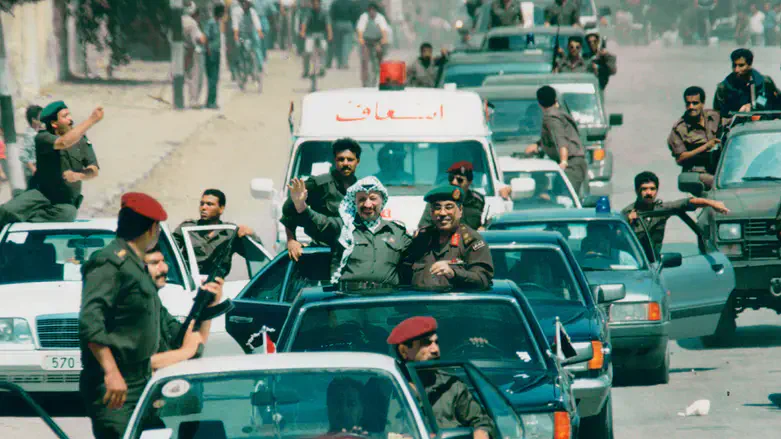
In a wide‑ranging interview, Muhammad al‑Dayeh, a longtime personal aide to Yasser Arafat, said the late Palestinian Arab leader would have reacted to the October 7th massacre by escalating the conflict rather than condemning it.
According to al‑Dayeh, "If Abu Ammar (Arafat) had lived to witness October 7, he would have moved toward widening the scope of the war to a far greater degree." He contrasted this with the current Palestinian Authority leadership, which he said "rushed to reject the operation and attack it from the first moments."
Speaking to the "Beyond the Seventh" podcast on al-Arabiya's Mazeej platform, al‑Dayeh asserted that Arafat viewed the confrontation as a long‑term struggle. "He did not see the conflict as something confined to a political framework or a quick settlement," he said. "He believed the struggle with Israel continues until the end of days."
Al‑Dayeh also discussed Arafat’s profound disappointment after the failure of the 2000 Camp David summit, which he said caused him to lose trust in the possibility of achieving a real peace with Israel.
The former aide further revealed, for the first time, what he described as historical details regarding Arafat’s final days. He stated that Arafat’s death resulted from deliberate poisoning administered “through the medicine.” He added that suspicion "points toward individuals close to the late Abu Ammar," calling the circumstances "a conspiracy."
He recounted harsh days inside the Muqata in Ramallah, where Arafat lived under Israeli siege from 2002. Al‑Dayeh said several senior figures abandoned Arafat in his most difficult moments, describing this as part of "the conspiracy that was crafted to isolate and weaken him."
According to al‑Dayeh, he himself was pushed out of Arafat’s inner circle in 2001, barred from reaching him under Israeli orders issued in coordination with certain Palestinian officials.
He also described a 2003 assassination attempt against him after he managed to enter Ramallah and attempted to approach the Muqata. He said 12 masked men ambushed him and opened fire to prevent him from reaching Arafat, part of what he called broader efforts to remove Arafat’s loyalists during the siege.
In the first half of the interview, al‑Dayeh revealed that Arafat held secret meetings with senior Israeli officials in Tel Aviv and Gaza, including former Prime Minister Ehud Barak.
He also addressed long‑standing claims surrounding the signing of the Oslo Accords, rejecting rumors that late Egyptian President Hosni Mubarak had insulted Arafat during the ceremony.
Al‑Dayeh emphasized that Arafat maintained a complex but supportive relationship with Hamas, saying the late leader offered the movement backing and assistance.
Arafat died on November 11, 2004, at Percy Military Hospital near Paris after his health suddenly deteriorated during the Ramallah siege. French medical reports attributed the death to a severe brain hemorrhage caused by blood disorders, while Palestinian sources promoted the possibility of poisoning.
In 2012, Arafat’s body was exhumed for examination by Swiss, Russian, and French teams. Their findings were not unified, and the Palestinian Authority has never released a final, comprehensive report identifying who was responsible. PA investigative bodies have repeatedly claimed to possess "dangerous facts" but have not made them public.