

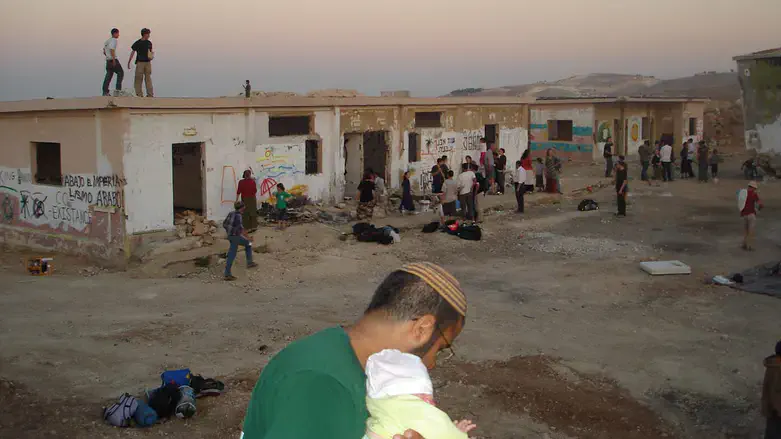
In late 2007, two years after the 2005 expulsion from Gush Katif (which the October 7, 2023 massacre proved was a disastrous mistake), Yehudit Katsover and Nadia Matar, then heads of the Women in Green organization, received a phone call from journalist Haggai Huberman, a columnist for the Makor Rishon Hebrew newspaper. He had discovered that the Israeli government, headed by Ariel Sharon's successor, Prime Minister Ehud Olmert, intended to transfer Shdema to the Palestinian Authority as part of the Roadmap and Annapolis Agreements. Urgent action was needed to stop this egregious move, one which would have cut off the eastern Etzion Bloc (Gush Etzion) from Jerusalem.
Jewish life in Shdema did not start in the 21st century. The Shdema area was densely populated by Jews during the First Temple period and resettled again during the Second Temple period. Archeological remains of Jewish settlement in the Shdema area have been identified as hailing from the Hellenistic, Roman, Byzantine, and Mameluke periods. The Hasmoneans waged their final victorious battle there.
After the 1967 war, Shdema was used as an Israeli army base, as it is 3 miles from Jerusalem’s Har Homa and 4 miles from Tekoa. It was abandoned in 2006 for political reasons by Prime Minister Ehud Olmert. Shdema is in Area C, under full Israeli control according to the Oslo Accords, and is located at an extremely strategic point that connects Jerusalem and eastern Gush Etzion. It provides security for those traveling on the eastern Gush Etzion road. It was clear that the Palestinian Authority wished to seize the site in order to block Jewish contiguity between Jerusalem and the eastern part of Gush Etzion.
Immediately, Yehudit Katsover and Nadia Matar gathered together a group of residents from Gush Etzion and Jerusalem who decided to call themselves “The Committee for a Jewish Shdema.”
"Remember," said the late Attorney Elyakim Ha'etzni, "Shdema, Kiryat Arba and Alon Moreh guard Tel Aviv. Without them, there will be no Tel Aviv."
The film they produced is eerily prophetic:
The Committee resolved to maintain a constant presence on the site by holding Land of Israel cultural activities at the site. They organized events and lectures, concerts and seminars and established the Committee for a Jewish Shdema in the Knesset, all with the encouragement of the Gush Etzion Regional Council. The year they first ascended to Shdema, the council head was Shaul Goldstein. He was followed by Davidi Perl.
Committee for a Jewish Shdema activists held constant activities at Shdema for years, and were joined by many devoted supporters, including ministers and Knesset members, people from Israel and abroad who came in every type of weather. At the beginning, the group struggled with European anarchists and local Arabs who tried to take over the area. The Arabs living in nearby Beit Sahour built an illegal structure and set up a park with outdoor equipment in the northern part of the army camp.
However, thanks to the dedication of so many activists who came time and again in heat and cold, Shdema remained in Jewish hands, and, with the help of generous donors, those coming there weekly were soon renovating the buildings, affixing a mezuzah, and bringing in a Torah scroll.
This moving video clip of the mezuzah affixing in Shdema in 2012 with the participation of Geula Cohen z"l - with English subtitles - tells the story of idealism and love for the Holy Land
In 2013, the army officially asked Yehudit Katsover and Nadia Matar to hand over the keys to Shdema, as the IDF had decided to return to the site. For the Committee for a Jewish Shdema, this represented a major victory. The army invested significant resources in renovating the area and turning it into a functioning base. An order to destroy the illegal Arab structures was issued.
And a few days ago, on the eve of Rosh Chodesh Kislev, November 20, 2025 the Gush Etzion Regional Council headed by Yaron Roenthal placed caravans at Shdema, so that the site is now an authorized, albeit fledgling, community. May it grow and flourish.