

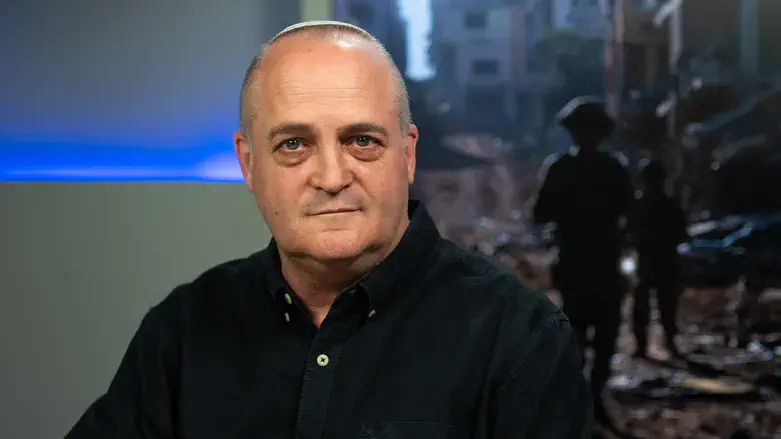
Brigadier General (Ret.) Erez Weiner, who headed the operational planning team in the Southern Command, launched a fierce attack against ex-Military Advocate General Yifat Tomer-Yerushalmi in an interview with Arutz Sheva.
According to Weiner, the judicial decisions made under her during the war in Gaza prevented the military from achieving a fast and effective victory against Hamas.
Asked if the MAG and her staff prevented the Prime Minister from declaring war on the first day, Weiner said that while he has heard about it, he could not confirm. "I don't remember that someone held us back during the first hours," he said, "The limitations came from being caught off guard."
This being said, according to the retired general, after the attack, the judicial system immediately resumed functioning, but "not in a positive way." As a major example, he brought a weapons system to detonate explosives before the ground forces entered, but according to him, its use was prohibited for fear of harming noncombatants, even though those areas were clear of civilians.
Weiner stresses that it was not only the MAG who was responsible, but rather the senior command, led by the Chief of Staff, who were supposed to make clear to the MAG that she only advises and nothing more than that.
Among the other cases that Weiner mentioned were the refusal to classify Hamas's police force as a legitimate target and the decision not to indict the murderers of the Bibas family as Hamas members, which harmed the IDF's ability to strike targets from the air.
Weiner also criticized the approach to the civilian population. In his opinion, after the civilians were given a chance to evacuate, aid should be prevented from reaching such areas, which should be empty. However, the MAG opposed this, claiming that the IDF should not execute a siege, even if it is a combat zone.
"We tried to bring opinions from international law experts who said that it is a legitimate means of war that is recognized by international law, but it didn't help. We brought examples from foreign militaries that did so and from the IDF's history, where such steps were implemented. However, unfortunately, the Chief of Staff took her side and refused to enforce his rule over her. The command has no less responsibility.

The result, according to Weiner, is a blurring of boundaries between legal advice and command authority, creating deep systemic disruption. “I argue that we’ve completely lost our way. The Military Advocate General and her people have completely lost their way. I don’t need to prove it, because when you look at the Sde Teiman affair and see that the Military Advocate General and eight of her senior officers are conducting a WhatsApp discussion on how to incriminate IDF soldiers, it’s clear there is a moral confusion in understanding who I am and whom I serve. This is where the commander must step in and restore order.”
Weiner concluded with personal criticism of those who praise Tomer-Yerushalmi’s tenure. “I know many people who devoted many years to the state and served in Lebanon and Gaza. Yifat Tomer-Yerushalmi studied at university, lived in Ramat HaSharon, traveled to the Kirya in Tel Aviv, and for thirty years moved from office to office, receiving a membership card and a military pension. To say that she sacrificed, contributed, and achieved, that’s a bit pretentious.”