
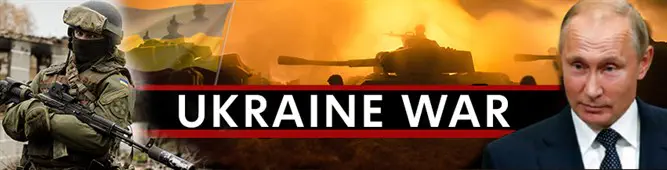
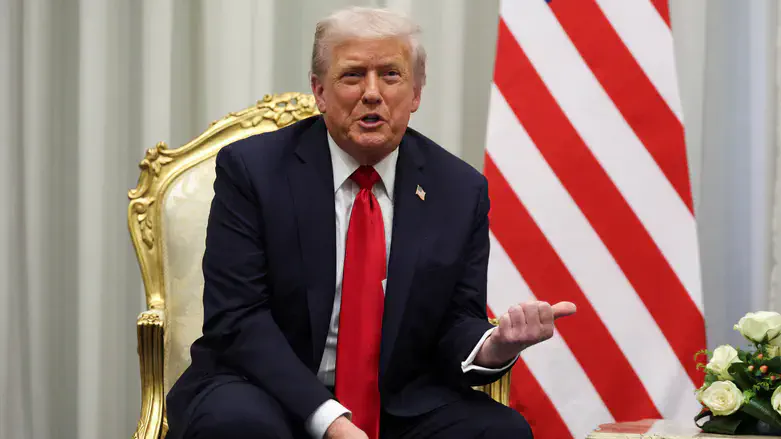
US President Donald Trump’s proposed peace for Ukraine represents a validation of Russian crimes of war, crimes against peace and crimes against humanity. In essence, Trump’s conspicuous submission to Vladimir Putin disregards every key principle of modern international law, especially ones regarding sovereignty and punishment of aggression, Notwithstanding the codified and authoritative Nuremberg Principles (1950), this continuous submission declares to the wider world that the most grievous international crimes should be rewarded.
Following such historical examples as Munich in 1938 (regarding dismantling of Czechoslovakia), the particulars of Trump’s proposal are indefensible prima facie. Plausibly, any forced dismemberment of Ukraine will be just the first step toward future Russian aggressions. These now-impending crimes could extend to assorted NATO states, a perilous extension that would raise the prospects of an uncontrollable nuclear war.
As to the Trump promise of NATO-type collective security for Ukraine, it is unassailably disingenuous. Could any sane observer believe that US President Trump would risk a direct nuclear conflict with Russia on behalf of a victim state for which he has never shown any real regard?
It’s not bewildering. Donald Trump’s “peace” for Ukraine is a contradiction in terms. It calls for that persistently heroic state to accept its own annihilation. Credo quia absurdum, said the ancient Philosopher Tertullian: “I believe because it is absurd.”
There is more. If you like the American president’s proposal for Ukraine, you’ll love what he has in store for Israel. Though it is likely that Trump has greater intrinsic affections for the Jewish State than for Ukraine, he still displays no reassuring commitment to his “20-Point Peace Plan” expectations.
More specifically, by his recent agreements with Qatar and Turkey and his expanding financial relations with Saudi Arabia, Trump makes it clear that maintaining Israel’s “qualitative edge” will no longer be Washington’s top regional priority.
Moreover, incrementally but uncompromisingly, Jerusalem can expect escalating pressures from the Trump administration to accept a Palestinian Arab state. If Israel ultimately agrees to carve a potentially existential adversary from its own still-living body, it will suffer a fate very similar to the one planned for Ukraine. From any such crime-rewarding initiative of an American president, there would be neither escape nor sanctuary.
As can be learned from Trump’s law-violating peace proposals in Europe (Ukraine) and the Middle East (Israel), world peace requires respect for world law. Under modern international rules, system-wide anarchy was confirmed at the Treaty of Westphalia in 1648, but anarchy is now morphing into something much more ominous. With a wink and a nod from the White House, it is becoming chaos.
In Trump’s “peace” between Israel and Hamas, jihadi terrorists are being granted safe haven in Qatar. Guaranteed by the president’s new mutual defense agreement with Doha, jihadi terror criminals can expect immunization from Israeli retaliatory punishments in that Gulf state. Ipso facto, such lawless protections should also be expected by Islamist terrorists operating from Turkey, Syria and Iraq.
These US plans for peace will not help Israel. Although it is certainly true that US preemptive strikes against Iranian hard targets were gainful for Israel in June 2025, the Islamic Republic is down, but not out. Among other portents, an already-nuclear enemy state such as North Korea or Pakistan could sometime act as Tehran’s nuclear surrogate. While there is no scientific way to calculate scenario outcomes, there is also nothing to suggest that Israel could survive a nuclear exchange with Pyongyang or Islamabad.
US President Donald Trump has mused openly about nuclear weapons as usable instruments of war, not just as elements of strategic deterrence. Russian president Vladimir Putin has voiced similarly dangerous nuclear musings.
Under Trump’s peace plan for Gaza, no action is contemplated against jihadism in any of its more insidious forms. To wit, even an alleged defeat of Hamas would do nothing to reduce the risk of radiation dispersal weapon attacks by jihadi elements in Sinai, "West Bank" (Judea/Samaria), Lebanon, Syria, Iraq, Afghanistan or Yemen.
Trump’s plan for placing “stabilizing” Arab forces to govern Gaza would heighten the chances of a more widespread regional conflict. Should anyone plausibly expect that terror-supporting Islamic states (both Sunni and Shiite) would actively discourage Gaza deployments of “Hamas replacements”? Could anyone reasonably deny that these Trump policies toward Israel are a welcome gift to Vladimir Putin?
There is still more. Various interactions between catastrophic harms could render the risks of regional chaos more urgent. If Jerusalem should at some point have to face a jihadist state adversary with access to nuclear weapons, Israel’s strategic deterrence posture could be fatally undermined. In principle, at least, such a challenge would signify tangible threats of nuclear terrorism and nuclear war.
There are related questions of rationality. In world politics, irrationality is never the same as madness. An irrational adversary could sometime value certain intangible goals even more highly than national self-preservation. A mad adversary, on the other hand, would display no determinable preference ordering of any sort, and thus not be subject to any calculable threats of deterrence. Realistically, for Jerusalem, no analytic choice will be available. Whether Israel would prefer to confront irrationality, madness or both, will not be Jerusalem’s decision to make.
Since the seventeenth century, our world can best be described as a “system.” What happens in any one part of this world, therefore, will more-or-less affect what happens in some or all other places. When deterioration becomes marked and begins to spread from one country to another, corollary impacts will undermine balance of power infrastructures. When this deterioration becomes rapid and catastrophic, as would likely be the case following the onset of unconventional war or unconventional terrorism, effects would be cascading.
If you like Donald Trump’s planned peace for Ukraine, you’ll love his peace for Israel.
LOUIS RENÉ BERES (Ph.D., Princeton, 1971) lectures and publishes widely on war, terrorism, and nuclear security matters. Born in Zürich at the end of World War II, he is the author of twelve major books on international relations and international law. Dr. Beres, a frequent contributor to law and strategy journals, is Emeritus Professor of International Law at Purdue University. In Israel, he was Chair of Project Daniel (PM Ariel Sharon, 2003-2004).