
The entire being of Moses was the Torah that he brought to his people. The Torah was more than something he taught. It was what he was. It was his G-d within him. Yet, when it came to a choice between the Torah and his people, he chose his people. He said: ‘And if you do not forgive them, then wipe me out from Your book that You have written!’
His whole being was the Torah, but deep into his essence, at the very core, was his oneness with his people.
He argued not just for the righteous, but also for those who had failed”. (The Lubavicher Rebbe, Bringing Heaven Down to Earth, compiled by Tzvi Freeman, pp152-3).
Genesis 27, verses 14-19: “And he brought (the goats) to his Mother (Rivka)."
Midrash Rabbah: forced and coerced (by Mother Rivka) and crying. …and he said to his father (Yitzchak):’ I am Esav your firstborn’.
Rav Avraham Y. Hakohen Kook: these are words of truth, there is no falsehood in them whatsoever” (Midbar Shur, Drush 29, p.272).
For the last few years, THE story always in the headlines is haredi IDF enlistment- i.e., what to do about tens of thousands of draft eligible young hareidim who do no army (IDF) or national service. Certainly this is a political hot potato; but it’s also a Halakhic one: these young men are learning Torah- is the Medinah (the country of Israel) allowed to tear them from their studies to serve this Nation?
In the wake of the October 7/Simchat Torah War, Israel has been forced to activate its standing Army and Reserves (Miluimnikim) for most of two full years. This has caused a severe strain on those serving, with both fallen (about 950) and wounded soldiers. Furthermore, since these 20-60 year old Miluimnikim aren’t working, they, their families and the country have been under tremendous financial and psychological stress.
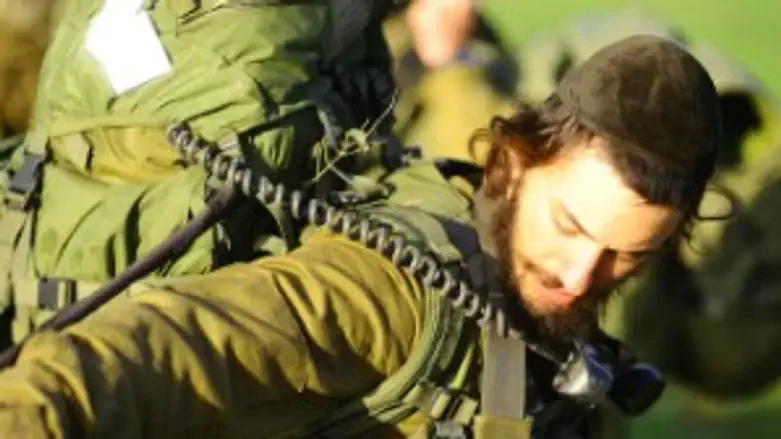
The IDF says that if 12,000 combat eligible hareidim would join this fight, it would alleviate the strain on Miluimnikim, many of whom have done 300-400 days of Reserve duty since Oct. 7, 2023. The hareidi Roshei Yeshivot have been adamant that their young men not serve, as they are learning Torah. (However, many haredi young men are on the deferment lists but are not learnng Torah full time and are still not enlisting - a fact the haredi Roshei Yeshivot admit. Those are the ones the IDF seeks to draft but the haredi leadership refuses, ed.)
So the question is: per Halakhah, is a Jew allowed to leave his yeshiva, stop learning, and fight a war?
This week’s Parsha, Toldot, provides understanding of Rav Kook’s philosophy of Jewish militarism and power. It sheds light on what should be a Jew’s attitude toward serving his Nation, and on the use of Jewish power (Midbar Shur, Drush 29 as explained by Rav Tzvi Tau in Emunat Iteinu, volume 4 pages 55-92):
“Have you ever wondered about this convoluted Parshat Toldot and the blessings? Why was it that Yitzchak loved Eisav? And why did the Lord bring about such circumstances that Yitzchak’s blessing for Yaakov/Yisrael was said by Yitzchak at the time that he thought that he was blessing Eisav?
"Yitzchak was not totally fooled by Eisav. Yitzchak was well aware of Eisav’s crude nature ( although not the depths of his depravity and evil acts), which was accompanied by tremendous strength. This strength matched Yitzchak's own trait of gevura (strength), and indeed had been inherited from Yitzchak, Eisav's father. And the likes attracted one another. Yitzchak also knew that Yaakov was righteous, much more than Eisav.
"But Yitzchak feared that Yaakov's righteousness lacked the strength that would be needed by the nation of Israel to survive in this world. Therefore, it seemed to Yitzchak that the founder of the chosen people would descend from Eisav, though not be Eisav himself (his crudeness, and lack of learning and righteousness precluded that).
"And so there must be a place in the chosen one's good soul to accept the necessary use, sometimes, of evil traits (midot ra'ot), without which the chosenness cannot reach its fulfillment, cannot emerge victorious in the war the bring light to the world and to turn this world from a Hell into a Gan Eden.
"In truth, Yitzchak was wrong. It was the will of the Almighty that Yaakov be the chosen one, his trait of truth being absolutely pure, having no trace of midot ra'ot, as they are a blemish on the soul. Yet, there is the necessity to sometimes use these midot ra'ot, in order to subdue the forces of evil that exist in the outside world, in Eisav and in Yishmael, so that their impurities be removed and that they be turned from darkness to light.
"And so, it was God's will that Yaakov have in him a foreign power (koach zar), outside of his pure soul, so that he thereby make use, at times, of these midot ra'ot. This was achieved by the blessings and their occurring as described in this parsha. Eisav's hands are hairy, always; his way is a limitless appetite for power and conquest. Yaakov can make use of the same hairy hands of power, but only sometimes, donning the hands reluctantly (this explains why he was “crying”; see the quote at the beginning of this article), at the bidding of Mother Rivka; and removing the hands when they are no longer needed, as one dons and doffs a Purim costume.
"That is why the boys were twins: the common womb, Rivka's, which they shared, furnished a 'beachhead' in Yaakov, a fertile ground having the necessary preparation so that use could be made of his neighbor's traits."
Rabbi Matis Weinberg comments that the meaning of Rivka's name is "yoke", a device to harness two often opposing forces, two polar personalities, and to train them to work together.
It was Rivka's womb and teachings that allowed Yaakov to use the traits of Eisav. It follows, therefore, that the womb of Rivka, her makom tolada, gives hope that Eisav may someday share in the good traits of Yaakov, as we see in the historical friendship of Rebbe and Antoninus. This idea provides hope for peaceful cooperation between the polar worlds, secular and religious, Yaakov-like and Eisav-like, that comprise Israeli society .
This common womb is the tolada of our parsha, Toldot.
And so we see that Yaakov grabs Eisav by his heel (Genesis 25 ,26). The heel represents a natural quality, whereas the hand represents a willed, reasoned action.
Yaakov's hand acts out of thought, making use of power only after judging its appropriateness, making use of midot ra'ot as a free-willed action. But the leg's action is more natural, without wisdom and knowledge (as the Midrash says of King David, that he, like Eisav, was red-haired and killed; but Eisav killed on his own volition. David did so mida'at HaSanhedrin, only according to the ruling of the Sanhedrin).
And so, the Romans, Eisav's descendants, in their 2,200-year-long rule over the world, showed koach and gevura, power and might. To rule over others, an attacking nature and cruelty, and the love of glory, victory and the sword are necessary. Rivka saw all this, and so, she put the hairy goat-skins on Yaakov's hands and neck, to show that in order to perfect the world, Yaakov will have to possess military power in his hands; and he will need power in his mouth, to decide and decree, in order to rule over his part of the world.
Furthermore, in the future, this same sa'ir, this same goat, will be the scapegoat offering of Yom Kippur. This shows that the demonic power with which Eisav sins is, to the Jews, our atonement: for we Jews may sometimes misuse that power, but the sin is only external and accidental, and in our hearts we don't want to use that power at all.
The cause of sinning via use of these midot ra'ot is because Eisav has perverted these midot, and so anyone who touches them is blemished somewhat (if he is not a perfect tzaddik, which most of us are not). But the Lord grants atonement and purification to Israel even in the case of these sins. For He knows that these sins do not derive from the Jewish heart and soul, which quickly does teshuva for the sin, as the Jew returns to his true self (doffing the hairy Purim 'costume').”
So teaches Rabbi Kook.
I would add that Purim, the time when we don costumes, is the time of the war against Amalek, who is of Eisav’s family.
Thus, we see, for example, that long before the founding of the State of Israel, the rabbis of the Midrash, and later Rabbi Kook, pulled the rug out from under those who argue that Jewish rule and use of power are immoral, perverting the Jewish soul. The argument, as we have seen, is false.
Those leftists who don't want to rule and make use of the power we were given by G-d have caused rivers of Jewish blood to flow in the Land of Israel during the Oslo-"peace" years.
In truth, those who don't want to rule over Arabs shouldn't be ruling- should not be in government. Period.
Since the Oslo “Peace” fraud in 1993, our leftists have abrogated their responsibility to provide security to this nation.
As the Haftorah says, Edom (Eisav) says that he will make a comeback and rebuild. But as opposed to the gevura of Yitzchak, who digs "rechovot" (Genesis 26,22) - a place of openness, fruitfulness and positiveness - the perverted gevura of Eisav (and those who follow in his brutal ways) inverts the Hebrew letters and "builds Chorovot," builds "ruins", not buildings. All that Eisav touches, he destroys.
Just take a look at Gush Katif. The התנתקןת, the Disengagement that destroyed Jewish Gush Katif, led directly to this present war. Those who armed Arabs in 1993 (Arabs possessed NO guns till Oslo), then pulled out of Gush Katif, gave the opening to Hamas for the bloodbath of October 7- and for the necessity of a larger Army.
That leads us to this Draft Bill controversy. In the true era of relative peace, 1973 to 1992, Israel could afford a small army with no need to draft young hareidim. It’s now evident that we face Hamas, PLO, Hezbollah and other enemies who constitute an existential threat. Those serving in the IDF have bled and suffered enough, with the entire burden of security on their shoulders.
As in my opening quote of the Lubavitcher Rebbe, it’s time for hareidim to show that oneness with the Nation (with also the sinners), is a principle that even surpasses Torah. Mother Rivka’s call to arms was explicit: Yaakov was expected, when necessary, to don the hairy hands of war.
Now is when it’s necessary.