

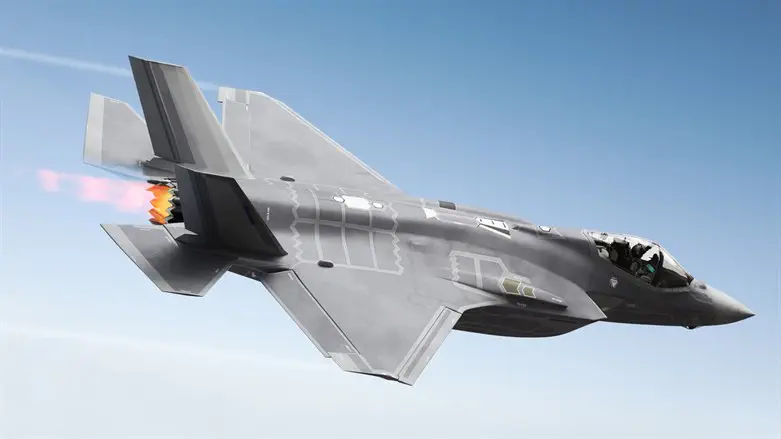
The proposed U.S.-Saudi defense arrangement, which includes a sale of F-35 stealth fighters, is not merely another arms deal. It redefines the long-term balance of power in the Middle East, tests the limits of American export policy, and directly challenges Israel’s doctrine of maintaining an unambiguous Qualitative Military Edge (QME).
Jerusalem is not opposed to normalization with Saudi Arabia, in fact, strategic alignment with Riyadh would be one of the most beneficial developments in a generation. The problem is the conditions and the price, which reveal deeply uncomfortable realities that Israel cannot afford to ignore.
The Saudi “BUT”: A Two-State Illusion That Shattered on October 7
Saudi Crown Prince Mohammed bin Salman has tied normalization to “irreversible steps toward a Palestinian state.” This demand is not symbolic, it is structural.
But Israel cannot revisit the illusions of the 1990s. October 7 revealed what happens when terrorists are given autonomy, territory, funding, and international protection. Hamas used its mini-state in Gaza to build tunnels, train battalions, stockpile rockets, and plan a massive multi-axis invasion.
A Palestinian Arab state, with airspace, borders, supply lines, and international recognition, would be catastrophically more dangerous.
Saudi Arabia’s insistence on this fiction signals a fundamental misalignment. And misalignment matters when discussing the transfer of advanced next-generation weapons.
Israel’s F-35I “Adir”: Not Just a Jet, but a Strategic System
Israel’s F-35 variant is the most advanced version outside the United States.
It includes:
- Israeli-built mission computers,
- Indigenous electronic warfare (EW) suites,
- IAF-specific data fusion algorithms,
- Unique sensor integration,
- The ability to mount Israeli air-to-air and air-to-ground munitions,
- Tailored command-and-control (C4I) connectivity to Israeli intelligence networks.
This creates an F-35 that is not only stealthy, but also deeply integrated into Israel’s real-time intelligence umbrella: Aman, Mossad, Unit 8200, and the Air Force’s network-centric architecture.
The operational result:
Israel can detect, track, attack, and suppress threats before enemy radars even register an intrusion.
This is not an airplane.
It is a joint-strike ecosystem.
Saudi Arabia would not receive this capability.
The Saudi F-35: Downgraded but Still Dangerous
Washington has assured Israel that:
- Saudi jets will have downgraded EW,
- Saudi integration with local systems will be limited,
- Software update pathways will remain under strict U.S. control.
Even so, the F-35, even in downgraded form, is not comparable to legacy jets.
-Its stealth profile drastically reduces radar detection range.
-Its sensor fusion exceeds the capabilities of any 4.5-generation aircraft.
-Its long-range weapon compatibility transforms its strike potential.
For Israel, any fifth-generation platform in another Middle Eastern state is inherently destabilizing, because even a “less advanced” fifth-gen jet is still a fifth-gen jet.
And aircraft endure long after regimes change.
Why Israel Cannot Bet Its Future on “Friendly Today, Friendly Tomorrow”
Saudi Arabia is aligned with Western interests today, but strategic analysts know the Middle East changes faster than any other region.
Israel must consider:
- A possible future ruler less friendly than MBS,
- Islamist pressures from clerics and conservative factions,
- A population still influenced by anti-Israel narratives,
- Growing military ties with China, including ballistic missile cooperation,
- Saudi Arabia’s stated willingness to pursue nuclear capability if Iran does,
- The fragility of U.S. commitments due to political polarization.
Weapons systems last 30 to 50 years.
Political alliances last until the next crisis.
Israel cannot, under any circumstances, rely on permanent goodwill.
American Concerns: Intelligence Leakage and Chinese Access
Washington has major concerns of its own.
Saudi Arabia already hosts:
- Chinese ballistic missile engineers,
- Chinese drone technology advisors,
- Chinese cyber systems,
- Chinese-made surveillance networks.
Allowing F-35 technology in this environment introduces unprecedented intelligence risks.
Stealth geometry, electronic warfare signatures, infrared suppression, these are among the most carefully guarded secrets in the American arsenal.
Washington knows that once advanced technology leaks, it cannot be un-leaked.
This affects not only Israel’s edge, but America’s global air superiority against China, Russia, and Iran.
Nuclear Complications: The Saudi Enrichment Demand
Saudi Arabia is asking for:
- U.S. civilian nuclear reactors,
- Domestic uranium enrichment capability,
- Fuel-cycle autonomy.
Israel sees this as a near-red-line threat, because enrichment, civilian or not, is the key step toward nuclear weapons.
If Saudi Arabia gains enrichment rights, Turkey, Egypt, the UAE, and others will follow.
This is how a nuclear arms race begins.
No stealth jet is worth opening that Pandora’s box.
The U.S. Should Slow Down, Not Rush
American policymakers are eager for a diplomatic victory and a strategic counter to Iran. But rushing risks:
- repeating the optimism-fueled failures of Oslo,
- destabilizing the region by overarming one actor,
- exposing U.S. secrets to China,
- creating nuclear precedents,
- undermining Israel’s trusted defense umbrella.
Every major crisis in the Middle East has stemmed from one of two forces:
wishful thinking or underestimating future instability.
This deal risks both.
Israel Wants Normalization, but Not at the Price of Survival
Israel supports normalization with Saudi Arabia.
It welcomes strategic cooperation.
It sees value in a Sunni-Israeli-American alignment against Iran.
But peace cannot be:
- conditioned on a fantasy Palestinian Arab state,
- paid for by eroding Israel’s qualitative military edge,
- justified by short-term American politics,
- rushed at the expense of long-term regional stability.
Normalization must be earned through alignment, not illusions.
Conclusion: Realism, Not Romance
Saudi Arabia is not an enemy.
But the F-35 is not a toy.
It is the world’s most advanced strike aircraft, stealth, networked, and intelligence-driven.
Israel’s caution is not paranoia.
It is professional military judgment shaped by decades of hard lessons.
The United States must understand that Middle Eastern stability is built on realism, not diplomatic theater.
Weapons endure. Regimes do not.
Uncertainty is the only constant.
Israel is right to be careful. The United States should be too.