
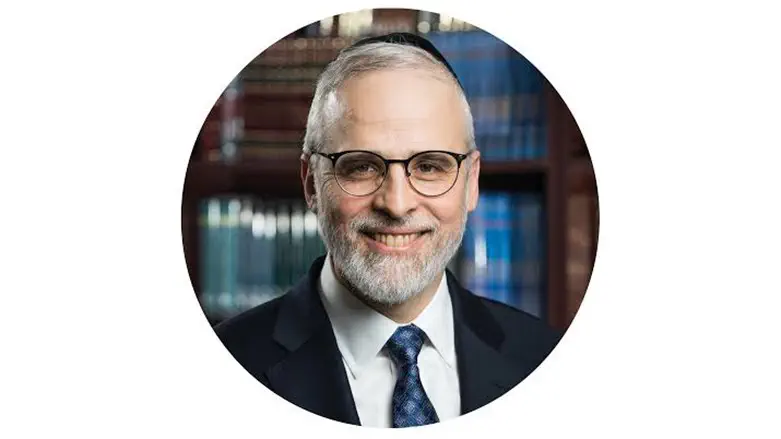
For four years, my boss and mentor, Rabbi Moshe Hauer, Executive Vice President of the Orthodox Union, and I, argued about how much self-promotion is needed for a leader to make a global impact.
As the leader of the Orthodox Union, representing the largest Jewish Orthodox organization in the world, I felt it was imperative that Rabbi Hauer spend more time talking publicly about the work of the organization.
I asked that he allow us to post more pictures of him in high-level meetings on social media, and that as a respected spiritual leader, he give people more access to his inner world in his writings. He fought me on each one.
And now, with his shloshim on November 15, following his passing at age 60 on Shmini Atzeret, he has proven me wrong. Tributes streamed in from all over the world - from Presidents Trump and Biden to Israeli Prime Minister Benjamin Netanyahu, from faith leaders to communal leaders across all Jewish denominations.
I’ve been reminded that the Talmud teaches, “One who runs from honor, honor chases after him.”
Rabbi Hauer’s was not a natural shyness; it was a principled modesty. The book of Micah speaks of “walking modestly with your God.” It was a value that underscored all of Rabbi Hauer’s work.
There were initiatives that, for political reasons, he felt would be more impactful if they were not associated with the Orthodox Union. Without hesitation, he would greenlight the project and instruct those managing it to take no credit. Similarly, one colleague once quipped how a certain Jewish organization “beat the Orthodox Union to it,” by attaining a goal we were also working to achieve. Rabbi Hauer was incredulous: “Beat us?! We are all on the same team!”
Such levels of selflessness and integrity are rare in higher levels of leadership; corner offices are known for their outsized egos. This is perhaps why he made such an impact on the many political and faith leaders he met. Though he was soft-spoken, and though he never shied away from making it known when he disagreed with them, he was respected by all. In the words of Rabbi Rick Jacobs, president of the Union for Reform Judaism, “Yes, we disagreed on so many issues but shared a profound respect and love for one another.”
Rabbi Hauer had a rich inner world. Watching him pray or study Torah, you could see the genuine emotions pouring forth. I begged him to write more often about his inner spiritual world, but he was allergic to charismatic faith leadership. As a rabbinic intern in the synagogue he led for 25 years, I saw how hard he worked to create leaders, not followers. Despite him rarely speaking about himself, thousands have described how much they grew from his spiritual teachings and model.
More recently, as his special assistant, I was witness to a unique dynamic between a boss and his employees. He was revered, and some may say feared, in the halls of the Orthodox Union, not because he reprimanded anyone, but because of his very high standards that motivated everyone around him to meet his expectations. Employees were often hesitant to argue with a decision made by Rabbi Hauer, their boss. They would ask me to be the go-between, and I would try to explain to them how wrong they were to avoid speaking with him directly.
Rabbi Hauer welcomed everyone into his office with a big smile. He took advice from anyone regardless of their title. If he was wrong, he would admit it - publicly and often. The Talmud states that God’s greatness is found in his humility. Rabbi Hauer was a Godly man.
I would assist him with his personal communications, which he was always catching up on. His inbox overflowed with messages; from wealthy donors, side by side with those from former congregants, from a world leader who wanted advice on a thorny topic and from a teenager who had a simple question about something he wrote. His schedule was grueling, and I begged him to ignore emails and just send a standard reply - a practice adopted by many people of his stature. He refused. He valued each and every person and wanted to make sure they knew it.
The most difficult part of my job was having to give him feedback. He was my teacher, and I had so much respect for him, making it hard to criticize him in any way. Whenever this happened, he would see me hesitating and begged me to speak my mind. Quite often he would ask me if he was missing something, if he was expecting too much from others or inserting himself too much into a situation. He was not asking from a place of low self-esteem, he was extremely confident. Rather, he recognized that in positions of power, one can too easily be blinded by that power, and so he worked tirelessly to maintain a healthy self-awareness.
Though some leadership books have recently started describing modesty and humility as valuable characteristics, it’s all too rare to see them put into practice.
In a world of social media influencers, and even faith-based social media influencers, self-promotion is seen by many as the only way to make an impact. But the thousands who gathered in Baltimore for Rabbi Hauer’s funeral, the thousands more who gathered in Jerusalem for his burial, the thousands visiting his home daily to pay their respects to the family, the countless tributes from faith leaders and politicians of all persuasions, and more important to Rabbi Hauer, the many simple regular people who felt touched by his greatness, are proof that genuine modesty and humility are exceptionally effective tools in making a real difference.
May his memory be for a blessing.
Rabbi Yisrael Motzen is the rabbi of Ner Tamid and the Special Assistant to the EVP at the Orthodox Union.