
בימים ההם ובזמן הזה
In this week’s parasha, we encounter one of the most dramatic scenes in the Torah. Rivka turns to Yaakov and tells him that the moment has arrived: he must go to his father Yitzchak and bring him food so that he - Yaakov - will receive the berachot, and not Esav, who until now seemed to be Yitzchak’s favorite. Yaakov hesitates. He fears that something may go wrong. He says the famous words:
“אוּלַי יְמֻשֵּׁנִי אָבִי, וְהָיִיתִי בְעֵינָיו כְּמְתַעְתֵּעַ, וְהֵבֵאתִי עָלַי קְלָלָה וְלֹא בְּרָכָה”
"Perhaps my father will feel me, and I will appear in his eyes like one who is deceiving him, and I will bring upon myself a curse, not a blessing."
Rivka answers with certainty:
“עלי קללתך, בני” - “Upon me, your curse, my son.”
This statement is not only an expression of confidence; it carries deep symbolic meaning. The Gaon of Vilna explained that each letter of the word “עלי” can be understood as representing the three great dangers that confront Am Yisrael:
- ע - Ayin represents Esav, the threat of physical destruction. Rivka takes responsibility to guide Yaakov through this danger.
- ל - Lamed represents Lavan, the threat of spiritual destruction. Rivka assumes responsibility to protect Yaakov from assimilation and spiritual annihilation.
- י - Yud represents Yosef, symbolizing internal conflict, division, and strife within the family or community. Rivka guards Yaakov against these internal dangers as well.
Thus, when Rivka says “עלי קללתך בני,” she is effectively saying: “I take upon myself all these dangers - Esav, Lavan, and Yosef - so that you, my son, can succeed and receive the blessings.” This insight shows that her guidance is not only for a single moment of receiving a blessing, but a lesson about confronting the enduring challenges that face Am Yisrael across generations.
These three forces - Esav, Lavan, and Yosef - represent fundamental challenges that every generation of Jews must confront:
- Esav - the threat of physical destruction by enemies who rise against us.
- Lavan - the threat of spiritual annihilation through assimilation, “killed with kindness,” slowly absorbed into another culture.
- Yosef - the danger of internal strife, division, and baseless hatred within the Jewish people.
Tragically, all three confront us today, simultaneously.
Klal Yisrael finds itself in the midst of a great war. Hamas openly declares its intention to annihilate us, and beyond Hamas, there are other groups committed to jihad against the Jewish people. Beyond these groups, nations and organizations aim at the physical destruction of the Jewish state and Am Yisrael. This is the Esav challenge to us today!
At the same time, nearly 60% of Jews worldwide are assimilating, disappearing not by hatred but through a warm embrace. Like Lavan, the threat is subtle, polite, and tragically effective - loved out of existence. This is the Lavan challenge to us today!
And we face the challenge symbolized by Yosef and his brothers: internal division. Arguments over identity, religion, politics, and society are sharp and painful. When we lose the ability to live with mutual respect, forgetting that we are one family, the danger becomes as real as the other two. This is the Yosef challenge to us today!
Three ancient challenges.
Three eternal challenges.
Three challenges stand before us at this very moment.
Never before has the world been so transparent - a global village where everything can be observed from everywhere, and where events and actions are known instantly at all times. Never have we been able to see the challenges so openly.
While Klal Yisrael’s survival is guaranteed by Hashem, the survival and strength of individual communities and Jewish individuals depend on recognizing the great challenges they face. Each community must understand these challenges, take responsibility for defending itself, and protect itself from these threats, both spiritually and physically, as well as socially.
By acknowledging these dangers and responding with awareness and action, we ensure that our heritage, our Torah, and our people continue to thrive.
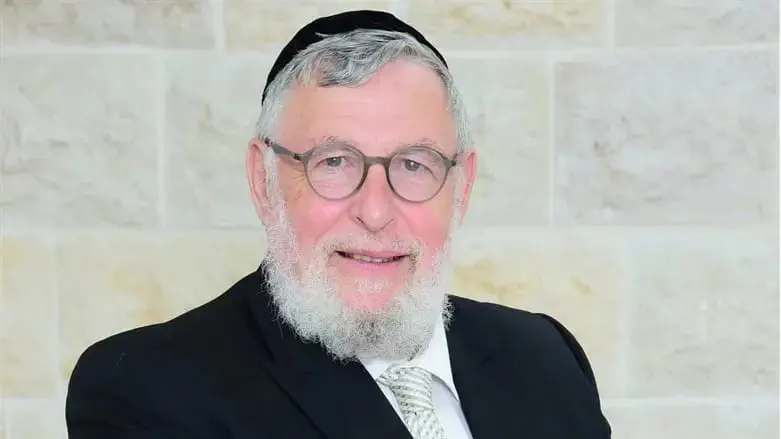
Rabbi Eliezer Simcha Weisz is a member of the Israel Chief Rabbinate Council.