
From the court records.
Stade de France:
"Against the stadium gate we find a bone. Pieces of human flesh, a hand. Then what could be an arm and shreds of meat. On Rue de l’Olympisme, a finger."
Then the photo of Manuel Colaço Dias, the first victim of the attacks. His body had “eleven metal nuts, including one in the lung that caused death.”
Next stop: Le Carillon and Le Petit Cambodge, two restaurants in the city center.
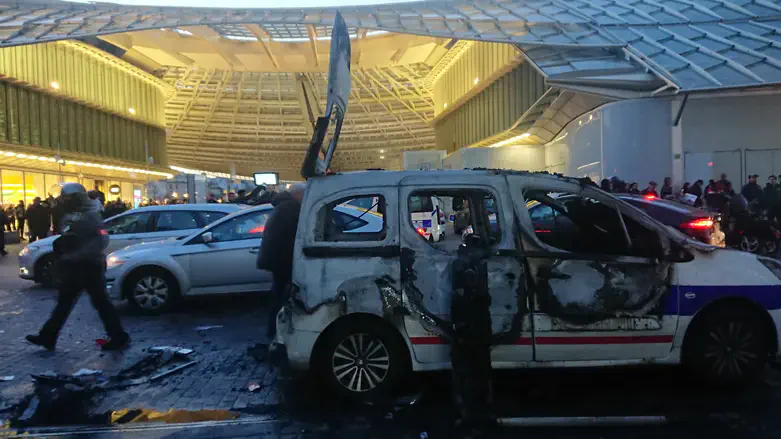
“It’s not a crime scene, it’s a war zone.” Bodies on the sidewalk, too many to count, forming a “shapeless mass.” On some victims, the documents of others were found. “This kind of mistake happened because people fell on top of each other. The only thing you could hear were the victims’ phones ringing.” Hundreds of Kalashnikov casings. “We found 36 shots in one victim, 22 in another, 14 in a third.”
Finally: the Bataclan.
A sea of lifeless red blood. Ninety dead in thirty-two minutes. Seventy-one inside the Bataclan, forty-four of them at the foot of the stage. Others outside.
It’s 10:15 p.m. The Rapid Intervention Brigade (BRI) enters the Bataclan. “There were 500 or 600 people on the ground, no noise, only moans,” recalls Jay, staring blankly ahead. The stage lights were still on, flooding the room with a harsh white light. “The image was surreal. That was the first thing we saw.”
Then Kader: “It’s atrocious. It’s a mass grave. What I saw looked like a war scene. Like the ones you see on TV or in history books. I thought of the Holocaust... all those bodies piled one on top of another.”
And again: “shattered skulls,” “unrecognizable faces,” and “fragments of teeth and bones.”
Judicial police officer Patrick: “It was like the site of a plane crash. We were walking through coagulated blood, pieces of teeth, vibrating phones, handbags, backpacks. Bodies, bodies, bodies. Bodies entangled with one another.”
Photos show a bathroom where the ceiling had been smashed by people trying to escape upstairs. “The pit was the most gruesome area, the bloodiest, with 41 victims. Among them, unrecognizable faces, exploded teeth.”
In the restrooms near the pit, large streaks of blood showed that victims had tried to take refuge there. “The green-blue of the tiles had disappeared under red blood. A dark, cold atmosphere, with a white light that made everything look pale and gave it the feeling of a cathedral.”
Guillaume Valette never regained inner peace. A Bataclan survivor, he hanged himself in his room at the psychiatric clinic where he was being treated. He was 31.
Like Fred Dewilde, a doctor and illustrator who didn’t have time to flee - and nine years later, took his own life.
Today marks ten years since that watershed event in Western history. Every generation, in its own way, inherits a trauma. The Bataclan is the trauma of Europeans who understood.
And ten years later, who is winning?
According to Jean Szlamowicz - the terrorists.
“The strategy of Islamic terrorism always unfolds in two phases. First, the violence itself constitutes an initial gain, derived from the sheer pleasure of unleashing it. Then comes the long-term gain: intimidation, fear, and the demonstration of power it creates. Once the possibility of violence has been internalized, one hesitates to unleash it.
"Appeasement, and thus the renunciation of power, is now the political response to the risk of violence. This amounts to a discourse of fear and submission, revealing an inability to confront force with force. As a symbol, the eruption of violence into a peaceful, comfort-seeking society is profoundly destabilizing. It provokes various reactions (denial, anxiety), but above all raises the question of its appearance as a social problem that challenges the entire society.
"As a signal, the terrorist act enters public debate and, through the discourse it generates - whether apologetic, condemnatory, or analytical - already begins to normalize the issues it raises. We know how skilled Islamist ideologues are at turning our own way of thinking - that of Human Rights - against us, leading to self-victimization, which in turn justifies marginalization increasingly encouraged by religious representatives, who portrayed those rejecting integration based on republican values and principles as victims of a supposedly intolerant system.
"We never saw them take to the streets shouting ‘Down with Islamism!’ To this reality was added the unexpected internal support of a part of our intellectual and political class, which saw in colonial history the source of all evil. Instead of a clear and massive defense mechanism, after November 13 there was a discursive dilution, in which some opinion currents minimized the violence and managed to reverse the aggression through a narrative in which the victim becomes the perpetrator and Islamism becomes the result of Islamophobia.
"Political Islam now sees an opportunity to infiltrate the machinery of democratic power through elections to advance its program. Anxiety can be soothed by cowardice: the slogan ‘You will not have my hatred’ allows people to pretend to take a morally superior, sovereign, and seemingly courageous path. In reality, it’s a denial that allows us to avoid confronting reality by pretending that evasion is a form of strength. We saw very few movements proclaiming a specific identity, apart from the consumerist assertion that we must keep enjoying café terraces.”
So in a sense François Hollande is right when he says today: “Terrorism is a slow poison; its effects are felt long after the horrific acts it produces.”
Ten years after the Paris attacks, Gilles Kepel tells Le Figaro, “they are winning the cultural battle.”
They haven’t won in the way the terrorists hoped - not by territorial conquest. But in a subtler, more poisonous, and longer-lasting way. They haven’t won the war, but they’ve changed the battlefield: no longer the streets, but our minds.
Looking at the thousands of crowds over these past two years rallying in support of Islamist terrorism - Who is winning?
One in two teachers now self-censors. Who is winning?
Ten years after Bataclan, there are 120 people in France under police protection due to Islamist threats. Who is winning?
The terrorists who struck Paris used European welfare to finance the attacks. In effect, we paid for that massacre.
The main surviving perpetrator of the attack, Salah Abdeslam, is now held in Fleury-Mérogis, France’s highest-security prison. Satellite TV, mail and visits, books from the library, two hours of daily recreation, and a private gym. A treatment the Italian mafia under 41-bis can only dream of. Le Point reveals that even a rowing machine was installed in a cell next to his so he could work out.
Libération, not me, described his imprisonment as a “vacation club.” As if that weren’t enough, the French state was ordered by a judge to compensate Abdeslam for illegal video surveillance during detention. His family in Molenbeek, Brussels’ Islamist district, was relocated by authorities to another public housing unit.
Who is winning?
“Bataclan is no longer the name of a concert hall, but that of a mythical battle, like the Battle of Badr, the first victorious battle of Muhammad against the idolaters of Mecca,” said Boualem Sansal to Le Figaro three years after the attacks. “Poor Hollande didn’t understand that he had to crush the symbolism of that act at its birth. With his laments under the rain, he gave France the image of a defeated nation.”
The great Sansal - freed yesterday thanks to German mediation - wrote the novel The Train of Erlingen, inspired precisely by the Bataclan attacks in Paris (great novelists should be read, as well as defended when they end up in jail).
Sansal tells the story of Ute Von Ebert, heir to an industrial empire. She lives in Erlingen, stronghold of the upper bourgeoisie - the archetype of Mitteleuropean fantasy, a typically clean and prosperous German city. In letters to her daughter Hannah, who moved to London, Ute describes life in a city besieged by an unknown enemy she calls “the servants,” because they have chosen to submit to divine law.
The people of Erlingen are waiting for a train for evacuation. But it never arrives. The city’s leaders issue reassuring messages, but are actually planning their own escape. Ute will end her life in Saint-Denis, “the land of savages.”
Sansal depicts a world collapsing and clinging to its last material certainties:
“Social security, paid holidays and all the rest - it’s the cancer of civilized nations; it makes us weak. Freedom and peace have made us poor, frightened devils, ready for every cowardice, while hatred for life, liberty and peace has given our evil enemy the taste for eternity and omnipotence and the determination to obtain them by any means. What a tragedy it was to think that submission would be a satisfactory solution for us.”
Today comes the news that (like other German cities) Magdeburg, where there was a terrible attack a year ago, has canceled its Christmas market. The reason: “If a Christmas market is considered a potential terrorist target, then every city festival becomes a source of threat. Preventing terrorist acts is the responsibility of the state and the police, not municipalities.”
Truly, without rhetoric I ask myself: ten years later - Who has won?
Giulio Meotti is an Italian journalist with Il Foglio and writes a twice-weekly column for Arutz Sheva. He is the author, in English, of the book "A New Shoah", that researched the personal stories of Israel's terror victims, published by Encounter and of "J'Accuse: the Vatican Against Israel" published by Mantua Books, in addition to books in Italian. His writing has appeared in publications, such as the Wall Street Journal, Gatestone, Frontpage and Commentary.