
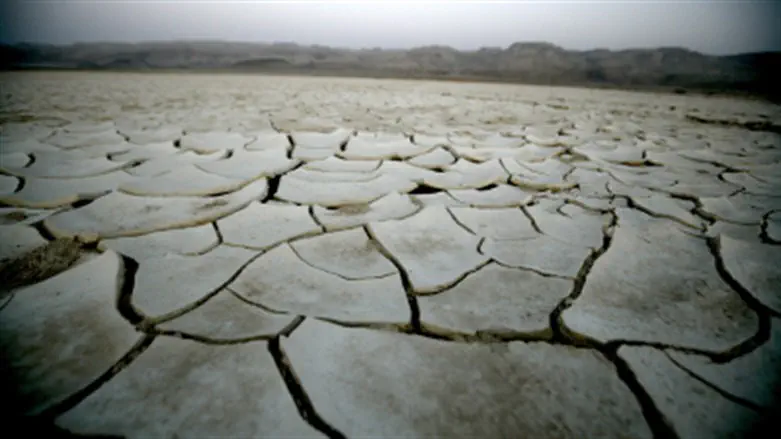
In a land where rivers have run dry, lakes have vanished, and fertile soil has turned to dust, men in clerical robes still stand on pulpits without shame and declare: “Women’s unveiled hair causes drought!”
This is not satire, nor the delirium of a lone village cleric. It reflects the mindset of a regime that has ruled Iran for forty-six years, a regime still incapable of understanding that the connection between clouds and rain is scientific, not moral or religious.
From its inception, the Islamic Republic was built on ignorance and superstition. Today, it stands idle before the greatest environmental catastrophe in Iran’s modern history. Drought has become a silent, devastating war displacing thousands of families from their land every day. Yet instead of reviving water resources, reforming agriculture, or managing dams, the rulers perform rain prayers and send unveiled women to prison.
In this regime’s mind, the unveiled woman is the enemy of God, not the corrupt official or the reckless dam builder. In their eyes, the earth burns with thirst because young women walk the streets without headscarves. And when a cleric reduces the universe to a veil and a turban, there is no room left for science, reason, or technology.
For over four decades, this government has had no coherent plan for natural resource management. The Ministry of Energy has become a factory for falsified reports, while Iran’s water has fallen victim to the Revolutionary Guard’s reckless dam projects and the greed of semi-state contractors.
Lake Urmia has turned into a salt flat, the Zayandeh Rud has forgotten the sound of flowing water, and Tehran teeters on the brink of environmental collapse.
Faced with disaster, the regime relies not on science but on superstition. Every crisis becomes an opportunity for propaganda. Every drought, an excuse for prayers for rain. Every tragedy, a sermon on “women’s sin.”
Even more absurdly, clerics preach that “rain prayers will make God show mercy” as though millions of years of climate change, hydrological science, and atmospheric cycles could be reversed by a handful of mullahs chanting at the sky. If prayer alone could summon rain, Iran would be drowning in floodwaters, not choking in dust.
This incompetence extends far beyond water management. The Islamic Republic has no concept of modern governance. Its leaders pour the nation’s energy and wealth into suppressing women, censoring the internet, and promoting the decayed ideology of Shi’a theocracy. The result is a poorer society, more polluted cities, and a ravaged environment, but the appearance of piety remains, for them, more sacred than saving the nation itself.
Last year alone, over a hundred women and girls in Iran were murdered by male relatives, victims of the very culture of “religious honor” promoted by this regime. The same government that preaches about “Muslim chastity” turns a blind eye to these murders, yet mobilizes entire police forces over a few strands of women’s hair. This grotesque theater of morality exposes a society where civilization and ethics have been buried under the weight of superstition and tyranny.
Meanwhile, urban residents endure water rationing, constant power cuts, and the stench of sewage in the streets. Tehran, this sick, gasping capital inches closer each day to ecological death. And yet, state television still preaches “public morality,” and the president speaks of “Satan’s enmity toward the sacred system,” as if the devil hides not in their incompetence, but in women’s hair.
Today’s Iran is a victim of a regime that sees reason as the enemy of faith, and science as a threat to clerical authority. In their worldview, development and technology are “Western corruption,” and every scientific solution to the water crisis is “intellectual dependency on foreigners.” That same thinking has paralyzed projects on desalination, dam management, and water distribution for decades.
In a country where the educated are jobless, scientists have fled, and universities are suffocating under censorship, how could one expect a scientific policy for drought mitigation? A government that imprisons biologists and environmental engineers for speaking truth can only rely on clerics and preachers to bring the rain.
The Islamic Republic is, in truth, nothing but a continuation of 1979 a revolution that brought neither bread, nor freedom, nor prosperity. It offered only poverty, fear, and endless sermons. The cleric who once rode a cart into Tehran in the name of “the revolution” now cruises the streets in armored cars still urging the people to “trust in God.”
But in this parched land, God seems buried between the cracks of the earth. If prayers and beads were the solution, Iran would be the greenest country on earth. If women’s veils brought rain, Qom and Mashhad would be underwater.
The problem is not in the heavens, but on the ground in a decayed system that plants superstition instead of science and preaches sermons instead of progress. This regime serves neither the people nor the land; its only mission is to preserve power, even if Iran itself dies of thirst.
Drought is not just a natural crisis; it is the mirror of Iran’s political and spiritual decay a land that lacks water but has hundreds of religious seminaries; that builds no dams but appoints thousands of Friday imams. And every time another cleric climbs the pulpit, the earth grows a little drier.
Perhaps one day, the people of Iran will no longer pray for rain. They will cry out for freedom and on that day, perhaps the sky will weep too. Not from divine mercy, but from the breath of a land finally freed from the chains of superstition.