
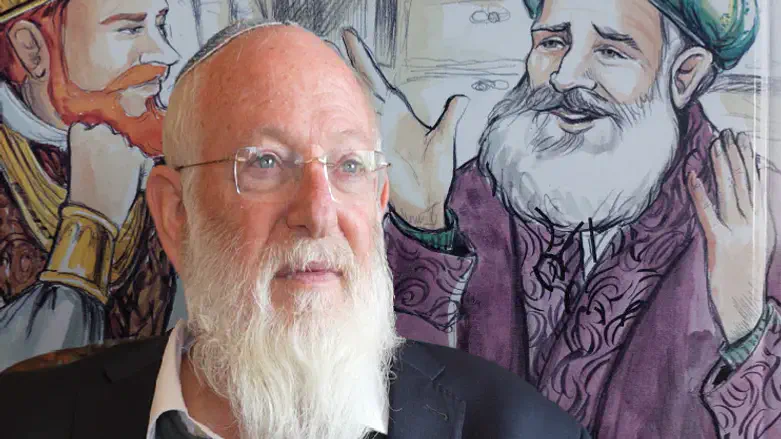
Last week I had the pleasure of driving from Jerusalem to Beit Shemesh with Rabbi David Samson, my co-editor on our new book, “Torat Eretz Yisrael Anthology,” a 700 page compilation of essays written by Torah luminaries from the past and present explaining the “new light on Zion” which shines on the Nation of Israel as it advances forward on the path of Redemption in Eretz Yisrael.
The book is a treasure chest of Torah, including writings of Rabbi Yehuda HaLevi, the Maharal, Rabbi Kook and his son HaRav Tzvi Yehuda, Rabbi Chaim Drukman, Former Israel Chief Rabbis Mordechai Eliahu and Abraham Shapira, all of blessed memory; as well as present day Torah Scholars such as Rabbis Shlomo Aviner, Dov Begon, Tzvi Tau, Yaacov Filber, Shmuel Eliahu, Moshe Kaplan, Eliezer Melamed and more.
Rabbi Samson and I were on the way to Yeshivat Lev HaTorah, where some eighty students from America were waiting to hear a shiur by Rabbi Samson and to receive free copies of the “Torat Eretz Yisrael Anthology” donated by a generous benefactor.
Rabbi Samson is perhaps best known in Israel for the several highly-acclaimed high schools he established for English speakers and for youth at risk. We have collaborated on several books explaining the teachings of Rabbi Kook and HaRav Tzvi Yehuda. During the past decade he has immersed himself in the study of Kabbalah and has published several books on the system of Kabbalistic Meditation in the writings of Rabbi Avraham Abulafia, who lived in Spain some 800 years ago.
I asked if his foray into the world of Jewish mysticism was a natural outgrowth of his learning of Rabbi Kook who emphasized the vital importance of studying in “inner Torah” at the time of Israel’s Redemption.
“Rabbi Kook certainly believed that the inner dimension of Torah must be revealed as part of the redemptive process. He writes that the spiritual light buried deep in the soul of Am Yisrael must be awakened, and that can only happen through the study of the “nistar” - the hidden Torah. Did he specifically point to Rabbi Abulafia? Not directly. But the themes align. Abulafia’s system is centered around spiritual clarity, inner purification, and prophecy which is exactly what Rav Kook said would return to the Jewish People in the generation of “techiyat ha’uma,” the National Revival. So while they come from different times and speak in different voices, I believe their visions are deeply connected.”
I asked him if he knew where he was heading when he embarked on his journey into a realm inhabited by “maggidim” and great souls of the past?
“Well, maybe because I had experience in creating high schools, I imagined establishing a “School of Prophecy.” After all, the Jewish People are the People of Prophecy, equipped with prophetic chromosomes and genes which we inherited from our forefathers. Since prophecy is destined to return to the nation here in the Land of Israel, and since Rabbi Kook wrote about it extensively, it seemed like a reasonable idea to build such an “Age of Mashiach” institution. At other times I saw it in the form of a Meditation Center located in the Judean Desert with a hotel where seekers from all over the world would come to learn authentic Jewish Meditation.”
“Sounds like it might attract a crowd,” I responded.
“The problem with bringing the idea to fruition is that after managing three high schools for the past two decades I became burnt out on the administrative burdens involved. If you know someone who wants to invest and manage a Jewish Meditation Resort overlooking the Dead Sea, have him or her get in touch with me.”
“In the remaining time we have before reaching Beit Shemesh can you elucidate on the differences between Jewish Meditation and the kinds of meditation with which most people are familiar?”
“While there are a few things in common, like visualization techniques and the use of mantras, the differences are cosmic. The practice of Jewish Meditation, in one form or another, has been around for a few thousand years. For instance, our Sages teach regarding the Psalms of King David: “Wherever in the title of a Psalm the name of David appears before the phrase, ‘A Song,’ exaltation came first and the song was its outpouring. But wherever the phrase, ‘A Song,’ precedes David’s name, there David raised himself to exaltation only upon the wings of the song,” (Pesachim 107a).
In Jewish Meditation the goals are lightyears beyond relaxation and feeling groovy. It is sort of like comparing a totem pole to a real person. For example in non-Jewish forms of meditation designed to facilitate “out-of-body” experiences, the use of a mantra, a repeated word, sound, or image, is used to detach the meditator from his intellect so that he can glide brainless in outer space. In contrast, in Jewish Meditation, even though we leave our bodies, we do our best to hang onto our brains. In simple terms, the goal of Jewish Meditation is to experience the supreme delight of the highest spiritual worlds, to build a channel to receive Ruach HaKodesh (Divine Inspiration), and to form a deeper bond with Hashem.
However, the focus of the Jewish meditator is not how he can enjoy himself, but how he can help others. If a person is fortunate to reach the level of Divine Prophecy, then he can help the world. If you start out on a path of Jewish Meditation to attain one of these self-centered goals as a personal achievement, you are going to end up empty-handed. A person’s motivation must be totally holy and pure. Simply to unite one’s life to Hashem because that’s the way life should be.
“Is Jewish Meditation for everyone?”
“Although in his writings, Rabbi Kook repeatedly emphasizes the importance of learning the secrets of Torah as a vital component in attaining an all-encompassing knowledge of Torah, his son, HaRav Tzvi Yehuda, did not encourage the study of Jewish Mysticism in the yeshiva. Being familiar with the prohibitions cited by the Rama, the Maharsha, and other halachic authorities who require that a person must be filled with years of Torah learning before beginning to learn Kabbalah, I sought out Rabbinic approval before I walked through the gates leading to the Torah’s inner treasures.
Rabbi Moshe Isserles, the Rama, writes in the Shulchan Orach (Yoreh Deah, 246:4) that a person should be well versed in Shas and Poskim (Talmud and Halakhah) before he begins. The Shach adds that a person should be at least forty years old and married. Today in Israel the age has been reduced to twenty in accordance with the opinion of the Ramak. Nevertheless there remain entrance level requirements for the initiate who seeks to enter the world of Kabbalah.
“Seeking a green light to learn the secrets of Torah, I went to the home of Rabbi Raphael Levine, the saintly son of Rabbi Aryeh Levine, who was known as the ‘Tzaddik of Yerushalayim.’
“Can I begin to learn the secrets of Torah?” I asked him.
“In his great modesty, he told me that only a Gadol in Torah could answer my question. So I went to ask the Gaon, Rabbi Shlomo Zalman Auerbach, universally considered to be one of the leading Torah Giants of the day. After asking me a few questions about who I was and what and where I had learned, he gave me his permission.
“In light of the opinions of the Torah authorities brought down in the Shulchan Aruch, coupled with the wisdom and advice of my own teachers, I believe that a candidate for Jewish Meditation must have at least weathered his teenaged years; filled his mind and heart with the foundations of Torah, Gemara, and Halakhah; rectified improper character traits, be married, and purify himself regularly in a mikvah. Furthermore, the initiate should explain his yearning to a Rabbi and receive his OK before continuing.
If you don’t meet these requirements, then get to work on acquiring them before tackling the meditative exercises set forth in the pathways designated by Rabbi Abulafia. Certainly everyone can set out on a course of character refinement and improved mitzvah observance. This is a life long journey in itself. There is great value in knowing the path leading to Divine Inspiration even though we have not yet acquired all of the equipment necessary to begin the ultimate climb.
Therefore, my advice is to learn the material which is permitted for each person’s level, but not to venture further, even if you feel a strong pull, until Rashi and Tosefot become second nature, and until someone can rebuke you harshly and you don’t get angry and belittle him in return. Just as a person can’t pick up a scalpel and become a brain surgeon without years of preparation, a person cannot become a Jewish Meditator without first meeting all of the entrance requirements.”
Arriving at the yeshiva and the large gathering of Diaspora students, Rabbi Samson gave a very down-to-earth shiur about the vital importance of Aliyah in their lives:
“HaRav Tzvi Yehuda Kook stated that in our day, the place of every Jew is in Eretz Yisrael. ,” he told the students, relating how his own parents objected to his desire to move to Israel as a youth. He told them that making Aliyah was the most important decision of their lives and that no one should turn away from becoming a part of the rebuilding on the Jewish Nation in Hashem’s chosen Land, which was, he said, the entire narrative of the Torah and Tanach and the mission of every Jew in our time.