
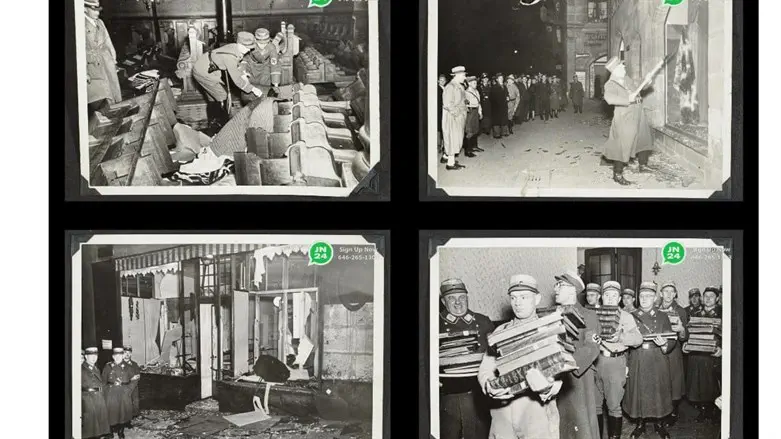
George Santayana was still an idealist when he wrote in 1905, “Those who cannot remember the past are condemned to repeat it.” No time in the past has been remembered more-or has been more exhaustively studied-than the Third Reich (1933-1945), which includes the November 1938 Kristallnacht pogrom (“Night of the Broken Glass”), a bitter foretaste of the coming Holocaust.
The 87th anniversary of Kristallnacht this November 9-10 upends Santayana’s aphorism. A resurgence of antisemitism no less dangerous than in Adolf Hitler’s time challenges the well-being of the Jewish people and the conscience of non-Jews.
In a wicked campaign to “Free Palestine from the river to the sea,” Muslims and their beguiled followers have spread such anti-Jewish and anti-Israel calumny over the internet and on college campuses that it has come close to normalizing hatred. American Jews are openly belittled, assaulted on city streets, and even murdered in their houses of worship.
The US Democratic Party’s anti-Israel choice for mayor of New York City, Zohran Mamdani, who has won with a definite mandate, has called the Palestinian Arab cause “central to my identity” and refuses to condemn a phrase coming from pro-Palestinian Arab circles to “globalize the intifada”-which everyone knows means, “attack Jews worldwide.”
Before Kristallnacht, Third Reich policy toward Jews was harsh discrimination and boycotts. The 1938 pogrom marked a brutal shift to widespread physical violence, vandalism and arson, ignored by police and firefighters unless non-Jewish property was at risk.
Thousands of Jewish men were arrested on Kristallnacht and sent to brutal concentration camps to pressure the Jewish community to leave Germany, abandoning their assets in the process.
The German people’s indifference to the plight of their Jewish neighbors, and the international community’s passive acceptance of the terrorism assured the Nazis they could move from intimidation to annihilation without resistance.
Although basic conditions of modern Western democracies differ significantly from Nazi Germany’s dictatorship, there are disturbing parallels between the Kristallnacht atmosphere and our current climate, especially as the Democratic Party seems intent on one-party rule and has much of the media on its side.
Minister of Propaganda Joseph Goebbels relentlessly demonized Jews in newspapers and radio broadcasts. Today, antisemitic tropes and hate speech, once on the fringes, are increasingly accepted in the mainstream of public discourse. As deceptive rhetoric blurs the line between criticism of Israel and holding all Jews accountable for Israeli policies, a continuing stream of Palestinian propaganda, underwritten by duplicitous Arab leaders and Iran, fuels violence.
The Anti-Defamation League (ADL) reports record-high levels of incidents, including harassment, vandalism, and assault, with a dramatic spike in such events following the October 7, 2023, Hamas attack on Israel.
The targeting of synagogues, Jewish community centers, and Hillel houses mirrors the destruction of synagogues and Jewish businesses in the Third Reich. Though security measures are now mostly in place, the need for alarms and armed guards underscores the vulnerability of the Jewish community.
Another correlation is how Kristallnacht revealed the cold indifference of ordinary citizens to the pitiless attacks. Our videos from street cameras show the same indifference: people with yarmulkes being sucker-punched by strangers, knocked unconscious to the street as other pedestrians avert their eyes and hurry on past or callously stop only to take a photo.
The events of eighty-seven years ago are a chilling reminder of how a cultured society can descend into barbarism and genocide if the forces of extremism are not actively and effectively countered. The potential for a modern version of Kristallnacht exists wherever there is unchallenged hatred and a willingness to let it go unchecked. Such a failure happened this week in New York City's mayoral election-in a city that is home to almost a million Jews.
In 1922, after the First World War ended with twenty million dead and an equal number of wounded, a chastened George Santayana had a darker, more realistic view of humanity's prospects. What good was remembering the past if you did not act upon its lessons? Everything then was to be repeated.
"The poor fellows think they are safe!” wrote the disillusioned philosopher: “They think that the war is over! Only the dead have seen the end of war."
Robert Scott Kellner, a navy veteran, is a retired English professor who taught at the University of Massachusetts and Texas A & M University. He is the grandson of the German justice inspector and diarist Friedrich Kellner and is the editor and translator of My Opposition: The Diary of Friedrich Kellner--A German against the Third Reich, Cambridge University Press, United Kingdom, 2020.