
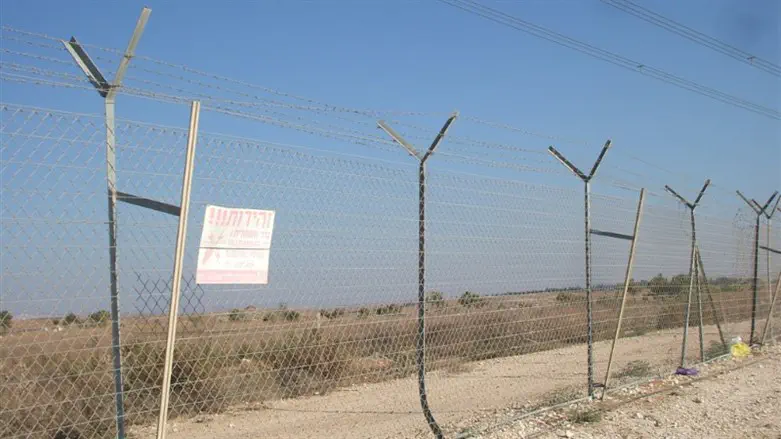
Defense Minister Israel Katz has declared the area along Israel’s border with Egypt a closed military zone - a move he described as the first step in combating the growing threat of drone-based arms smuggling.
Eran Doron, governor of the Ramat Negev Regional Council, welcomed Katz’s acknowledgment of the problem but strongly disagreed with the chosen approach. He argues that the decision to close the area is not only unnecessary but counterproductive.
Doron recalls that from the beginning of the drone smuggling phenomenon, local leaders had called for recognizing all cross-border activity from Egypt as terrorism-related, thereby justifying counterterrorism measures. While Katz’s declaration formally adopts this position and involves the ISA and other security agencies, Doron says it fails to address the root of the problem.
“Route 10 is already a closed military zone,” Doron explains. “Even now, agricultural work near the border or movement from Nitzana to the Petach Shalom area requires a divisional commander’s approval. The area’s status hasn’t really changed.”
According to Doron, the only meaningful development is the government’s acknowledgment that smuggling from Egypt constitutes a terror-related threat. However, he insists that the real issue lies beyond the border fence:
“The drones are just the mosquitoes - the swamp is the illegal arms market,” Doron says. “The Israeli government must act to eliminate the conditions that allow this trade and demand that Egypt take responsibility for what originates on its side.”
Doron views the new military zone designation as a tactical and mistaken move. He points to the recent Sukkot holiday, when more than 10,000 visitors came to the area. Despite the influx, the army reinforced its presence without incident - a sign, he says, that civilian activity can coexist with security needs.
“Opening the area brings security,” Doron argues. “Settlement brings security. Closing it off only harms agriculture, tourism, and the local economy.”
He warns that restricting civilian access could signal a deeper problem: “I don’t know of any other place in Israel that’s closed to civilians in times of peace,” Doron says. “If this land belongs to the State of Israel, its citizens should be allowed to enter it. Otherwise, it feels like abandonment.”
Instead of further restricting access, Doron calls for encouraging settlement, tourism, and agricultural development to strengthen the region. He notes that the defense minister’s decision has already caused financial harm, with tour operators reporting cancellations.
Still, Doron acknowledges one positive outcome - the renewed attention from security agencies, including the IDF, ISA, and police, to the issue of illegal weapons entering Israel.
When asked why the Defense Minister’s declaration came only now, Doron admitted he had no clear answer.
“We’ve been raising our concerns for a long time, long before this specific incident,” he says. “Expanding settlement, agriculture, and tourism should have been happening anyway. The State of Israel must act - for its security and for its citizens.”