
Can an Israel based on Jewish principles also be democratic? Based on halakhic sources, we see that Torah law and majority rule are compatible when moral limits are applied. Democracy is valuable but does not replace Israel’s Jewish essence, which no majority can alter. However, disputes must remain peaceful and lawful.
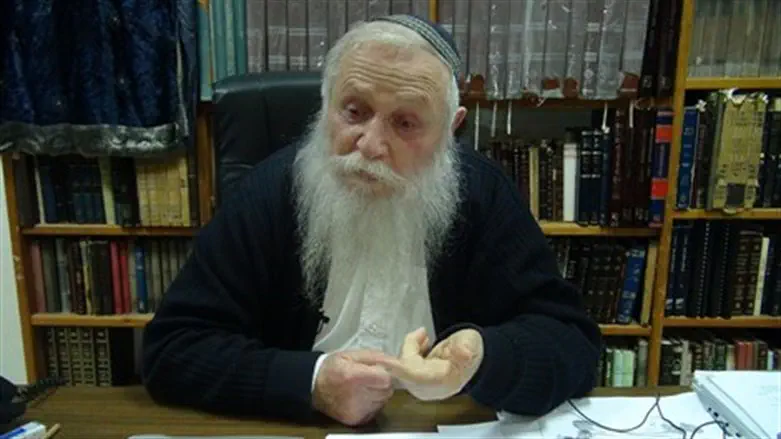
This article is an extract from Rabbi Chaim Drukman’s book, “Step by Step,” an enlightening discussion of the process of redemption that is taking place in our generation.
(Adapted and translated by Moshe Goldberg)
Majority Rule
The State of Israel is a democracy. And we may ask about the relationship between the Torah and democracy. Are they compatible? Are majority decisions halakhically binding, or are they limited or restricted in any way?
The Torah tells us how to apply majority rule: “Do not follow a majority to do evil, do not distort a dispute but follow the majority opinion” (Shemot 23:2). The Sages derive from this that judgement is decided by a majority despite any opposing minority opinion. But this rule is limited, and there are times when the majority is not followed, as is written, Do not follow a majority to do evil (Mishna Sanhedrin 1:6).
However, this refers to a halakhic dispute, where both sides are wise men discussing Torah law. Does it also apply to disputes that do not directly involve the Torah? Can a community make decrees based on their own ideas?
The question of majority rule in matters not directly related to the Torah is not new. More than 700 years ago, the Rashba was asked: “Can a community decide on decrees, agreements, and mutual vows, and punish people for violating them even though they are not Torah law?” He replied:
The community is allowed to make rules and regulations, and to make mutual agreements, which are then like Torah law. And they may levy a fine and punish anybody who violates their rules, if the entire community agrees, without exception... This has always been the practice in all the holy communities, and nobody ever doubted it. (Responsa of the Rashba 4:185).
A community can make new laws, which are then as valid as “Torah law.” Strictly speaking, a simple majority is enough and rules can be put into effect even if some individuals object. According to the strict halakha this applies to for every community. However, some communities adopt “extra piety” and insist on unanimous decisions.
The Rashba also adds that a community can establish a small council to make decisions, which do not have to be unanimous. Rather, if “in their discussions the majority agree on a rule, the minority is overruled, and it must act in accordance with the majority decision.”
The Rosh, who lived at the same time as the Rashba, agreed that the minority must accept majority decisions:
Know that with respect to public matters the Torah wrote to follow the majority opinion. And Individuals must abide by whatever most of the community decides. (Responsa of the Rosh 6:5).
These rulings dealt not with halakha but with public decrees - for a community, a city, or an entire country. They must be able to regulate the public aspects of life, and individuals must accept their decisions even if they personally disagree.
In the past, the authority of the kings was based on a Divine command, as is written in the Torah (Devarim 17:14-20) and in the Prophets (Shmuel I 8:11-17). However, Rav Kook writes, “When there is no king - since the laws of the kingdom are relevant for the general status of the nation - the privilege to judge is returned to the hands of the nation as a whole” (Responsa Mishpat Kohen 144).
This means that a government chosen by the people has the authority to rule. “Every leader of the nation rules with royal laws according to the needs of the nation and the world’s status… There can be no doubt that authorized judges and the general leadership take the place of the king.”
Rav Kook brings proof from Rambam: The leaders of the Exile in Babylon serve instead of the king, and they can rule Yisrael and judge them... (Hilchot Sanhedrin 4:13).
Rav Kook writes, “leaders authorized by the nation, whenever the people are sovereign in their land... are clearly no worse than the Heads of the Exiles in Babylon!”
The Jewish State
The State of Israel was established as a Jewish State, as is explicit in the Israeli Declaration of Independence:
By virtue of our natural and historic right and on the strength of the resolution of the United Nations General Assembly, [we] hereby declare the establishment of a Jewish State in Eretz Yisrael, to be known as the State of Israel... (Provisional Government of Israel, 1948).
The word “democracy” does not appear at all in the Israeli Declaration of Independence! Democracy is important and necessary, but it is not the main value of the State of Israel - as opposed to the central role of Judaism.
Clearly, democracy - with all its importance and value - is limited. For example, if there were a democratic decision that Israel is no longer a Jewish State - would that make it so? Can the very essence and basis of the country be changed by a majority decision? If, heaven forbid, such a resolution would ever be passed, we would then all be obliged to fight it! The State of Israel was founded as a Jewish State. Can democracy overrule the core and the essence of the country?
In matters pertaining to Israel’s core, its soul, and its basic and moral essence - no majority has any right to make modifications or to object. These are basic facts which can never be touched by any democratic principles.
We must emphasize that in essence and in practice there is no conflict between a Jewish and a democratic state if it recognizes its limitations. In the 75 years since Israel was formed many laws have been passed. We cannot honestly say we are satisfied with all of them. However, there is not one law to force an individual to violate the laws of the Torah and Jewish halakha!
It is very important for us to recognize this principle, since the command Do not follow a majority to do evil implies a case where the majority forces an individual to violate a Torah command. If this happens, we are not allowed to give in to the majority and we must follow God’s word. However, if laws in the country do not correspond to Torah law without insisting that an individual take any specific action - what can we say? Of course, it goes without saying that in this case every individual should use his or her influence to try and change the laws.
A Pattern for Struggle
We must keep in mind that the people who object to the Jewish character of Israel are not acting out of evil intentions, heaven forbid. However, good intentions alone do not suffice to change evil into good and darkness into light. We must always remember that we are not standing up against enemies who want to harm us, heaven forbid. These are our brothers, acting in a framework far removed from Torah truth. Even if a struggle is necessary, it must be done in a democratic way. There is never any excuse to resort to violence. The struggle must be waged by legal means. This is the only way the Jewish People can live together in a single state.
We live in a complex world: On one hand, we must accept the positive values of democracy, the general community, and majority rule. On the other hand, we must remember that these elements have limits. When we struggle against attempts to harm the Jewish character of Israel, we must never make use of war and hatred.
We are in a historical era of change and intermingled light and darkness, neither day nor night (Zecharia 14:7). The Redemption is not a sudden event but a continuous step-by-step process, including light and darkness, ups and downs, success, and failure. Until we achieve final Redemption, we must continue to act with wisdom and sensitively, and play an active role in advancing the process.