
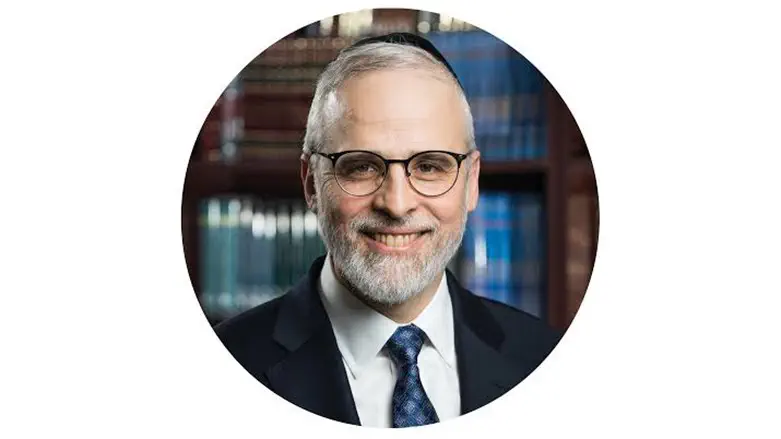
Mitchel Aeder is president of the Orthodox Union.
(JNS) When Rabbi Moshe Hauer stepped down as the full-time rabbi at Bnai Jacob Shaarei Zion Congregation in Baltimore, a position he held for 26 years, to become executive vice president at the Orthodox Union in 2020, he could have announced the move from the pulpit or sent an email to the congregation.
Instead, he called or met with each congregant individually to explain the change and to promise to remain available to them and be part of their lives. And indeed, he did so, commuting weekly between New York and Baltimore.
This is just one of many stories that capture Hauer’s sensitivity and personal connection. For the past five years, as part of the leadership of the OU, I had the honor and blessing of working very closely with him, until he tragically and suddenly passed away on Oct. 14, on the Jewish holiday of Shemini Atzeret. I was his boss, but he was my rebbe.
Hauer loved the Torah. He was a master teacher, capable not only of explaining complicated talmudic and philosophical works but also contextualizing them in a way that made them alive and relevant. While still a shul rabbi, he was teaching more than 20 Torah shiurim (“classes”) weekly. After joining the OU, he had to reduce the number of lessons, though he still taught daily.
He used his OU platform to convey sophisticated and relevant Torah thoughts to an international audience.
The rabbi was kind, articulate and warm. More than anything, he cared. He cared deeply about the OU staff (and their families), about the war in Israel, about the hostages, about single mothers, about people in the community who were lonely, about young Jews on college campuses-the list goes on and on. It showed in his daily work.
He elevated us, helping us make better decisions. When we would visit various OU programs, he wanted to spend his time with the participants rather than the leaders. I vividly recall attending an OU JLIC (Jewish Learning Initiative on Campus) event in Los Angeles with college students from the University of California, Los Angeles, and Santa Monica Community College featuring the music of Simcha Leiner, a contemporary religious singer. Hauer danced with the students with unbridled joy. He related to everyone with respect.
This was true no matter where he went. And he went many places, especially in his tireless efforts to stand up for and defend the Jewish people, and the place of religion and religious freedom in America, to push for the safety of all Jews and to advocate for Israel. From the halls of Congress to meeting with leaders of other faiths who shared common goals, his voice was always out there, engaging with others.
He was soft-spoken, putting people at ease; at the same time, he was principled and unwavering, firmly standing up for what he believed in and for what the Jewish people needed. All of his work was driven by his mission to build Jewish unity and to instill Torah values everywhere.
While doing this, he showed respect and developed genuine friendships with Jews and non-Jews from many different backgrounds and communities, and across the political spectrum.
Hauer was not only caring and passionate and driven. He was effective. He got things done, forged partnerships and built trust where few others could. His influence will be felt for generations in the programs and initiatives of the OU, particularly his focus on making Torah accessible through various daily learning programs, his care for individuals in need who are often overlooked and his emphasis on enabling Jewish communities to thrive.
He raised us all up. He always knew what to say.
I miss him. The OU misses him. Klal Yisrael, the Jewish nation, misses him.
“There is so much to do,” he would say. And there still is.
All of us at the OU are grieving, but we are going to go back to work, to serve Klal Yisrael because that is what we do. And thanks to Rabbi Moshe Hauer, we will do it with a renewed sense of purpose and holiness.
May his memory be a blessing.